
prst.ai
prst.ai is a self-hosted AI automation and prompt management platform. It enables businesses to seamlessly integrate any external …
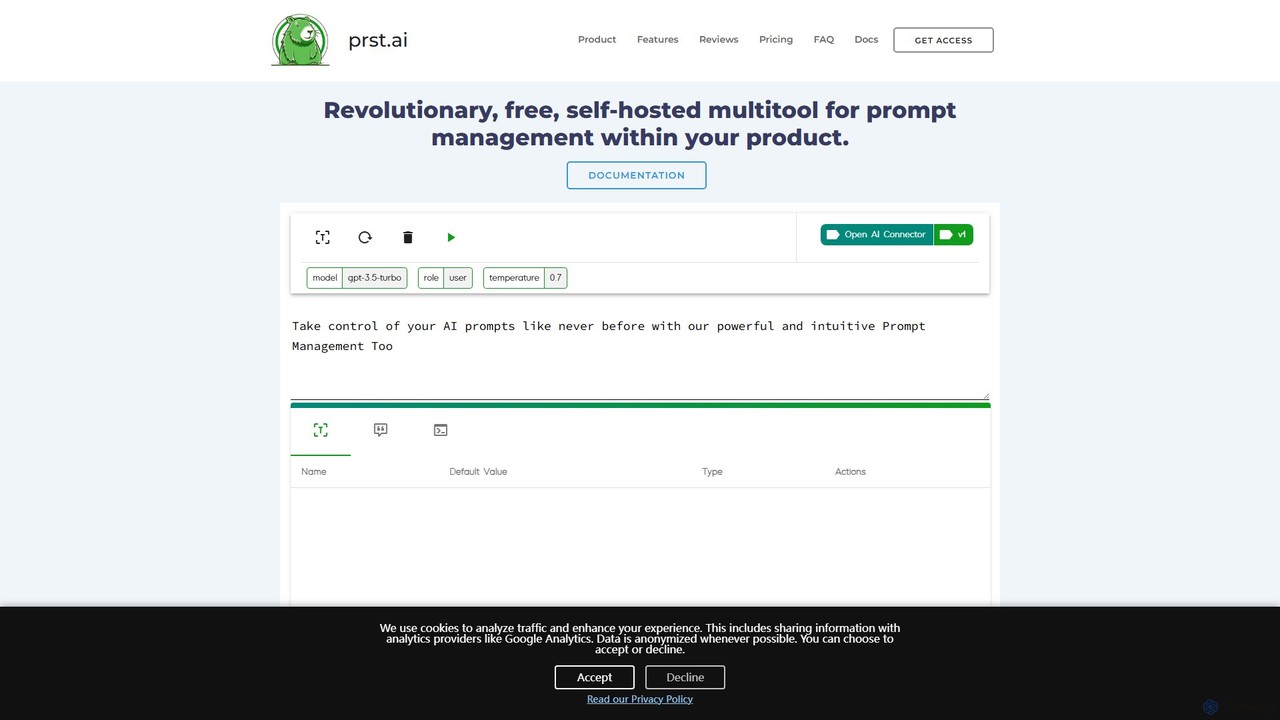
prst.ai is a self-hosted AI automation and prompt management platform. It enables businesses to seamlessly integrate any external AI model, manage prompts without code, and control operational costs with custom pricing rules. Featuring A/B testing, feedback analysis, and enterprise-grade scalability, prst.ai provides full data ownership and a flexible framework to build, test, and optimize AI-powered applications.
About Ai Integration
Ai Integration tools are platforms and services designed to embed artificial intelligence capabilities into existing business applications and workflows. These tools facilitate the seamless connection of AI models, such as large language models or computer vision, with enterprise systems like CRMs, ERPs, and marketing platforms. Their primary value lies in automating complex tasks, enhancing decision-making, and personalizing customer experiences without requiring extensive AI development expertise. They enable businesses to leverage AI's power directly within their operational environment.
Core Features
- API Management & Orchestration: Streamline the connection and management of various AI service APIs (e.g., LLMs, vision, speech) into unified workflows.
- Workflow Automation: Integrate AI steps (e.g., data analysis, content generation, classification) into automated business processes across different applications.
- Data Preprocessing & Post-processing: Prepare data for AI model input and process AI outputs for use in downstream systems.
- Low-Code/No-Code Integration: Provide visual interfaces and pre-built connectors to embed AI functionalities without extensive coding.
- Monitoring & Analytics: Track AI service usage, performance, and costs within integrated workflows to optimize operations.
Applicable Scenarios
Businesses use these tools to automate customer support responses, personalize marketing campaigns, analyze large datasets for insights, and streamline content generation processes. They are crucial for companies looking to operationalize AI across departments.
How to Choose
When selecting an AI integration tool, consider its compatibility with your existing tech stack, the breadth of AI services it supports, its ease of use (low-code/no-code options), and scalability for future needs. Evaluate its security features and pricing model based on your anticipated AI usage.
Ai IntegrationUse Cases
Automating Customer Support Responses
Customer service teams integrate AI models into their CRM or helpdesk systems to automatically draft responses to common queries, summarize support tickets, or route complex issues to human agents. This reduces response times and improves agent efficiency, allowing them to focus on more critical customer interactions.
Personalizing Marketing Campaigns
Marketing professionals connect AI tools with their marketing automation platforms to analyze customer data, segment audiences, and generate personalized email content, ad copy, or product recommendations. This enhances engagement and conversion rates by delivering highly relevant messages to individual customers.
Streamlining Content Generation Workflows
Content creators and marketers integrate AI writing assistants into their content management systems or publishing tools to generate article drafts, social media posts, or product descriptions. This accelerates content production, helps maintain brand voice consistency, and frees up creative teams for strategic tasks.
Enhancing Data Analysis and Reporting
Business analysts embed AI capabilities into their BI dashboards or data warehouses to automatically identify trends, detect anomalies, or generate natural language summaries from complex datasets. This provides deeper insights, faster reporting, and enables proactive decision-making based on real-time data.
Automating Document Processing and Extraction
Legal or finance departments integrate AI-powered OCR and NLP tools into their document management systems to automatically extract key information from contracts, invoices, or reports. This significantly reduces manual data entry, improves accuracy, and accelerates document-centric workflows like compliance checks or financial audits.
Optimizing Supply Chain Operations
Logistics managers integrate predictive AI models into their ERP or supply chain management systems to forecast demand, optimize inventory levels, or identify potential disruptions. This leads to more efficient resource allocation, reduced waste, and improved resilience against unforeseen challenges in the supply chain.