usevelvet
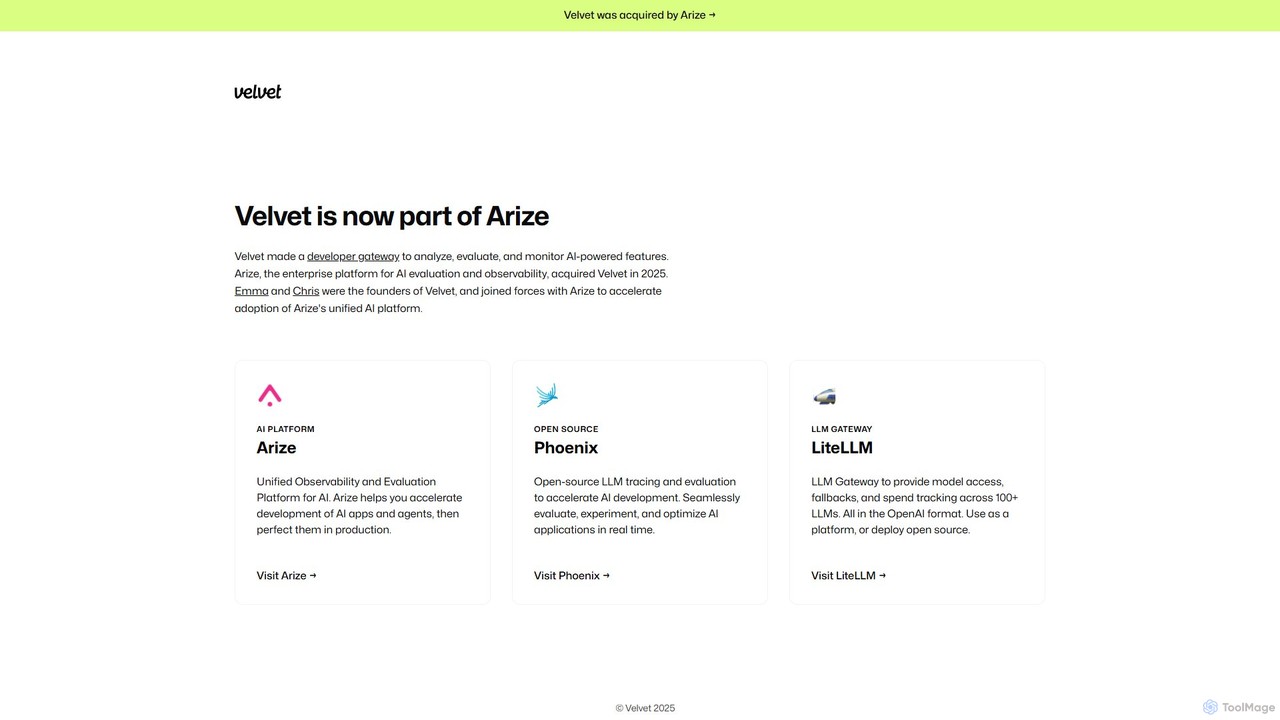
Velvet is a developer gateway, now part of Arize AI, designed for analyzing, evaluating, and monitoring AI-powered features. …
Velvet is a developer gateway, now part of Arize AI, designed for analyzing, evaluating, and monitoring AI-powered features. It provides a comprehensive suite for AI observability, LLM tracing, and model performance management, helping developers build and perfect AI applications from development to production.
About Ai Management
AI Management tools are specialized platforms designed to oversee the entire lifecycle of artificial intelligence initiatives within an organization. These tools leverage advanced analytics and automation to streamline the development, deployment, monitoring, and governance of AI models. They provide a centralized system for managing AI assets, ensuring compliance, and optimizing performance across various business operations, fitting within the broader category of Business AI solutions.
Core Features
- Model Lifecycle Management: Oversee AI model development, training, versioning, and deployment from a unified interface.
- Performance Monitoring: Track AI model accuracy, drift, and bias in real-time to ensure optimal operation and prevent degradation.
- Data Governance & Lineage: Manage data used for AI, ensuring quality, compliance, and traceability throughout its lifecycle.
- Resource Optimization: Allocate and manage computational resources efficiently for AI training and inference workloads.
- Compliance & Risk Management: Implement ethical AI guidelines, track regulatory compliance, and mitigate potential AI-related risks.
Applicable Scenarios
Organizations with multiple AI projects, data science teams, and IT operations benefit significantly from AI Management. They are used by MLOps engineers to automate deployment pipelines, by data scientists to track model experiments, and by compliance officers to ensure ethical AI practices. This ensures AI initiatives are scalable, secure, and aligned with business goals.
How to Choose
When selecting AI Management tools, consider the breadth of model lifecycle support, from experimentation to production monitoring. Evaluate integration capabilities with existing data infrastructure and MLOps pipelines. Assess features for governance, compliance, and explainable AI, alongside scalability and cost-effectiveness for your specific AI workload.

Ai ManagementUse Cases
Automating AI Model Deployment
MLOps engineers use AI management platforms to create automated pipelines for deploying trained machine learning models into production environments. This ensures consistent, rapid, and error-free model releases, reducing manual effort and accelerating time-to-market for AI-powered applications.
Real-time AI Performance Monitoring
Data science teams leverage these tools to continuously monitor the performance of deployed AI models, tracking metrics like accuracy, latency, and data drift. Alerts are triggered for anomalies, allowing proactive intervention to maintain model effectiveness and prevent performance degradation.
Ensuring AI Regulatory Compliance
Compliance officers utilize AI management solutions to enforce ethical AI guidelines and adhere to industry-specific regulations (e.g., GDPR, HIPAA). The tools provide audit trails, explainability features, and bias detection, demonstrating accountability and mitigating legal risks associated with AI use.
Managing AI Experimentation & Versioning
Data scientists use AI management platforms to track various model experiments, hyperparameters, datasets, and code versions. This centralized approach facilitates collaboration, reproducibility of results, and efficient iteration on AI models, accelerating research and development cycles.
Optimizing AI Resource Allocation
IT operations teams employ AI management tools to efficiently allocate and manage computational resources (GPUs, CPUs, storage) for AI training and inference workloads. This ensures optimal utilization, reduces infrastructure costs, and provides the necessary compute power for demanding AI tasks.
Centralized AI Project Governance
Enterprise leaders and project managers use AI management platforms to gain a holistic view of all AI initiatives across the organization. They can track project progress, manage budgets, assign roles, and ensure alignment with strategic business objectives, fostering better governance and decision-making.