Hammer AI
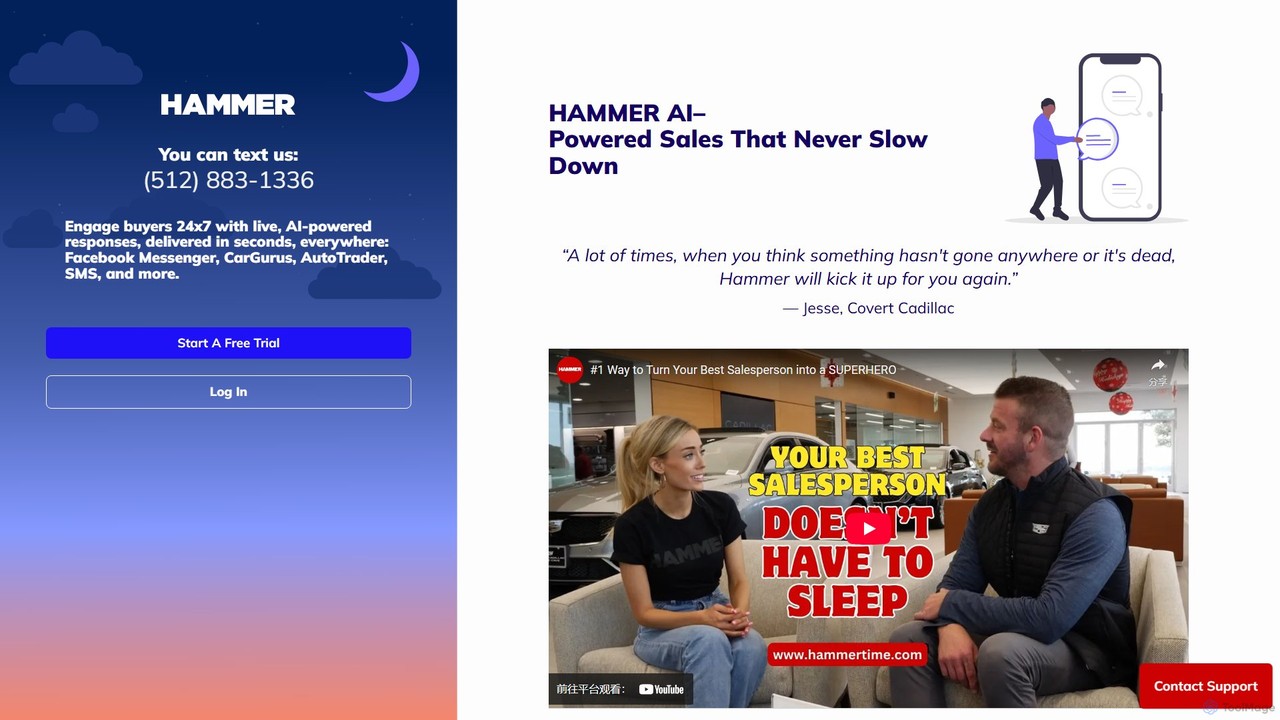
Hammer AI is a 24/7 AI-powered sales assistant for car dealerships. It instantly engages buyers across platforms like …
Hammer AI is a 24/7 AI-powered sales assistant for car dealerships. It instantly engages buyers across platforms like Facebook Messenger, SMS, and your website, answering questions with data-backed accuracy. By automating initial responses and filtering leads, Hammer AI ensures you never miss an opportunity, capturing more qualified customers even after business hours.
carvis
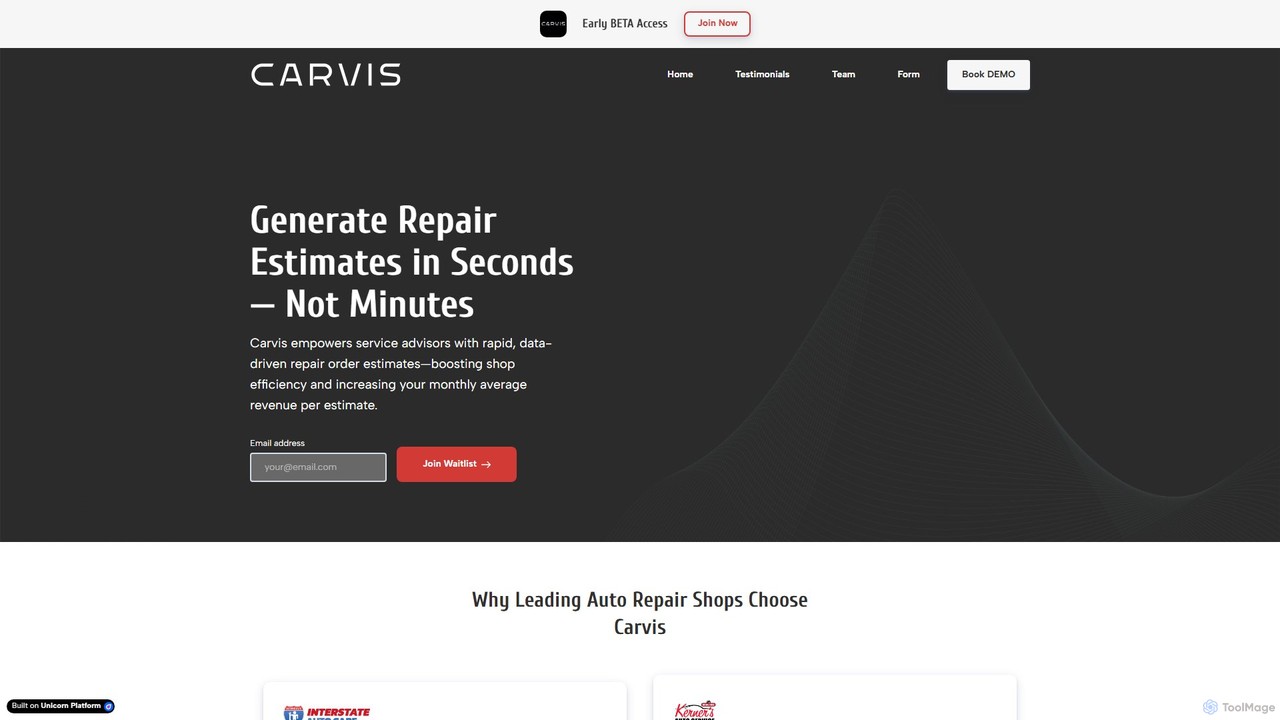
Carvis is an AI-powered platform designed for the auto repair industry. It revolutionizes shop operations by generating accurate …
Carvis is an AI-powered platform designed for the auto repair industry. It revolutionizes shop operations by generating accurate repair estimates in seconds. By leveraging real-world repair data, Carvis provides actionable insights to optimize inventory, allocate labor, and streamline workflows. This helps shops increase efficiency, improve customer turnaround times, and boost overall profitability.
About Automotive
Automotive AI tools are a specialized class of software that leverages machine learning and data analysis to enhance the design, manufacturing, performance, and sales of vehicles. These tools process vast amounts of data from sensors, cameras, and operational logs to provide predictive insights, automate complex tasks, and create intelligent in-car experiences. Their primary value lies in improving vehicle safety, operational efficiency, and manufacturing quality within the automotive industry. As part of the broader Business category, they provide industry-specific solutions that general business intelligence tools cannot offer.
Core Features
- Predictive Maintenance: Analyzes vehicle sensor data to forecast component failures before they occur, enabling proactive servicing.
- ADAS & Autonomous Driving Simulation: Creates realistic virtual environments to train and validate self-driving algorithms and safety systems.
- Computer Vision for Quality Control: Uses AI-powered cameras to automatically detect defects like scratches or misalignments on assembly lines.
- In-Car Experience Personalization: Powers intelligent voice assistants, adaptive infotainment systems, and personalized driver settings.
- Fleet Management Optimization: Processes telematics data to optimize routes, monitor driver behavior, and improve fuel efficiency for commercial fleets.
Use Cases
These tools are essential for automotive manufacturers to automate quality control and streamline production. Research and development teams use them extensively for creating and testing autonomous driving systems. Fleet management companies rely on them to reduce operational costs and enhance safety, while dealerships use them for automated vehicle inspections and personalized sales processes.
How to Choose
When selecting an Automotive AI tool, consider its data integration capabilities, particularly with vehicle-specific protocols like CAN bus. Evaluate the accuracy and reliability of its predictive models or simulation environments. Assess its scalability for handling data from thousands of vehicles or components. Finally, ensure it complies with relevant industry standards, such as ISO 26262 for functional safety.
AutomotiveUse Cases
Predictive Maintenance for Commercial Fleets
A fleet manager for a logistics company oversees hundreds of delivery trucks. Using an Automotive AI tool, they continuously monitor real-time data from each truck's engine, transmission, and braking systems. The AI analyzes patterns and anomalies, predicting a potential transmission failure in one vehicle 7 days before it would have occurred. This allows the manager to schedule proactive maintenance, avoiding a costly roadside breakdown, delivery delays, and ensuring driver safety. This process reduces unplanned downtime by up to 40% and cuts maintenance costs significantly.
AI-Powered Vehicle Inspection for Used Car Sales
A used car dealership needs to standardize its vehicle inspection process. They equip their staff with an AI-powered mobile application. An employee walks around a vehicle, taking photos from various angles. The tool's computer vision model instantly analyzes the images, identifying and cataloging every scratch, dent, and sign of rust. It generates a detailed, objective condition report with a consistent grading score. This eliminates subjective human error, builds trust with customers by providing transparent reports, and speeds up the vehicle intake process by over 60%.
Simulating Autonomous Driving Scenarios
An automotive engineer is developing an Advanced Driver-Assistance System (ADAS). Instead of relying solely on expensive and time-consuming physical road tests, they use an AI simulation platform. The platform generates millions of miles of virtual driving in hyper-realistic environments, including rare and dangerous 'edge case' scenarios like a child running onto the road or sudden icy conditions. The AI algorithm learns and adapts in this safe, controlled environment. This process drastically accelerates the development cycle, improves the system's reliability, and reduces R&D costs by allowing for massive-scale testing that would be impossible in the real world.
Automated Quality Control on the Assembly Line
A car manufacturing plant aims to achieve a zero-defect rate in its paint shop. They install high-resolution cameras integrated with an AI computer vision tool at a key checkpoint on the assembly line. As each car body passes, the AI system instantly scans its surface, detecting microscopic imperfections like dust particles, paint drips, or uneven coating that are invisible to the human eye. If a defect is found, the system automatically flags the specific vehicle for rework. This automated process operates 24/7 with consistent accuracy, increasing first-pass yield and reducing costly manual inspections and warranty claims.
Personalizing the In-Car Infotainment Experience
A driver enters their new electric vehicle. An AI-powered in-car assistant greets them by name. Based on the time of day and the driver's past habits, it suggests navigating to their office and queues up their favorite morning news podcast. The AI continuously learns their preferences for music genres, climate control settings, and frequent contacts. When the driver says, 'I'm feeling cold,' the system doesn't just turn up the heat; it increases the temperature by two degrees and activates the heated steering wheel, because it has learned this specific preference. This creates a deeply personalized and intuitive driving experience.
Optimizing EV Battery Management and Range
An electric vehicle (EV) owner wants to maximize their car's battery life and range. The vehicle is equipped with an AI battery management system. This system analyzes driving style (e.g., aggressive vs. smooth acceleration), typical routes, elevation changes, and external temperature to provide highly accurate range predictions. It also optimizes charging schedules, suggesting charging during off-peak electricity hours to save costs. Over time, the AI adjusts battery conditioning protocols to slow degradation, extending the battery's overall lifespan by an estimated 10-15% and giving the driver peace of mind.