ToolMage
Sign in

Best 1 Case Management AI tools for Business

Popular Case Management AI tools in Business include CaseXellence, helping you work more efficiently.

CaseXellence
Paid

CaseXellence

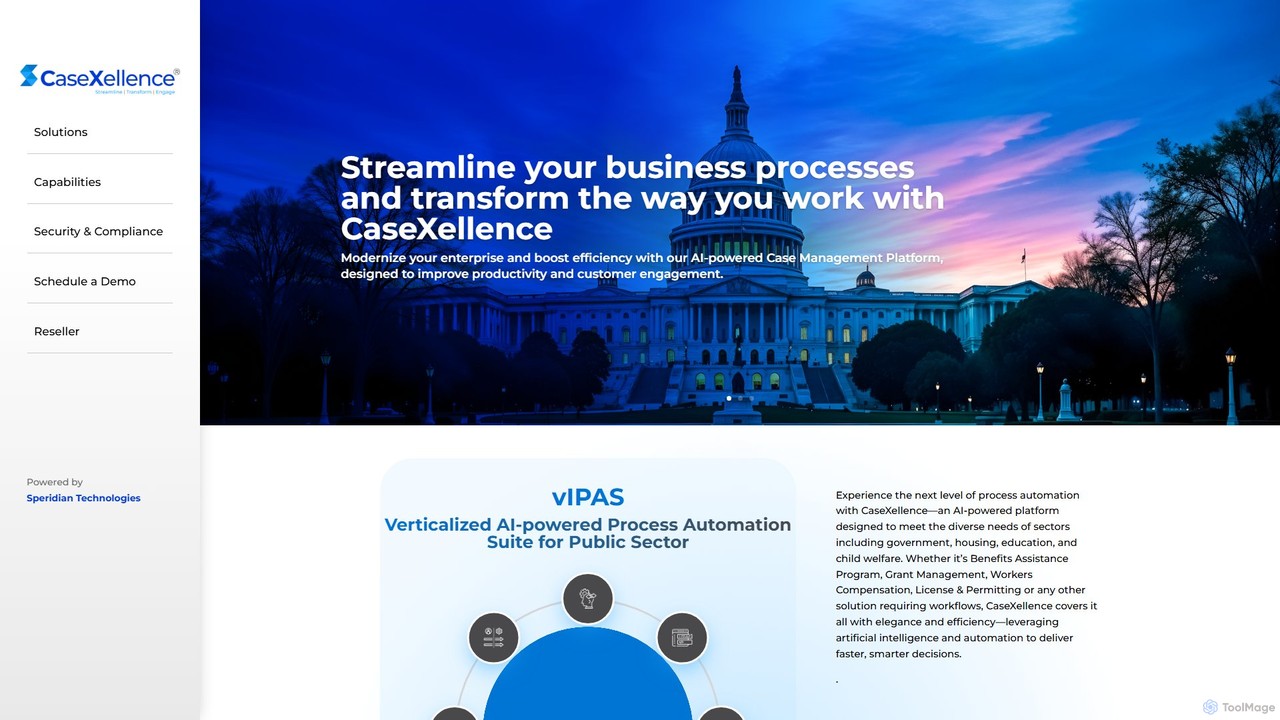
CaseXellence is a low-code, AI-powered intelligent process automation platform designed for public sector enterprises. It modernizes legacy systems, streamlines case management, and enhances efficiency through AI, analytics, and pre-built vertical solutions for government, healthcare, and legal sectors.

Case Management
Visits 5.8KFavorites 100Likes 129

About Case Management

Case Management tools are AI-powered platforms designed to streamline the organization, tracking, and resolution of individual cases or complex processes within a business context. These tools leverage artificial intelligence to automate routine tasks, provide data-driven insights, and enhance decision-making throughout the case lifecycle. By centralizing information and intelligently guiding workflows, AI Case Management solutions significantly improve operational efficiency, ensure compliance, and optimize outcomes across various industries.

Core Features

  • Intelligent Document Analysis: Automatically extracts key information from case-related documents, such as contracts, medical records, or customer complaints, for faster processing.
  • Automated Workflow & Task Assignment: Dynamically assigns tasks, triggers alerts, and automates routine steps based on case progress and predefined rules, reducing manual effort.
  • Predictive Analytics for Outcomes: Utilizes historical data to forecast potential case outcomes, identify risks, and recommend optimal actions, aiding proactive management.
  • Compliance & Audit Trails: Ensures adherence to regulatory requirements by tracking all case activities, decisions, and communications, providing a comprehensive audit trail.
  • Decision Support & Recommendations: Offers AI-driven suggestions for next best actions, resource allocation, or expert recommendations to accelerate resolution.

Applicable Scenarios

AI Case Management is invaluable for organizations dealing with high volumes of complex, multi-step processes. Legal firms use it to manage litigation, discovery, and client matters efficiently. Healthcare providers apply it to coordinate patient care pathways, manage insurance claims, and track treatment progress. Customer service departments leverage it to handle intricate support tickets, ensuring timely and consistent resolution for complex customer issues.

How to Choose

Selecting an AI Case Management solution requires evaluating several factors. Consider the tool's ability to integrate with existing business systems (CRM, ERP), its scalability to handle growing case volumes, and its compliance features for industry-specific regulations. Assess the level of AI automation offered, such as natural language processing for document analysis or predictive modeling, and ensure the user interface is intuitive for your team's adoption. Finally, evaluate the vendor's support and customization options to match your unique operational needs.

Case Management use cases

1

Streamlining Legal Discovery Processes

Legal professionals often face overwhelming volumes of documents during discovery. AI Case Management tools can automatically analyze contracts, emails, and other legal documents, identifying relevant information, key entities, and potential liabilities. This significantly reduces the manual review time, ensures comprehensive data extraction, and helps legal teams build stronger cases more efficiently, accelerating the entire litigation process.

2

Optimizing Patient Care Coordination in Healthcare

Healthcare organizations utilize AI Case Management to manage complex patient journeys, from admission to discharge and follow-up. The tools track appointments, medication schedules, test results, and care team interactions. AI can identify at-risk patients, suggest personalized care plans, and automate communication with patients and their families, leading to improved patient outcomes, reduced readmissions, and more efficient resource allocation.

3

Automating Complex Customer Support Ticket Resolution

Customer service teams handle diverse and often intricate customer inquiries. AI Case Management platforms centralize all customer interactions, analyze ticket content using NLP to categorize issues, and suggest relevant knowledge base articles or expert agents. They can automate initial responses, route tickets to the most qualified personnel, and track resolution progress, ensuring consistent service quality and faster problem-solving for complex customer issues.

4

Enhancing Fraud Detection and Investigation in Finance

Financial institutions employ AI Case Management to detect and investigate suspicious activities. The tools analyze transaction data, customer behavior, and external risk indicators to flag potential fraud cases. AI can prioritize high-risk alerts, automate the collection of evidence, and guide investigators through a structured process, improving the accuracy of fraud detection, reducing false positives, and accelerating the investigation and resolution of financial crimes.

5

Managing Regulatory Compliance and Audit Trails

Organizations in regulated industries must meticulously track compliance efforts. AI Case Management solutions provide a centralized system to manage regulatory requirements, track policy adherence, and document all compliance-related activities. They can automate audit trail generation, flag potential non-compliance issues, and ensure that all case-related decisions and actions are recorded, simplifying audits and minimizing regulatory risks.

6

Coordinating Large-Scale Project Tasks and Dependencies

For complex projects with numerous interconnected tasks and stakeholders, AI Case Management helps project managers oversee the entire workflow. The tools can break down projects into manageable cases, assign tasks based on resource availability and skill sets, and track dependencies. AI can predict potential bottlenecks, suggest optimal task sequences, and provide real-time progress updates, ensuring projects stay on track and within budget.

Case Management FAQ

What is AI Case Management?

AI Case Management refers to the application of artificial intelligence technologies to enhance the traditional process of organizing, tracking, and resolving individual cases or complex workflows. It leverages AI to automate routine tasks, provide data-driven insights, and support human decision-making, moving beyond simple task lists to intelligent, adaptive case handling. These tools are crucial for managing dynamic, unstructured processes that require flexibility and intelligence.

How does AI Case Management differ from traditional project management?

While both manage tasks, AI Case Management focuses on dynamic, often unpredictable "cases" with flexible workflows, such as legal disputes or customer complaints, where the path to resolution isn't always linear. Traditional project management, conversely, typically deals with structured projects with predefined tasks, timelines, and clear deliverables. AI Case Management excels in adapting to evolving information and supporting complex decision-making, whereas project management emphasizes planning and execution of fixed scopes.

What are the key benefits of implementing AI in Case Management?

Implementing AI in Case Management offers several key benefits. It significantly boosts operational efficiency by automating repetitive tasks like data entry and document analysis, freeing up human resources. AI provides predictive insights, helping organizations anticipate outcomes and mitigate risks proactively. Enhanced decision support guides users to optimal actions, leading to faster and more consistent case resolutions. Furthermore, AI-powered tools improve compliance tracking and provide comprehensive audit trails, reducing regulatory risks.

Which industries benefit most from AI Case Management solutions?

Industries dealing with high volumes of complex, information-intensive, and often unstructured cases benefit most. This includes the legal sector (litigation, contracts), healthcare (patient care pathways, claims processing), financial services (fraud detection, compliance), government (citizen services, investigations), and customer service (complex ticket resolution). Any sector where individual cases require adaptive workflows and intelligent decision support can see significant gains.

How do AI Case Management tools ensure data security and privacy?

AI Case Management tools prioritize data security and privacy through robust measures. They typically employ advanced encryption for data at rest and in transit, access controls based on user roles, and regular security audits. Many solutions are designed to comply with industry-specific regulations like GDPR, HIPAA, or CCPA, offering features such as data anonymization, audit trails, and secure data storage. Vendors often provide detailed security protocols and certifications to ensure data integrity and confidentiality.