Business Best in category 1 results Catalog Management AI Tool

Popular AI tools in the Catalog Management field of Business include CatalogIQ, etc., helping you quickly improve efficiency.

CatalogIQ

CatalogIQ

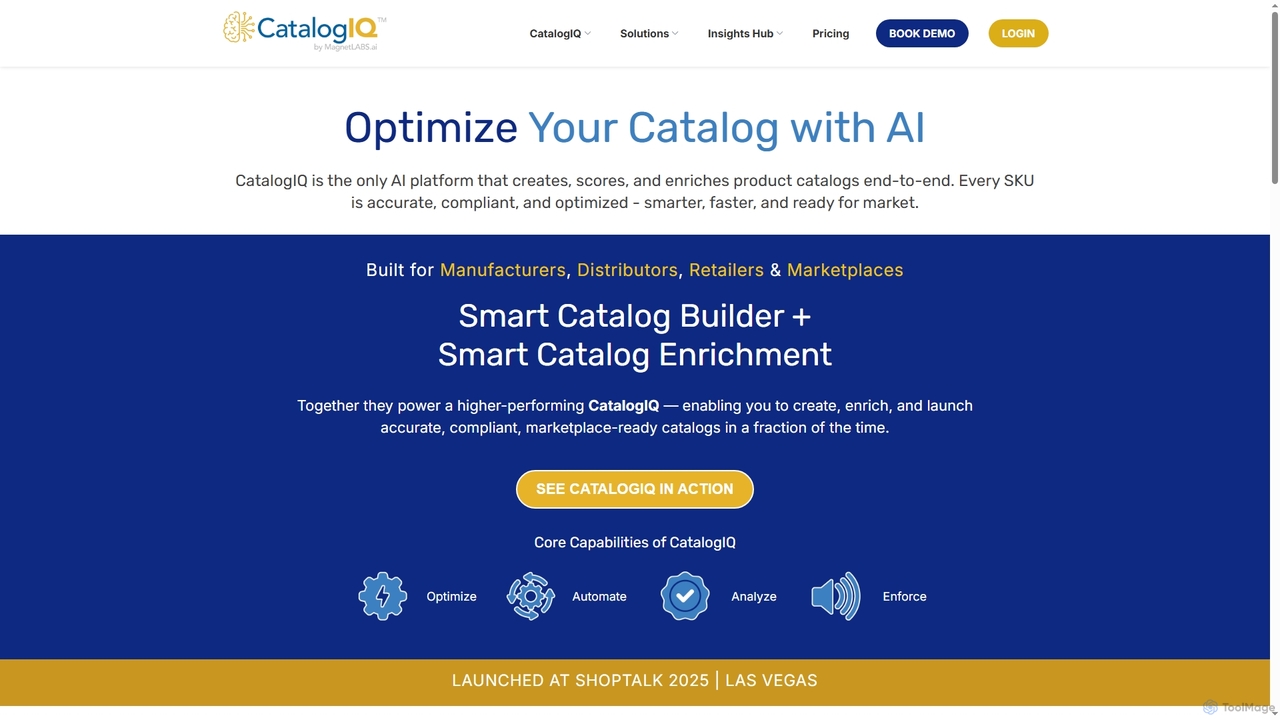
CatalogIQ is an AI-powered platform that optimizes e-commerce product catalogs by creating, scoring, and enriching product data end-to-end. …

4.7K

About Catalog Management

AI Catalog Management tools are a class of software designed to automate the organization, enrichment, and maintenance of product or service catalogs. These tools leverage artificial intelligence, particularly machine learning and natural language processing, to analyze, standardize, and generate product information. They significantly reduce manual effort, ensure data consistency across all sales channels, and accelerate the time-to-market for new products. By automating tedious tasks, these platforms allow businesses to manage vast and complex inventories with greater accuracy and efficiency.

Core Features

  • Automated Product Tagging: AI analyzes images and text to automatically assign relevant categories, attributes, and keywords.
  • AI Description Generation: Creates unique, SEO-friendly product descriptions and marketing copy from structured data like specifications.
  • Data Standardization & Cleansing: Automatically identifies and corrects errors, fills in missing information, and unifies formats from various sources.
  • Image Enhancement: Improves product photos by automatically removing backgrounds, adjusting colors, or resizing for different platforms.

Use Cases

These tools are primarily used in the e-commerce and retail sectors. Catalog managers, merchandisers, and marketing teams use them to manage large-scale inventories on platforms like Shopify, Amazon, or Magento. Manufacturers also use them to maintain consistent product information for their distribution networks.

How to Choose

When selecting a tool, consider its integration capabilities with your existing e-commerce platform or PIM system. Evaluate the scope and accuracy of its AI features, such as text generation and image recognition. Also, assess its ability to handle your specific data formats and the scalability to support your catalog size and growth.

Catalog ManagementUse Cases

1

Accelerate New Product Onboarding for E-commerce

An e-commerce catalog manager is tasked with adding 500 new products to their online store. Instead of manually writing descriptions, cropping images, and assigning tags, they upload the basic product data and images to an AI Catalog Management tool. The AI automatically generates compelling, SEO-optimized descriptions for each item, removes image backgrounds for a clean look, and assigns relevant category and attribute tags. This reduces the product onboarding time from several weeks to just a few days, allowing the business to launch new collections faster.

2

Standardize Data from Multiple Suppliers

A large online retailer sources products from hundreds of different suppliers, each providing data in inconsistent formats (e.g., 'KG', 'kg.', 'kilogram'). A data manager uses an AI tool to automatically ingest all these disparate data feeds. The AI recognizes and standardizes units, formats dates uniformly, corrects spelling errors in brand names, and maps supplier-specific categories to the retailer's master taxonomy. This ensures a clean, consistent, and trustworthy product catalog for customers without months of manual data cleansing.

3

Enrich Product Listings for Better SEO

A digital marketing specialist for a fashion brand wants to improve the search engine ranking of their product pages. They use an AI catalog tool to analyze their existing 2,000 product listings. The tool identifies listings with short, generic descriptions and suggests SEO-rich keywords. It then automatically rewrites these descriptions to be more descriptive, engaging, and infused with relevant long-tail keywords like 'women's high-waisted linen trousers'. This systematic enrichment helps improve organic search visibility and drives more qualified traffic to the product pages.

4

Automate Product Image Background Removal

A photography studio for an online furniture marketplace needs to process thousands of product images each week. The requirement is to have a clean, white background for all images to maintain a consistent look on the website. Using an AI catalog tool with image processing capabilities, the team can batch-upload all photos. The AI accurately detects the main product in each image and removes the background instantly, saving countless hours of manual work in photo editing software. The resulting high-quality images are immediately ready for the catalog.

5

Localize Product Catalogs for Global Markets

A global electronics brand is expanding into three new countries. A localization manager uses an AI catalog tool to adapt their product information. The tool not only translates product names and descriptions but also localizes them by considering cultural nuances and regional search terms. It can also convert measurements (e.g., inches to centimeters) and currencies automatically. This ensures that the product catalog resonates with local customers in each new market, improving user experience and conversion rates without a massive manual localization effort.

6

Automatically Categorize User-Generated Listings

An online marketplace for secondhand goods receives thousands of new listings from users daily. Manually reviewing and categorizing each item is impossible. The platform integrates an AI catalog management API. When a user uploads a photo and a title like 'Vintage leather armchair', the AI analyzes both the image and text, automatically placing the listing into the correct hierarchy: 'Home & Garden > Furniture > Living Room Furniture > Chairs > Armchairs'. This ensures the marketplace remains well-organized and easily searchable for buyers.

Catalog ManagementFrequently Asked Questions