
Free trial
MeetStream
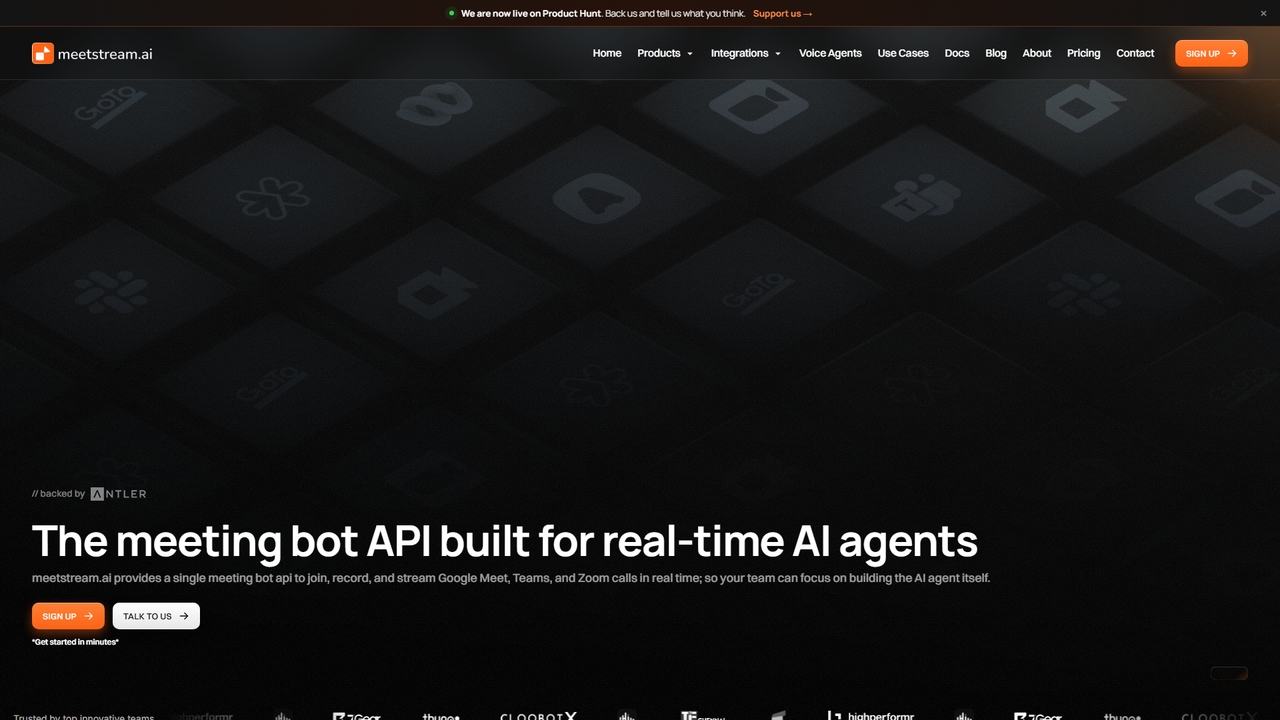
MeetStream is a meeting bot API for Zoom, Google Meet, and Microsoft Teams. Build AI agents that join, record, stream, and transcribe calls in real time.
Conversation IntelligenceVisits 4.4KFavorites 42Likes 31
Popular Conversation Intelligence AI tools in Business include Recall.ai, korus, and MeetStream, helping you work more efficiently.
MeetStream is a meeting bot API for Zoom, Google Meet, and Microsoft Teams. Build AI agents that join, record, stream, and transcribe calls in real time.
Conversation Intelligence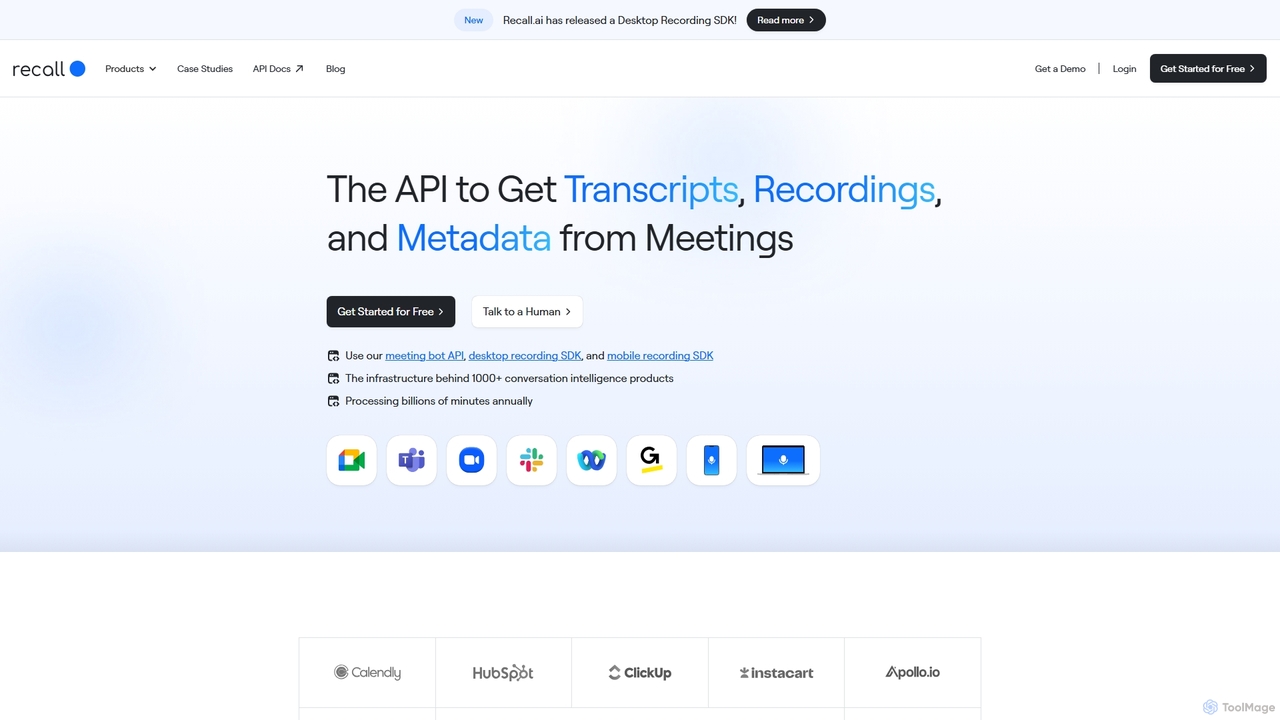
Recall.ai is a unified API for developers to access meeting data. It provides a single integration to get recordings, real-time transcripts, and rich metadata from platforms like Zoom, Google Meet, and Microsoft Teams, using meeting bots or SDKs for desktop and mobile.
Conversation Intelligence
Korus is an AI-powered conversation intelligence platform designed for sales teams. It records, transcribes, and analyzes customer calls and meetings to provide actionable insights. Korus helps sales managers coach their teams, improve sales execution, and gain deep visibility into deal health and pipeline risks, ultimately driving revenue growth.
AnalyticsConversation Intelligence tools are AI-powered platforms that record, transcribe, and analyze customer conversations from calls, video meetings, and emails. They leverage Natural Language Processing (NLP) to automatically extract actionable insights, such as customer sentiment, key topics, and sales objections. This transforms unstructured conversational data into structured intelligence, helping businesses understand customer needs, improve team performance, and make data-driven decisions. As a specialized area within Business tools, they focus specifically on unlocking the value hidden within every customer interaction.
These tools are widely used by B2B sales teams to replicate the habits of top performers and improve deal coaching. Customer support and success teams use them to automate quality assurance and identify at-risk customers. Product management teams also leverage them to gather unfiltered Voice of the Customer (VoC) feedback directly from sales and support interactions.
When choosing a Conversation Intelligence tool, evaluate its integration capabilities with your existing CRM and communication platforms (e.g., Salesforce, Zoom). Assess the accuracy of its transcription and analysis, especially for industry-specific terminology. Consider the depth of its analytics and reporting features. Finally, ensure it meets your organization's security and data compliance standards, such as GDPR or SOC 2.
A sales manager uses a Conversation Intelligence platform to improve their team's effectiveness. Instead of relying on anecdotal feedback, the manager reviews AI-generated call summaries that highlight key moments, such as when a competitor was mentioned or when a pricing objection was raised. They can create playlists of best-practice calls from top performers to use as training material for new hires. This data-driven approach allows for targeted, specific coaching that accelerates ramp-up time and measurably improves win rates across the team.
A customer support manager automates the quality assurance (QA) process. Instead of manually sampling a small fraction of calls, the Conversation Intelligence tool analyzes 100% of interactions. The manager sets up rules to automatically flag calls with negative sentiment, mentions of 'cancellation', or instances where an agent failed to follow a compliance script. This allows the QA team to focus their efforts on the most critical interactions, identify coaching opportunities, and ensure consistent service quality across the entire support organization.
A product manager uses Conversation Intelligence to understand user needs without conducting endless surveys. The platform aggregates all mentions of feature requests, product complaints, and competitor comparisons from thousands of sales and support calls. The product manager can then analyze trends, quantify the demand for a new feature, and use direct customer quotes to build stronger business cases. This provides an unfiltered, scalable channel for gathering product feedback and ensures the product roadmap is aligned with actual customer pain points.
In a highly regulated industry like finance or healthcare, a compliance officer uses Conversation Intelligence to mitigate risk. They create trackers for mandatory legal disclaimers and phrases that should be avoided. The system automatically scans 100% of customer interactions and flags any call where the required disclosures were missed or problematic language was used. This proactive monitoring helps the company maintain compliance, avoid hefty fines, and provides an auditable record of all conversations.
A marketing team sets up trackers in their Conversation Intelligence tool to monitor every mention of their key competitors. The platform provides a dashboard showing which competitors are mentioned most often, in what context (e.g., pricing, features, support), and how sales reps are handling these conversations. This allows the marketing team to understand their competitive landscape from the customer's perspective, refine their messaging, and create targeted sales enablement materials to better position their product against rivals.
An enablement manager creates a more effective onboarding program for new sales reps. They use the Conversation Intelligence platform to build a library of 'greatest hits' calls, categorized by use case, industry, or competitive scenario. New hires can listen to real-world examples of how top performers handle objections, pitch new features, and navigate complex deals. This self-serve, on-demand learning resource reduces the time it takes for new reps to become productive and ensures they learn from the best practices already established within the team.
Conversation Intelligence (CI) is a type of AI-powered software that analyzes customer conversations across various channels like phone calls, video meetings, and emails. It goes beyond simple recording by using Natural Language Processing (NLP) to transcribe discussions, identify speakers, analyze sentiment, and extract key topics and insights. The primary goal is to turn unstructured conversational data into structured, actionable intelligence for sales, support, and product teams.
Simple call recording software merely captures and stores audio files for later playback. Conversation Intelligence platforms do much more. They actively analyze the content of the conversation. Key differences include:
Conversation Intelligence tools are most beneficial for customer-facing teams within a business. Key users include:
While features vary between providers, most leading Conversation Intelligence platforms include a core set of capabilities. These typically are:
Choosing the right tool depends on your specific needs. Key factors to consider include: