ToolMage
Sign in

Best 1 Customer Communication AI tools for Business

Popular Customer Communication AI tools in Business include Interval AI, helping you work more efficiently.

Interval AI
Paid

Interval AI

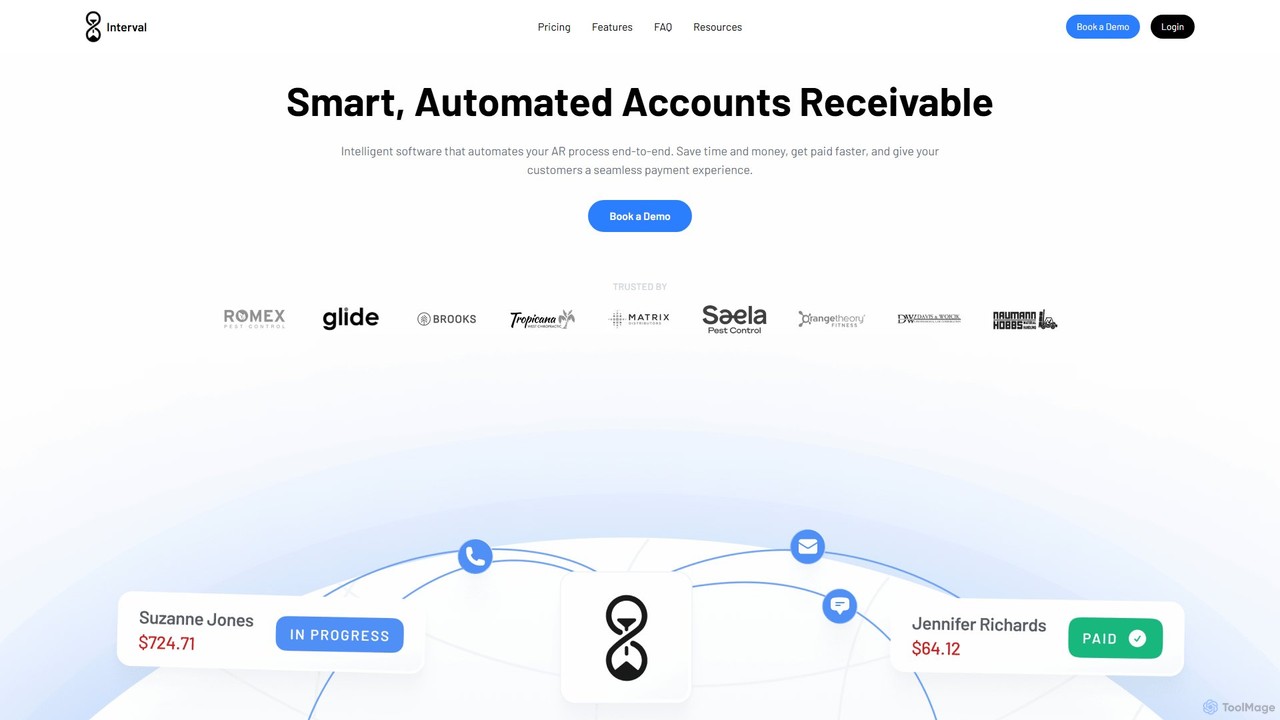
Interval AI is an intelligent, automated accounts receivable platform designed to streamline your collections process. Using AI-driven communication across calls, texts, and emails, it helps businesses save time, reduce costs, and get paid faster. The system optimizes outreach, negotiates payments, and maintains professional customer relationships, all on autopilot.

Customer Communication
Visits 9.7KFavorites 130Likes 134

About Customer Communication

AI Customer Communication tools are a class of software that leverages artificial intelligence to automate, personalize, and analyze interactions with customers. These tools utilize technologies like Natural Language Processing (NLP) and machine learning to understand user intent, provide instant responses, and gather insights from conversations. They are designed to enhance customer experience, improve support efficiency, and enable businesses to manage communications at scale across multiple channels. This approach allows for consistent, 24/7 engagement without a proportional increase in human resources.

Core Features

  • AI-Powered Chatbots: Provide instant, 24/7 responses to customer queries, handling a high volume of common questions automatically.
  • Sentiment Analysis: Automatically analyze text and voice communications to gauge customer emotion, helping prioritize urgent issues.
  • Automated Ticket Routing: Intelligently categorize and assign support tickets to the appropriate agent or department based on content and urgency.
  • Personalized Messaging: Generate tailored responses, recommendations, and marketing messages based on customer data and behavior.
  • Omnichannel Support Hub: Consolidate communications from various channels like email, social media, and web chat into a single, unified view.

Use Cases

These tools are widely adopted in sectors like e-commerce, SaaS, finance, and telecommunications. They are used by customer support teams to automate responses, sales teams to qualify leads and schedule meetings, and marketing teams to run personalized campaigns. For instance, an e-commerce store can use an AI chatbot to assist with order tracking, while a SaaS company can use it for user onboarding.

How to Choose

When selecting an AI Customer Communication tool, consider its integration capabilities with your existing CRM and helpdesk software. Evaluate the sophistication of its NLP and its ability to understand industry-specific jargon. Also, assess the range of supported channels (e.g., website, mobile app, social media), the level of customization available for chatbots and workflows, and the depth of its analytics and reporting features.

Customer Communication use cases

1

Automating 24/7 Customer Support with AI Chatbots

A SaaS company's support team often faces a high volume of repetitive questions about pricing, features, and account management, especially outside of business hours. By implementing an AI chatbot on their website and in-app, they can provide instant, 24/7 answers to these common queries. The chatbot uses NLP to understand user questions and provides accurate information from a knowledge base. This frees up human agents to focus on complex, high-value technical issues, reducing response times for all customers and improving overall satisfaction.

2

Personalizing E-commerce Shopping Assistance

An online fashion retailer wants to increase conversion rates by providing personalized shopping help. They use an AI-powered communication tool that acts as a virtual shopping assistant. It analyzes a customer's browsing history, past purchases, and items in their cart to offer tailored product recommendations. It can also answer pre-sale questions about sizing, material, and shipping policies in real-time. This proactive and personalized engagement mimics the experience of an in-store assistant, leading to higher customer engagement and increased sales.

3

Analyzing Customer Feedback at Scale

A large telecommunications company receives thousands of customer reviews, survey responses, and social media comments daily. Manually analyzing this data is impossible. They use an AI communication tool with sentiment analysis capabilities. The tool automatically processes all incoming text feedback, categorizes it by topic (e.g., 'network quality', 'billing issues'), and assigns a sentiment score (positive, negative, neutral). This provides the management team with a real-time dashboard of customer sentiment, allowing them to quickly identify widespread issues and track the impact of service improvements.

4

Streamlining Support Ticket Management

A growing B2B software company's helpdesk is overwhelmed with support tickets. Agents spend significant time manually reading, categorizing, and assigning each ticket. They adopt an AI tool that integrates with their helpdesk system. The AI automatically analyzes the content of new tickets, identifies the topic (e.g., 'bug report', 'feature request'), determines its priority based on keywords and customer history, and routes it to the correct specialized agent or team. This automation reduces the average first response time by over 40% and ensures that critical issues are addressed promptly.

5

Proactive Customer Onboarding and Engagement

A mobile app developer wants to improve user retention during the critical first week. They use an AI communication platform to create an automated onboarding sequence. The AI triggers personalized in-app messages and emails based on user actions (or inaction). For example, if a user hasn't tried a key feature after three days, the system sends a helpful tip or a short video tutorial. This proactive, context-aware communication guides users to value, reduces churn, and fosters a better user experience from day one.

6

Qualifying Sales Leads with AI Assistants

A sales team spends too much time on unqualified leads. They deploy an AI assistant on their website's contact form and live chat. When a potential lead engages, the AI asks a series of qualifying questions (e.g., 'What is your company size?', 'What is your budget?'). Based on the answers, the AI can instantly book a meeting with the appropriate sales representative for high-quality leads or direct lower-quality leads to a newsletter or resource page. This ensures the sales team only spends time on prospects with a high probability of converting.

Customer Communication FAQ

What are AI Customer Communication tools?

AI Customer Communication tools are software applications that use artificial intelligence, primarily Natural Language Processing (NLP) and machine learning, to manage and enhance interactions between a business and its customers. They automate tasks like answering FAQs, routing support tickets, and analyzing feedback. The main goal is to provide faster, more personalized, and consistent support across various channels like websites, social media, and email, while improving operational efficiency.

How to choose the right AI Customer Communication tool?

To choose the right tool, consider these factors:

  • Integration Capabilities: Ensure it integrates smoothly with your existing systems like CRM, helpdesk, and e-commerce platforms.
  • Channel Support: Verify that it supports the channels your customers use most, such as web chat, social media messengers, email, or SMS.
  • AI Sophistication: Evaluate the power of its NLP. Can it understand complex queries, handle multiple languages, and detect user sentiment accurately?
  • Customization and Scalability: Check how easily you can customize workflows, chatbot personalities, and responses. Ensure the tool can scale with your business growth.
  • Analytics and Reporting: Look for robust analytics that provide insights into conversation topics, customer satisfaction, and agent performance.
What's the difference between an AI chatbot and a rules-based chatbot?

The key difference lies in their intelligence and flexibility. A rules-based chatbot follows a predefined script or decision tree. It can only respond to specific commands or keywords it's programmed to recognize, making it suitable for simple, linear conversations like basic FAQs. An AI chatbot, on the other hand, uses Natural Language Processing (NLP) to understand the intent and context behind a user's message, even with typos or varied phrasing. This allows for more natural, human-like conversations and the ability to handle a much wider range of complex queries.

What are the main benefits of using AI for customer communication?

Using AI for customer communication offers several key benefits:

  • Increased Efficiency: AI handles repetitive queries and tasks, freeing up human agents to focus on more complex issues, thereby increasing overall team productivity.
  • 24/7 Availability: AI-powered bots can provide instant support around the clock, improving customer satisfaction by eliminating wait times.
  • Cost Reduction: Automating a significant portion of customer interactions reduces the need for a large support staff, lowering operational costs.
  • Data-Driven Insights: AI tools can analyze vast amounts of conversation data to identify trends, customer sentiment, and areas for service improvement.
  • Personalization at Scale: AI enables businesses to deliver personalized messages, recommendations, and support to thousands of customers simultaneously.
Can AI completely replace human customer service agents?

While AI is powerful for automating routine tasks and handling a high volume of queries, it is unlikely to completely replace human agents. AI excels at speed, data processing, and 24/7 availability. However, human agents are essential for handling complex, emotionally charged, or nuanced situations that require empathy, creative problem-solving, and genuine human connection. The most effective strategy is a hybrid approach, where AI handles the initial, repetitive interactions, and seamlessly escalates more complex issues to human agents. This allows each to do what they do best.