
ConversAItions
ConversAItions is a real-time AI conversation copilot that listens to your meetings, providing instant fact-checking, automatic note-taking, and …
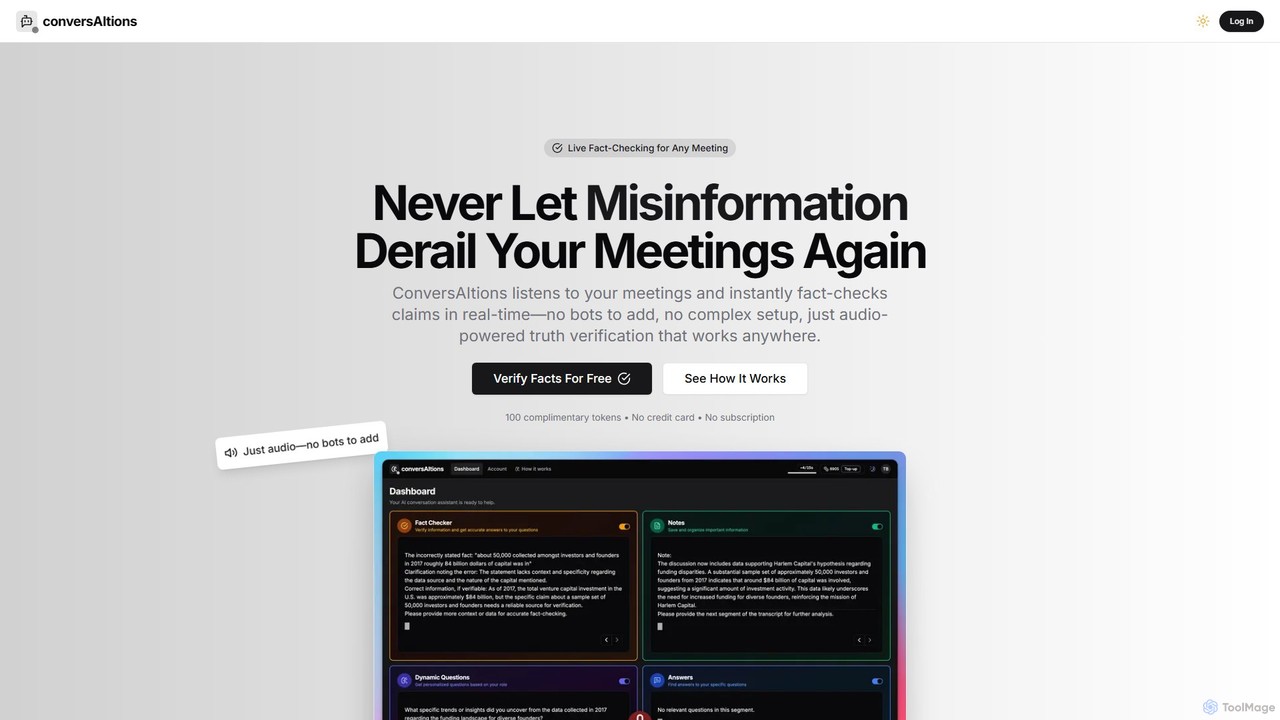
ConversAItions is a real-time AI conversation copilot that listens to your meetings, providing instant fact-checking, automatic note-taking, and smart follow-up questions. It works seamlessly with any audio source like Zoom or Google Meet without needing bots, ensuring your decisions are based on verified information.
About Fact Checking
AI Fact Checking tools are a specialized category of software designed to automatically verify the accuracy of information against reliable data sources. They leverage Natural Language Processing (NLP) and machine learning to analyze claims, identify potential misinformation, and provide evidence-backed assessments. These tools are crucial for journalists, researchers, and businesses to maintain credibility and combat the spread of false narratives in a fast-paced digital environment. Their ability to process vast amounts of text and cross-reference multiple sources in seconds offers a significant advantage over manual verification.
Core Features
- Claim Detection: Automatically identifies verifiable statements and assertions within a piece of text.
- Source Verification: Cross-references claims against a curated database of trusted news outlets, academic papers, and official reports.
- Evidence Retrieval: Presents supporting or contradictory evidence, along with source links, for a given claim.
- Credibility Scoring: Provides a score or classification (e.g., true, false, misleading) for the analyzed content.
- Bias Analysis: Detects potential political, commercial, or ideological bias in the source material.
Applicable Scenarios
These tools are widely used in newsrooms to quickly vet sources before publication, by academic researchers to validate data in literature reviews, and within corporate communications teams to monitor brand mentions and address false rumors. They are also integral to content moderation on social media platforms.
Selection Criteria
When selecting a fact-checking tool, consider the breadth and quality of its source database, its language support, and its integration capabilities with content management systems (CMS) or social media platforms. Also, evaluate the transparency of its verification process and its ability to handle different content formats like articles, posts, and reports.
Fact CheckingUse Cases
Verifying News Articles Before Publication
A journalist or editor in a fast-paced newsroom needs to ensure the accuracy of a breaking story. They input the draft article into an AI fact-checking tool. The system automatically scans for factual claims, such as statistics, quotes, and event descriptions. It then cross-references these claims against its database of reputable news agencies, official reports, and academic sources, flagging any statements that are unverified, misleading, or directly contradicted by evidence. This process significantly reduces the risk of publishing misinformation, upholds journalistic integrity, and accelerates the editorial workflow.
Combating Brand-Related Misinformation
A corporate communications manager monitors online conversations about their company. A false rumor about a product's safety begins to spread on social media. Using an AI fact-checking tool integrated with a social listening platform, the team can quickly identify the misleading posts and trace their origins. The tool provides verified data and links to official safety reports that directly refute the false claims. This allows the PR team to issue a swift, evidence-backed response, mitigating reputational damage and providing customers with accurate information.
Enhancing Academic Research and Literature Reviews
An academic researcher is conducting a literature review for a new study. To ensure the integrity of their research, they use an AI fact-checking tool to validate claims and data points from dozens of papers. By inputting key assertions from the source material, the tool quickly cross-references them against a vast academic database. It flags inconsistencies, retracted studies, or data that has been superseded by more recent findings. This not only saves the researcher countless hours of manual verification but also strengthens the foundation of their own study by ensuring it is built upon accurate and reliable prior work.
Automating Content Moderation at Scale
A trust and safety team at a large social media platform is tasked with identifying and flagging harmful misinformation. Manually reviewing millions of posts is impossible. They integrate an AI fact-checking API into their moderation workflow. The system automatically scans new user-generated content for claims related to sensitive topics like health or politics. It compares these claims against a real-time database of known falsehoods and flags posts for human review or automatic down-ranking. This allows the platform to address misinformation more quickly and consistently, improving user safety and reducing the workload on human moderators.
Conducting Financial Due Diligence
A financial analyst is evaluating a company for a potential investment. They need to verify claims made in the company's press releases, annual reports, and investor presentations. The analyst uses an AI fact-checking tool to cross-reference financial figures, market growth projections, and partnership announcements against trusted financial news outlets, regulatory filings, and market data providers. The tool highlights any discrepancies or unsubstantiated claims, providing the analyst with a clearer, more objective view of the company's standing. This enhances the rigor of the due diligence process and helps in making more informed investment decisions.
Rapid Response in Political Campaigns
A political campaign's rapid response team needs to quickly verify statements made by an opponent during a live debate. As the opponent speaks, the team inputs their claims into an AI fact-checking tool. The tool instantly searches public records, voting histories, reputable news archives, and non-partisan analyses to assess the accuracy of each statement. Within seconds, it provides a verdict (e.g., 'True,' 'Mostly False,' 'Lacks Context') with supporting evidence. This allows the campaign to immediately craft and distribute fact-based counter-messaging on social media and to the press, shaping the post-debate narrative in real-time.