Business Best in category 1 results Future Of Work AI Tool

Popular AI tools in the Future Of Work field of Business include FlexOS, etc., helping you quickly improve efficiency.

FlexOS

FlexOS

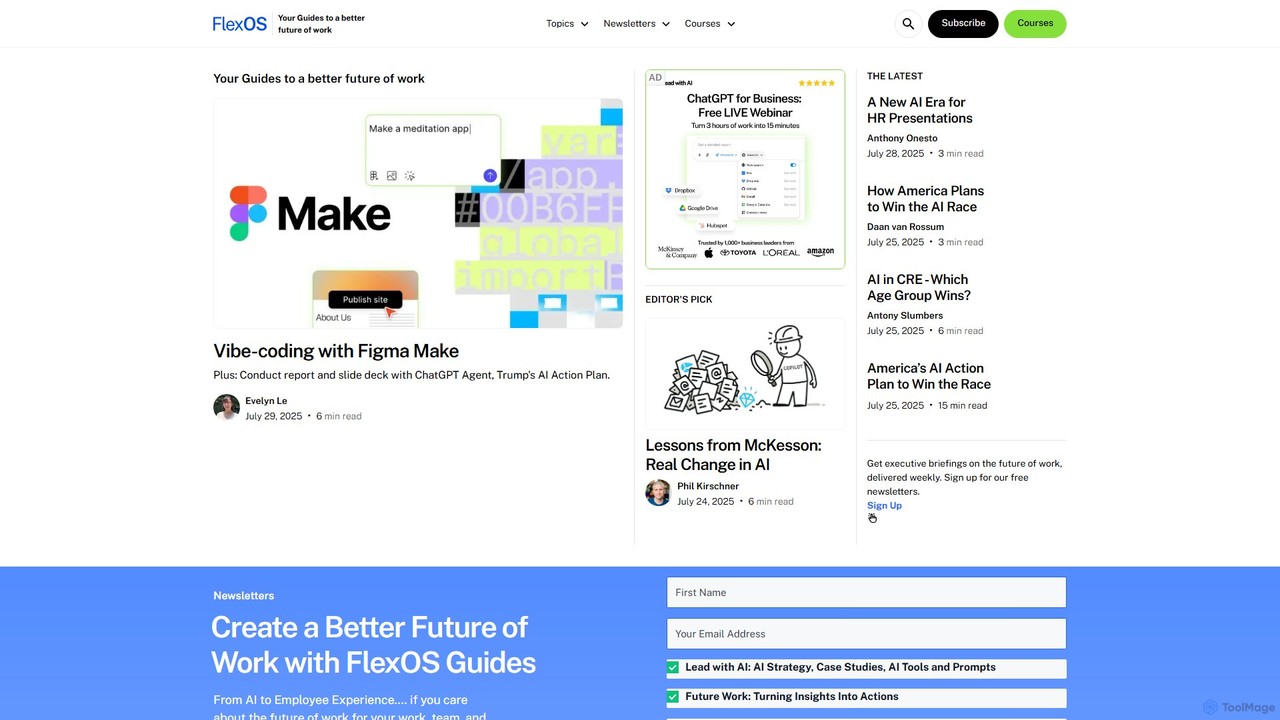
FlexOS is a media and learning platform dedicated to the future of work. It provides business leaders and …

12.3K

About Future Of Work

Future of Work tools are a class of AI-driven platforms designed to redefine how teams collaborate, automate complex workflows, and enhance employee productivity. They leverage technologies like large language models (LLMs), process mining, and predictive analytics to automate knowledge work, not just repetitive tasks. These tools are crucial for organizations adapting to hybrid work models, aiming to improve operational agility and foster a more data-driven culture. Unlike traditional business software, they focus on augmenting human capabilities and creating intelligent, adaptive work environments.

Core Features

  • Intelligent Workflow Automation: Automates multi-step processes that involve decision-making, data analysis, and cross-functional collaboration.
  • AI-Powered Collaboration Hubs: Centralizes communication, project management, and knowledge sharing with AI assistance like meeting summaries and action item tracking.
  • Talent Intelligence Platforms: Uses AI to analyze skills, predict talent needs, and personalize employee development paths.
  • Predictive Analytics for Operations: Provides data-driven forecasts and recommendations to optimize resource allocation and strategic planning.

Use Cases

These tools are ideal for HR departments optimizing talent management, operations teams automating complex business processes, and distributed teams seeking to improve remote collaboration. They support strategic initiatives by providing insights that guide decision-making and enhance organizational efficiency.

How to Choose

When selecting a tool, consider its integration capabilities with your existing tech stack (CRM, ERP), the level of customization required for your specific workflows, its data security and compliance standards (e.g., GDPR, SOC 2), and its scalability to support your organization's growth.

Future Of WorkUse Cases

1

Automating Employee Onboarding Process

An HR manager for a growing tech company needs to onboard multiple remote employees each month. The process involves coordinating with IT, Finance, and department heads, leading to delays and inconsistent experiences. By using a Future of Work platform, they create an automated workflow. When a new hire is added, the system automatically triggers IT equipment requests, schedules orientation meetings across time zones, assigns mandatory training modules, and provides an AI chatbot to answer common questions. This reduces manual coordination time by over 70% and ensures every new hire has a smooth, consistent start.

2

Enhancing Hybrid Team Collaboration

A project manager leads a globally distributed team, making real-time collaboration difficult due to time zone differences and information silos. They implement an AI collaboration hub. The tool automatically records, transcribes, and summarizes video meetings, highlighting key decisions and action items for those who couldn't attend. Its AI-powered search function allows team members to instantly find relevant information across chat logs, documents, and meeting transcripts. This ensures all team members stay aligned, reduces time spent searching for information, and bridges communication gaps effectively.

3

Proactive Skill Gap Analysis for Workforce Planning

A Learning & Development specialist needs to design future-proof training programs. Instead of relying on manual surveys, they use a talent intelligence platform. The AI analyzes data from project management tools, performance reviews, and external job market trends to map the current skills of the workforce. It then identifies critical gaps between existing capabilities and the skills needed for the company's future strategic goals. The platform recommends personalized learning paths for employees, enabling the company to invest in targeted upskilling and build a resilient, future-ready workforce.

4

Optimizing Operational Decision-Making with Predictive Analytics

An operations director for a retail chain relies on historical data and intuition for inventory management. To improve accuracy, they adopt a predictive analytics tool. The AI analyzes real-time sales data, supply chain information, weather forecasts, and social media trends to generate highly accurate demand forecasts for each store. It also simulates the impact of different promotional strategies on inventory levels. This allows the director to make proactive, data-driven decisions, reducing both stockouts and overstock situations, thereby optimizing cash flow and increasing profitability.

5

Creating an Internal Knowledge Assistant

Employees at a large enterprise spend significant time searching for internal policies, procedures, and technical documentation scattered across different systems like SharePoint and Confluence. The IT department implements an AI-powered enterprise search tool. This tool connects to all internal repositories and creates a unified knowledge base. Employees can now ask questions in natural language, such as "What is our travel expense policy?", and receive instant, accurate answers with direct links to the source documents. This empowers employees with self-service support and ensures consistent access to up-to-date information.

6

Automating Financial Reporting and Analysis

A financial analyst spends the first week of every month manually consolidating data from various ERP systems and spreadsheets for the monthly closing report. This process is tedious and prone to errors. They adopt an intelligent automation platform. The tool automatically extracts and consolidates the required data, generates standardized financial statements, and uses generative AI to draft an initial narrative summary highlighting key trends and variances. This accelerates the closing cycle by several days, improves report accuracy, and frees up the analyst to focus on strategic interpretation and providing deeper insights to management.

Future Of WorkFrequently Asked Questions