
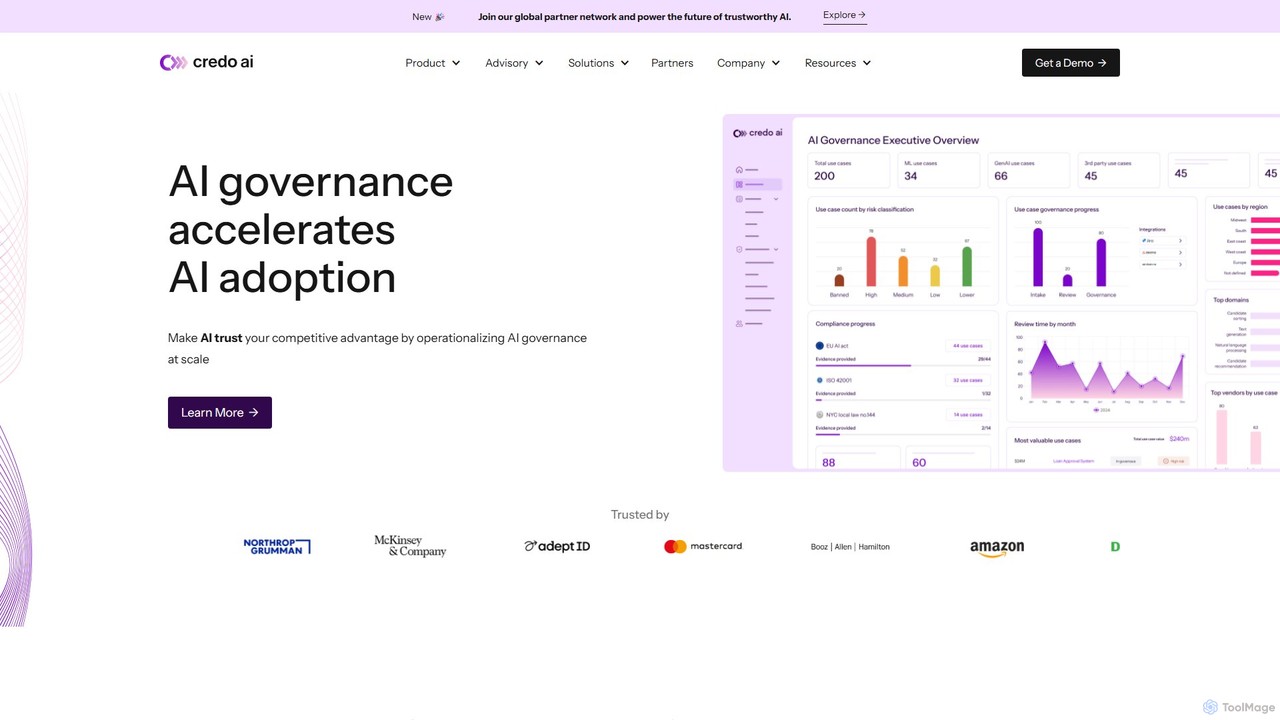
Credo AI
Credo AI is an enterprise-grade AI governance platform that helps organizations operationalize Responsible AI (RAI). It enables businesses …
Credo AI is an enterprise-grade AI governance platform that helps organizations operationalize Responsible AI (RAI). It enables businesses to manage AI risks, ensure compliance with global regulations, and build trust by providing tools for inventory, assessment, and monitoring of all AI systems, including generative AI.
About Governance
AI Governance tools are platforms designed to manage, monitor, and control the entire lifecycle of artificial intelligence systems within an organization. They provide a centralized framework to enforce policies, track model performance, and ensure compliance with legal and ethical standards. These tools are crucial for businesses to mitigate risks, maintain transparency, and scale their AI initiatives responsibly. They effectively bridge the gap between technical AI development and strategic business oversight.
Core Features
- Model Inventory & Catalog: Centralizes all AI models, providing a single source of truth for tracking versions, metadata, and ownership.
- Risk & Compliance Management: Automates checks against regulations like GDPR or the EU AI Act and internal ethical guidelines.
- Bias & Fairness Auditing: Scans models and data for potential biases related to protected attributes like age, gender, or race.
- Explainability & Transparency (XAI): Generates human-readable explanations for model predictions to improve trust and facilitate debugging.
- Automated Monitoring & Alerting: Continuously tracks live models for performance degradation, data drift, and security vulnerabilities.
Use Cases
AI Governance tools are essential in highly regulated industries such as finance, healthcare, and insurance for auditing and reporting. Large enterprises use them to standardize AI practices across departments, while technology companies rely on them to ensure the safety and reliability of customer-facing AI products.
How to Choose
When selecting an AI Governance tool, consider its integration capabilities with your existing MLOps toolchain and data platforms. Evaluate the breadth of its compliance frameworks, the sophistication of its bias detection algorithms, and the clarity of its reporting dashboards. Also, assess its scalability to support a growing number of models and its user access control features.
GovernanceUse Cases
Ensure Regulatory Compliance in Finance
A financial institution uses an AI governance platform to manage its loan approval models. The tool automatically generates audit trails, documents model validation steps, and continuously scans for discriminatory bias, ensuring compliance with fair lending laws and providing regulators with transparent reports.
Manage Clinical AI Model Risk in Healthcare
A hospital network deploys AI models for medical imaging analysis. A governance tool provides a central registry for these models, tracks their real-world performance against initial benchmarks, and manages access permissions to protect sensitive patient data (PHI), ensuring alignment with HIPAA and FDA guidelines.
Standardize Enterprise-Wide AI Initiatives
A large corporation with multiple business units develops AI solutions independently. The central IT team implements an AI governance platform to create a unified model inventory. This prevents redundant work, enforces consistent security standards, and provides leadership with a clear view of AI-related ROI and risks across the entire organization.
Monitor Generative AI for Safety and Ethics
A tech company integrates a large language model (LLM) into its customer service chatbot. The governance tool monitors conversations in real-time to detect and flag toxic language, harmful content, or data privacy leaks. It helps the company enforce responsible AI usage policies and protect its brand reputation.
Maintain Transparency in Public Sector AI
A government agency uses an AI system for resource allocation. An AI governance platform provides explainability features (XAI) that translate complex model decisions into simple terms. This allows the agency to offer clear justifications for its decisions to the public, fostering trust and ensuring accountability.
Optimize E-commerce Recommendation Engines
An online retail company uses a governance tool to monitor its product recommendation AI. The platform alerts the team to model drift when customer behavior changes, preventing a drop in recommendation accuracy. It also analyzes outputs to ensure the engine doesn't create unfair filter bubbles or promote certain products based on demographic bias.