ToolMage
Sign in

Best 2 Leadership AI tools for Business

Popular Leadership AI tools in Business include Seth's Blog and Wendi, helping you work more efficiently.

Wendi
Paid

Wendi

Wendi is an AI-powered manager workspace designed to help leaders handle sensitive people issues, document conversations, and receive HR-aligned guidance. It operates discreetly by capturing audio locally, generating notes and insights, and helping managers act early, fairly, and in compliance with best practices to prevent workplace conflicts from escalating.

Leadership
Visits 6.4KFavorites 33Likes 34
Seth's Blog
Free

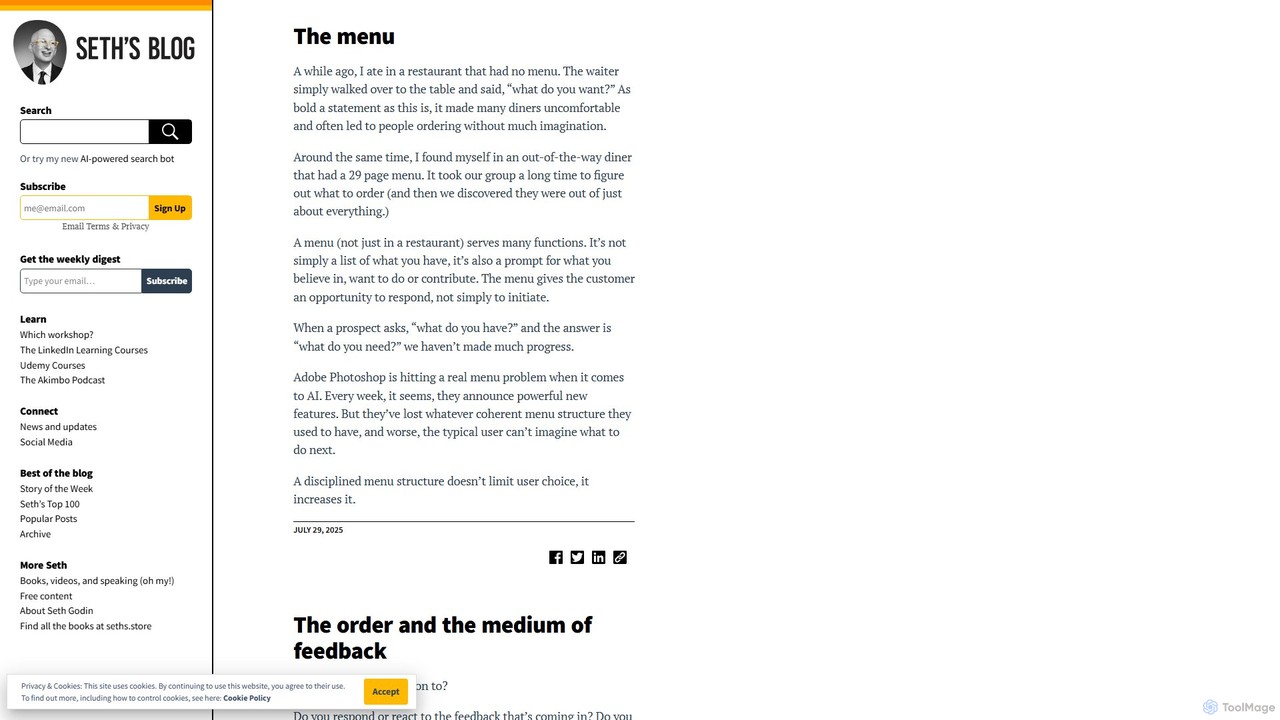
Seth's Blog

Seth's Blog is a daily source of wisdom from marketing guru Seth Godin. Featuring an AI-powered search bot, it allows users to instantly navigate nearly 10,000 posts to find profound insights on marketing, leadership, creativity, and the nature of work.

Leadership
Visits 188.7KFavorites 106Likes 103

About Leadership

AI Leadership tools are a specialized class of software designed to enhance managerial effectiveness and team performance. They leverage artificial intelligence to analyze communication patterns, performance data, and team dynamics, providing leaders with actionable insights and personalized coaching. These tools help managers make more informed decisions, improve feedback quality, and foster a more engaged and productive work environment. As a key component of the broader Business AI ecosystem, they focus specifically on the human and strategic aspects of management.

Core Features

  • AI-Powered Coaching: Delivers personalized, real-time feedback and development suggestions to managers based on their interactions and team performance.
  • Performance Analytics: Aggregates and analyzes team data to identify performance trends, potential burnout risks, and opportunities for growth.
  • Decision Support: Models potential outcomes of strategic decisions, providing data-backed recommendations to guide leadership choices.
  • Communication Analysis: Evaluates text and speech from meetings or emails to offer insights on clarity, tone, and inclusivity.
  • Team Sentiment Tracking: Anonymously monitors team morale and engagement levels through various data sources to provide an early warning system for potential issues.

Use Cases

These tools are primarily used by team leaders, department managers, and C-level executives across various industries, particularly in tech, consulting, and large enterprises. They are valuable for developing new managers, improving the effectiveness of 1-on-1 meetings, and aligning teams during strategic planning. HR and Leadership Development departments also utilize them to scale coaching programs.

How to Choose

When selecting an AI Leadership tool, consider its integration capabilities with your existing platforms like Slack, Microsoft Teams, and HRIS. Evaluate the tool's data privacy and security protocols, as it will handle sensitive employee information. Assess the underlying coaching methodology and psychological frameworks it uses. Finally, ensure it can scale from supporting a single team to the entire organization.

Leadership use cases

1

Personalized Coaching for New Managers

A newly promoted manager uses an AI leadership tool to accelerate their development. The tool analyzes transcripts of their team meetings and provides real-time, private feedback on their communication style, such as suggesting more inclusive language or clearer ways to delegate tasks. It also recommends micro-learning modules on specific challenges they face, like conflict resolution or conducting effective one-on-ones, helping them build confidence and competence faster than traditional training methods.

2

Analyzing Team Engagement and Burnout Risk

An executive uses a leadership platform to get a high-level view of organizational health. The AI analyzes anonymized data from communication platforms (like Slack channels) and calendar metadata to identify patterns. It might flag a department where after-hours communication has spiked by 50% or meeting loads are consistently high, indicating a potential burnout risk. This allows leadership to proactively intervene with resource adjustments or wellness initiatives before employee turnover increases.

3

Improving the Quality of Performance Reviews

An HR department implements an AI leadership tool to help managers write more effective and unbiased performance reviews. As a manager writes a review, the tool provides real-time suggestions. It can flag vague phrases like "good job" and suggest replacing them with specific, action-oriented feedback based on the employee's documented goals. It also scans for potential biases (e.g., gendered language) to ensure evaluations are fair and consistent across the organization, leading to more constructive development conversations.

4

Data-Driven Strategic Decision Making

A leadership team is considering a major organizational restructuring. They use an AI decision support tool to model different scenarios. By inputting variables like new team structures, reporting lines, and budget allocations, the AI simulates the potential impact on communication flows, project completion times, and employee engagement. The tool provides a comparative analysis, highlighting the pros and cons of each structure with data-backed projections, enabling the team to make a more strategic and less risky decision.

5

Optimizing 1-on-1 Meeting Effectiveness

A team lead connects their calendar and project management tools to an AI assistant. Before each 1-on-1 meeting, the AI generates a concise briefing document. This summary includes the team member's recent accomplishments, progress on goals, any noted roadblocks, and talking points suggested by the AI based on recent project activity. This preparation ensures the conversation is focused, productive, and tailored to the individual, transforming routine check-ins into high-impact development opportunities.

6

Facilitating Cross-Functional Project Alignment

A project leader overseeing a complex initiative involving marketing, engineering, and sales teams uses an AI tool to monitor alignment. The AI analyzes project documents, meeting notes, and communication channels to create a unified knowledge base. It can automatically identify conflicting terminology or mismatched timelines between teams and alert the project leader. This proactive monitoring helps prevent silos and ensures all departments are working towards the same strategic goals, reducing delays and rework.

Leadership FAQ

What are AI Leadership tools?

AI Leadership tools are software applications that use artificial intelligence to help managers and executives improve their leadership skills. They function as a digital coach or analyst, providing data-driven insights on team dynamics, communication effectiveness, and employee engagement. Key features often include personalized coaching, performance analytics, and decision support to help leaders build more effective and motivated teams.

How to choose the right AI Leadership tool?

To choose the right tool, consider these factors:

  • Integration: Ensure it connects seamlessly with your existing workflow tools like HRIS, Slack, Microsoft Teams, or project management software.
  • Data Security: Verify its compliance with data privacy regulations (like GDPR) and its security measures for handling sensitive employee data.
  • Focus Area: Identify your primary need. Some tools excel at communication coaching, while others are stronger in performance analytics or strategic decision support.
  • Scalability: Choose a tool that can grow with you, from supporting a single manager to being deployed across your entire organization's leadership.
What's the difference between AI Leadership and Business Intelligence (BI) tools?

The primary difference is their focus. Business Intelligence (BI) tools analyze quantitative business data like sales figures, website traffic, or operational costs to answer 'what' happened. AI Leadership tools, on the other hand, analyze qualitative and quantitative people-centric data—such as communication patterns, meeting effectiveness, and feedback—to answer 'why' things are happening and 'how' to lead teams more effectively. BI is about business metrics; AI Leadership is about people dynamics.

Can AI replace human leadership?

No, AI is not intended to replace human leadership. Instead, these tools are designed to augment it. They act as a co-pilot for managers, automating data analysis and providing insights that humans might miss. This frees up leaders to focus on uniquely human skills like empathy, strategic vision, mentorship, and building relationships. The goal is to combine the analytical power of AI with the emotional intelligence and judgment of a human leader for better overall outcomes.

Who are the primary users of AI Leadership tools?

The primary users are individuals in management roles at all levels, including:

  • Team Leaders and Frontline Managers: Who use them for day-to-day coaching, improving 1-on-1s, and monitoring team health.
  • Department Heads and Directors: Who leverage them for performance analysis, identifying leadership gaps, and strategic planning.
  • C-Level Executives: Who use them for organizational health monitoring, succession planning, and data-driven decision-making.
  • HR and L&D Professionals: Who deploy these tools to scale leadership development programs and support managers across the company.