ToolMage
Sign in

Best 1 Management Consulting AI tools for Business

Popular Management Consulting AI tools in Business include EMPRESS, helping you work more efficiently.

EMPRESS
Paid

EMPRESS

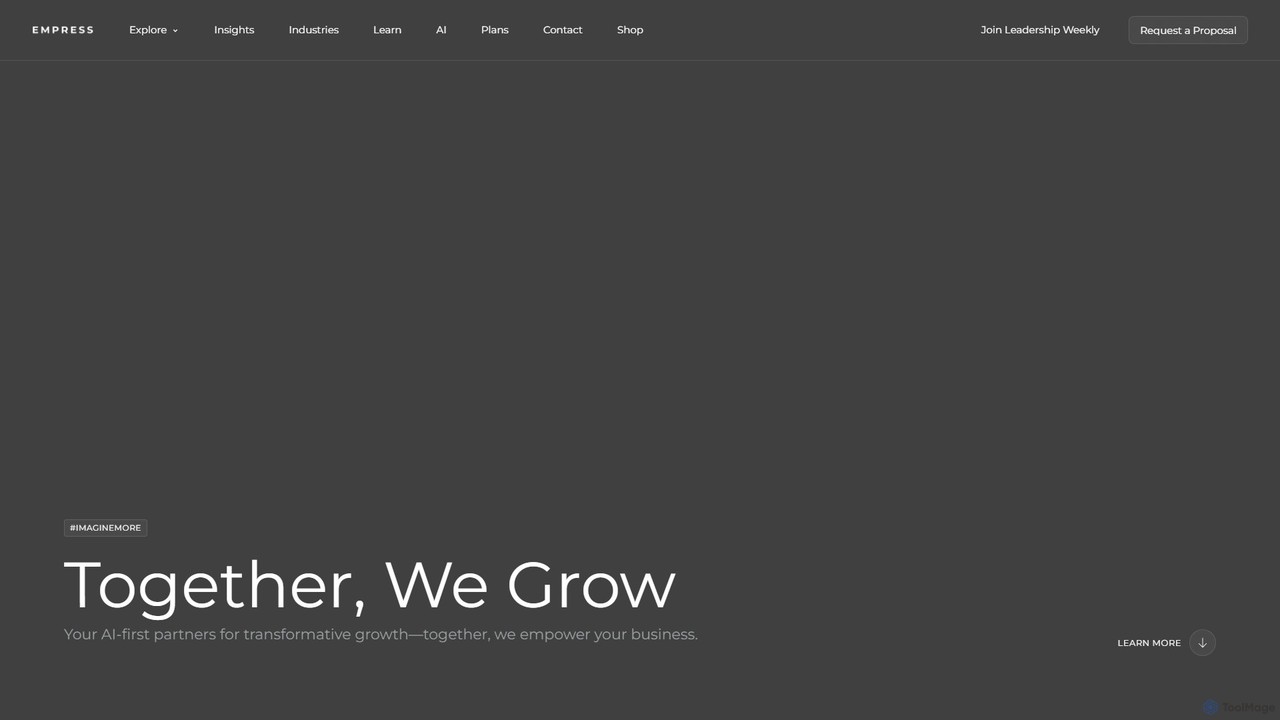
EMPRESS is an AI-driven managed service platform that orchestrates an ecosystem of specialized providers to accelerate business growth. It simplifies complexity by offering a unified strategy, streamlined management, and a central platform for real-time insights and performance tracking, empowering businesses to achieve transformative growth and strategic impact.

Management Consulting
Visits 6.6KFavorites 131Likes 112

About Management Consulting

AI Management Consulting tools are a specialized category of business software that leverages artificial intelligence to automate and enhance strategic analysis. These tools use machine learning to process vast datasets, identify market trends, and generate actionable insights traditionally provided by human consultants. They empower organizations to develop data-driven strategies, optimize operations, and gain a competitive edge with greater speed and accuracy. This approach makes high-level strategic analysis accessible to businesses of all sizes.

Core Features

  • Strategic Recommendation Engine: Analyzes internal and external data to suggest growth strategies, market positioning, and risk mitigation plans.
  • Automated Market Research: Gathers and synthesizes data on market size, customer segments, and industry trends automatically.
  • Competitive Intelligence Tracking: Monitors competitors' activities, product changes, and public sentiment in real-time.
  • Business Process Simulation: Creates digital models of operations to identify inefficiencies and test improvement scenarios.
  • Financial Forecasting & Modeling: Generates complex financial projections based on historical data and predictive analytics.

Use Cases

These tools are valuable for strategy departments in large corporations, startups seeking to validate business models, and investment firms conducting due diligence. They are applied in scenarios like new product launches, international expansion, operational restructuring, and M&A analysis, providing data-backed support for critical decisions.

How to Choose

When selecting a tool, consider the depth of its analytical capabilities and the data sources it integrates with. Evaluate its specialization—whether it focuses on market strategy, operational efficiency, or financial analysis. Also, assess the user interface's complexity and the quality of its automated reports and visualizations. Finally, review the pricing model to ensure it aligns with your budget.

Management Consulting use cases

1

Develop a Data-Driven Market Entry Strategy

A tech startup's strategy team uses an AI consulting tool to evaluate potential international markets. By inputting their product specifications, the tool analyzes market size, regulatory hurdles, competitive density, and consumer behavior data. It generates a ranked list of viable markets, provides a detailed SWOT analysis for the top three, and outlines a recommended go-to-market strategy. This process reduces weeks of manual research into a few hours, enabling faster, more informed decision-making.

2

Automate Competitive Intelligence Monitoring

A product manager at a consumer goods company uses an AI tool to continuously track key competitors. The platform automatically scans news, social media, and pricing data. It delivers a weekly synthesized report highlighting competitors' new feature launches, marketing campaign shifts, and changes in customer sentiment. This allows the manager to react proactively to market dynamics and adjust their product roadmap without dedicating a team to manual monitoring.

3

Optimize Operational Efficiency

An operations manager for a retail chain employs an AI consulting tool to identify inefficiencies. The tool integrates with their inventory, sales, and logistics systems. It runs simulations to model the impact of different inventory strategies and transportation routes. The AI identifies a key bottleneck in a regional distribution center and recommends a new inventory allocation model, projecting a 15% reduction in holding costs and a 10% improvement in delivery times.

4

Streamline M&A Target Due Diligence

A corporate development analyst uses an AI platform to accelerate the due diligence process for a potential acquisition. After uploading the target company's financial statements and contracts, the AI automatically flags contractual risks, identifies financial anomalies, and benchmarks the target's performance against industry peers. This automates the initial data review, allowing the analyst to focus on high-level strategic evaluation and negotiation.

5

Generate an Investor-Ready Business Plan

An entrepreneur with a new business idea uses an AI management consulting tool to create a professional business plan. They provide core information about their product and target market. The AI then conducts market research, generates a competitive analysis, and creates a 5-year financial projection. It structures all this information into a coherent, well-written business plan document, providing a robust foundation for pitching to investors.

6

Simulate Organizational Restructuring Scenarios

An HR director at a large enterprise uses an AI consulting tool to model different restructuring scenarios for a departmental merger. The tool analyzes current organizational charts, employee skill sets, and communication patterns. It predicts potential impacts on productivity, identifies skill gaps, and simulates the effect on employee morale. This data-driven approach helps leadership choose the least disruptive path for the reorganization.

Management Consulting FAQ

What are AI Management Consulting tools?

AI Management Consulting tools are software platforms that use artificial intelligence to perform tasks traditionally done by management consultants. They analyze complex business data to provide strategic insights, generate market research, model financial scenarios, and recommend operational improvements. Their goal is to make high-level strategic analysis more accessible, faster, and data-driven.

How do AI Management Consulting tools differ from standard business analytics (BI) tools?

The key difference lies in their purpose. Standard BI tools are primarily for visualizing and exploring data, helping users find their own insights. AI Management Consulting tools are more prescriptive; they not only analyze data but also interpret it to generate strategic recommendations, competitive analyses, and actionable plans, effectively acting as an automated strategist.

How to choose the right AI Management Consulting tool?

When selecting a tool, consider these factors:

  • Analytical Focus: Does the tool specialize in market strategy, financial modeling, or operational efficiency? Choose one that aligns with your primary need.
  • Data Integration: Check its ability to connect with your existing data sources (e.g., CRM, ERP).
  • Output Quality: Evaluate the clarity, depth, and customizability of the reports it generates.
  • Usability: Assess if the user interface is intuitive for your team or requires specialized skills.
Who can benefit from using AI Management Consulting tools?

A wide range of users can benefit. This includes corporate strategy teams looking to augment their analysis, startups and SMBs needing affordable strategic guidance, private equity and venture capital firms for due diligence, and individual entrepreneurs developing business plans. Essentially, any organization that needs to make complex, data-informed strategic decisions can find value in these tools.

What are the key functions of AI Management Consulting tools?

Core functions typically include automated market research, competitive intelligence analysis, financial forecasting and valuation, business process simulation, and the generation of strategic reports. They synthesize large volumes of structured and unstructured data to produce insights that guide executive decision-making, effectively democratizing access to high-level strategic analysis.