
ToolMage
Sign in

Best 1 Mentorship AI tools for Business

Popular Mentorship AI tools in Business include GrowthMentor, helping you work more efficiently.

GrowthMentor
Paid

GrowthMentor

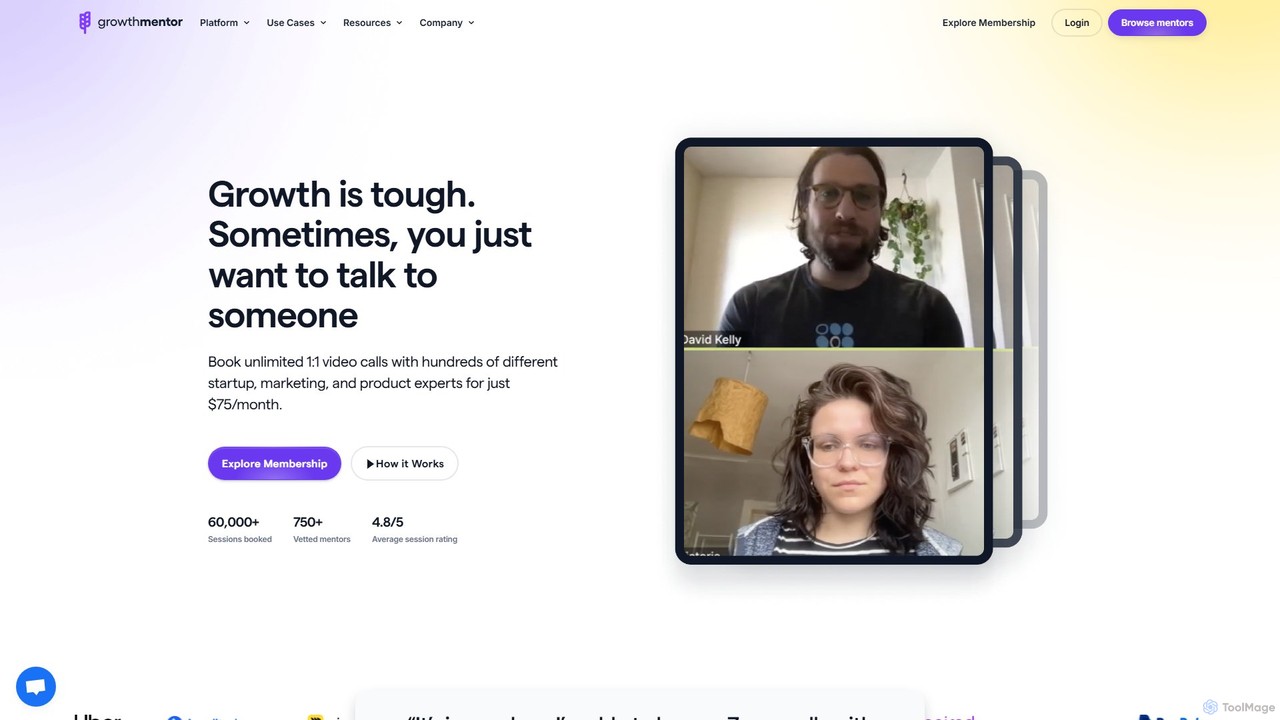
GrowthMentor is a mentorship platform connecting startup founders, marketers, and product professionals with over 750 vetted experts for 1:1 video calls. It offers personalized, actionable advice on challenges like growth, marketing, product development, and fundraising. Featuring an AI matching tool, a vibrant community, and affordable subscription plans, it provides real-world experience to help users get unstuck and accelerate their growth.

Mentorship
Visits 101.5KFavorites 124Likes 105

About Mentorship

AI-powered Mentorship tools are platforms that leverage artificial intelligence to facilitate, enhance, and personalize mentoring relationships. These tools utilize advanced algorithms to intelligently match mentors with mentees, provide structured guidance, and track developmental progress. They are designed to scale traditional mentorship programs, making professional and personal development more accessible and efficient for individuals and organizations within the business context.

Core Features

  • Intelligent Matching: AI algorithms precisely pair mentors and mentees based on skills, goals, experience, and personality.
  • Personalized Learning Paths: Tools suggest relevant resources, tasks, and discussion topics tailored to a mentee's specific development needs.
  • Progress Tracking & Analytics: Monitor mentee growth, mentor engagement, and program effectiveness with data-driven insights.
  • Automated Scheduling & Reminders: Streamline the logistics for mentoring sessions, follow-ups, and goal tracking.
  • Resource Curation: AI identifies and recommends articles, courses, and tools pertinent to established mentoring goals.

Applicable Scenarios

These tools are invaluable for corporate talent development programs, university alumni mentorship initiatives, and professional associations. They support individual career coaching, skill acquisition, and leadership development, enabling organizations to efficiently foster growth and knowledge transfer across various business functions.

How to Choose

When selecting an AI mentorship tool, evaluate the sophistication of its matching algorithm for precision and customization. Consider its personalization capabilities, such as adaptive content and guidance. Assess the depth of reporting and analytics for program management, and check for seamless integration with existing HR or learning management systems. User experience and support for both mentors and mentees are also crucial.

Mentorship use cases

1

Accelerating Onboarding for New Hires

HR managers in large organizations face the challenge of quickly integrating new hires into company culture and roles. AI mentorship tools automatically match new employees with experienced colleagues, providing structured onboarding plans, regular check-ins, and access to relevant company resources. This results in reduced time-to-productivity for new hires, increased retention rates, and improved overall employee satisfaction from the outset.

2

Fostering Leadership Development within Enterprises

Learning & Development (L&D) specialists aim to cultivate internal leadership talent for succession planning. AI mentorship platforms identify high-potential employees and pair them with senior leaders, offering tailored development modules, goal setting, and performance feedback loops. This creates a robust pipeline of future leaders, enhances management skills across the organization, and contributes to strategic talent retention.

3

Supporting Career Transitions and Skill Reskilling

Individuals seeking career changes or employees undergoing reskilling often need guidance to navigate new industries or acquire new competencies. AI mentorship platforms connect these individuals with mentors who possess expertise in their target fields, providing personalized roadmaps, skill assessments, and industry insights. This facilitates smoother career transitions, effective skill acquisition, and increased confidence in new professional roles.

4

Scaling University Alumni Mentoring Programs

University career services departments aim to leverage their alumni network to support current students' career readiness. AI mentorship tools efficiently match students with alumni mentors based on academic background, career interests, and industry, facilitating communication and tracking engagement. This leads to enhanced student employability, stronger alumni engagement, and a scalable program that doesn't require extensive manual coordination.

5

Empowering Entrepreneurs with Expert Guidance

Startup founders and small business owners often lack access to experienced advisors in specific business areas like strategy, fundraising, or marketing. AI mentorship platforms connect these entrepreneurs with seasoned experts or successful business leaders, offering tailored advice and insights to navigate challenges. This results in more informed decision-making, accelerated business growth, and the avoidance of common startup pitfalls, contributing to higher success rates.

6

Personalizing Professional Skill Development

Professionals and lifelong learners often seek to continuously improve specific skills, such as public speaking, data analysis, or project management. AI mentorship tools pair learners with mentors specialized in desired skills, providing structured practice exercises, feedback mechanisms, and curated learning resources. This enables targeted skill enhancement, measurable progress, and increased professional competence, tailored to individual career aspirations.

Mentorship FAQ

What are AI Mentorship Tools?

AI Mentorship tools are software platforms that utilize artificial intelligence to optimize and manage mentoring relationships. They automate mentor-mentee matching, personalize development paths, and track progress, making mentorship more accessible and effective. These tools aim to scale traditional mentorship programs by leveraging data-driven insights and intelligent recommendations for a more tailored experience.

How do AI Mentorship Tools differ from traditional mentorship programs?

AI mentorship tools differ from traditional programs primarily in their scalability, personalization, and data-driven approach. Traditional programs often rely on manual matching and less structured guidance, limiting their reach. AI tools use algorithms for precise matching, offer dynamic learning content, and provide analytics on program effectiveness, enabling broader reach and more tailored, measurable experiences without extensive administrative overhead.

What are the key benefits of using AI for mentorship?

The key benefits of using AI for mentorship include enhanced matching accuracy, leading to more compatible and productive relationships. AI tools also enable greater scalability, allowing organizations to support more mentees without proportional increases in administrative effort. Furthermore, they offer personalized learning experiences, data-driven insights into program effectiveness, and streamlined administrative tasks like scheduling and resource sharing, ultimately boosting engagement and outcomes.

Who can benefit most from AI Mentorship Tools?

AI Mentorship tools benefit a wide range of users. Organizations, particularly large enterprises, can scale their talent development and onboarding programs efficiently. Educational institutions can connect students with alumni more effectively for career guidance. Individuals seeking career growth, skill development, or career transitions also benefit significantly from personalized guidance and access to a broader, intelligently matched network of mentors.

What should I look for when choosing an AI Mentorship platform?

When choosing an AI mentorship platform, consider the sophistication of its matching algorithms to ensure relevant pairings. Evaluate its personalization features, such as adaptive learning paths and resource recommendations. Look for robust analytics and reporting capabilities to measure program impact. Also, assess ease of integration with existing HR or learning systems, the overall user experience for both mentors and mentees, and the level of customer support provided.