TanyaPDF
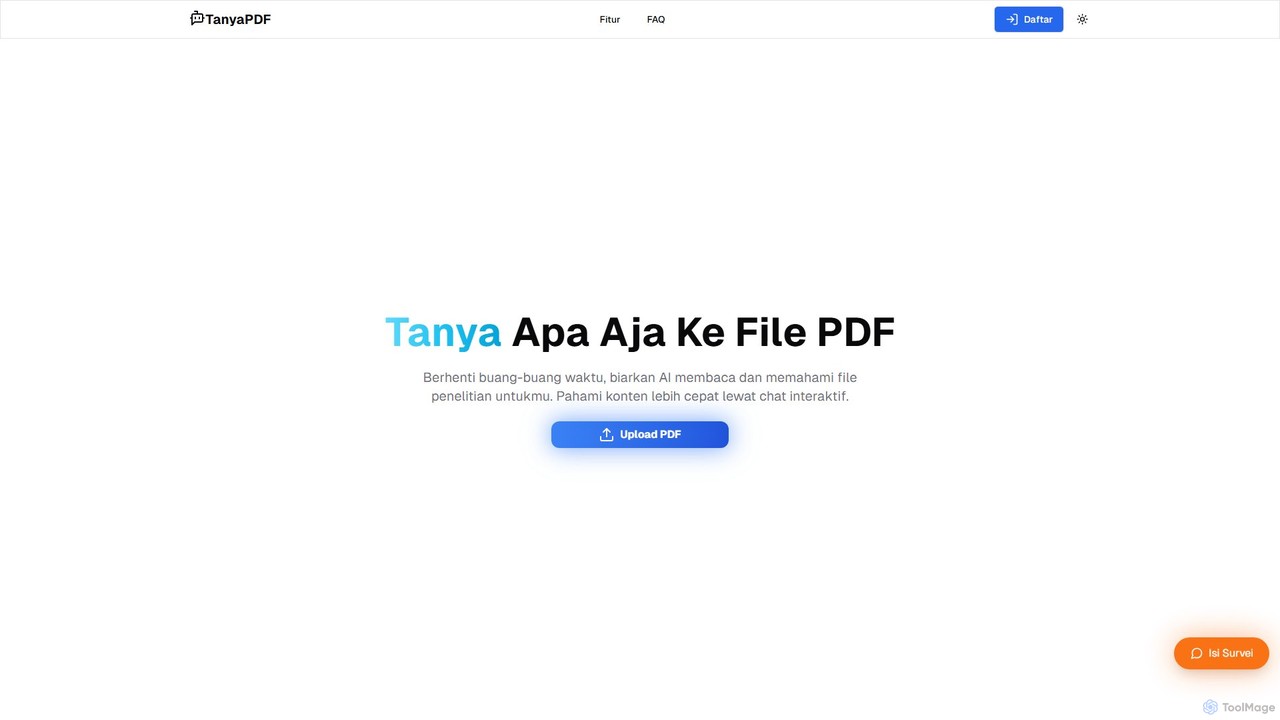
An AI-powered tool that allows you to chat with your PDF documents. Upload a file, ask questions in …
An AI-powered tool that allows you to chat with your PDF documents. Upload a file, ask questions in natural language, and get instant summaries and answers. Designed for students, researchers, and professionals to understand complex documents faster and more efficiently.
About Report Analysis
Report Analysis tools are AI-powered applications designed to automatically extract, summarize, and interpret key information from complex documents. Leveraging Natural Language Processing (NLP) and machine learning, these tools comprehend text, tables, and charts within various report formats. This enables users to quickly grasp critical insights, identify trends, and make data-driven decisions without exhaustive manual reading. They are particularly effective for processing large volumes of documents like financial statements, market research, and scientific papers.
Core Features
- Automated Data Extraction: Accurately pulls specific data points, figures, and tables from diverse report formats like PDF and DOCX.
- Intelligent Summarization: Generates concise, context-aware summaries of long documents, highlighting key findings and conclusions.
- Semantic Search & Q&A: Allows users to ask complex questions in natural language and receive direct, context-based answers from the document content.
- Trend and Anomaly Detection: Analyzes data across single or multiple reports to identify recurring themes, emerging trends, and unusual patterns.
- Cross-Document Comparison: Compares information from several reports simultaneously to synthesize insights and identify inconsistencies.
Use Cases
These tools are invaluable for financial analysts reviewing quarterly earnings reports, market researchers synthesizing competitor analysis, and academics conducting literature reviews. They streamline workflows in sectors such as finance, consulting, legal, and scientific research by automating the intensive process of information discovery.
How to Choose
When selecting a Report Analysis tool, consider its document format compatibility (PDF, DOCX, HTML), the accuracy of its data extraction and NLP models, and its integration capabilities with other business systems. Also, evaluate the user interface for ease of querying, the ability to handle industry-specific terminology, and the security protocols for sensitive documents.

Report AnalysisUse Cases
Automating Financial Due Diligence
An investment analyst performing due diligence for a potential acquisition uploads hundreds of financial statements and annual reports into the tool. Instead of manually searching each PDF, they use natural language queries like 'What was the year-over-year revenue growth for the last three years?' or 'List all mentions of outstanding litigation'. The AI extracts the precise data, compares figures across documents, and flags potential risks mentioned in the footnotes. This reduces the analysis time from weeks to a few days, minimizes human error, and allows the analyst to focus on strategic interpretation rather than data collection.
Accelerating Market Research Synthesis
A market research team needs to produce a competitive landscape report. They feed dozens of industry reports, competitor press releases, and market surveys into an AI analysis tool. The tool automatically identifies key market trends, extracts mentions of competitor product launches, and performs sentiment analysis on customer feedback sections. It generates a consolidated summary with key statistics and themes, allowing the team to draft their comprehensive report in half the time. This enables faster delivery of strategic insights to stakeholders for timely decision-making.
Streamlining Scientific Literature Reviews
An academic researcher preparing a meta-analysis needs to review hundreds of scientific papers. They use a report analysis tool to process a large corpus of research articles. The tool helps identify papers with specific methodologies, extracts key findings and reported p-values, and summarizes the conclusions of each study. It can also visualize connections between papers based on citations. This transforms a months-long manual process into a more manageable task, helping the researcher to identify relevant studies and synthesize evidence more efficiently and accurately.
Enhancing Legal Contract Review
A corporate legal team is tasked with reviewing a 150-page service agreement from a new vendor. Instead of reading it line-by-line, a paralegal uploads it to an AI analysis tool. The tool is pre-trained on legal documents and quickly identifies non-standard clauses, extracts key obligations and deadlines, and flags any language that deviates from the company's standard templates. The paralegal can then focus their detailed review on these flagged sections, ensuring a thorough and compliant review process in a fraction of the time, reducing risk and accelerating procurement.
Monitoring Competitor Intelligence Reports
A competitive intelligence manager sets up an AI tool to automatically ingest quarterly earnings reports and press releases from key competitors. The tool analyzes each new document as it becomes available, summarizing key financial metrics, extracting executive commentary on strategy, and identifying any new product or market expansion announcements. The manager receives a daily digest of these synthesized insights, allowing them to maintain a real-time pulse on the competitive landscape and provide timely updates to their executive team without manually sifting through dozens of documents.
Auditing Compliance and Risk Reports
An internal auditor uses a report analysis tool to review hundreds of pages of internal control reports and regulatory filings. They can quickly search for keywords related to non-compliance, such as 'control weakness' or 'material deficiency'. The tool can also cross-reference findings across multiple reports to identify systemic issues that might be missed in a manual, siloed review. This enhances the thoroughness and efficiency of the audit process, ensuring better risk identification and allowing auditors to focus on investigating and resolving the most critical issues.