ToolMage
Sign in

Best 2 Revenue Cycle Management AI tools for Business

Popular Revenue Cycle Management AI tools in Business include Athelas and Medicodio, helping you work more efficiently.

Athelas
Paid

Athelas

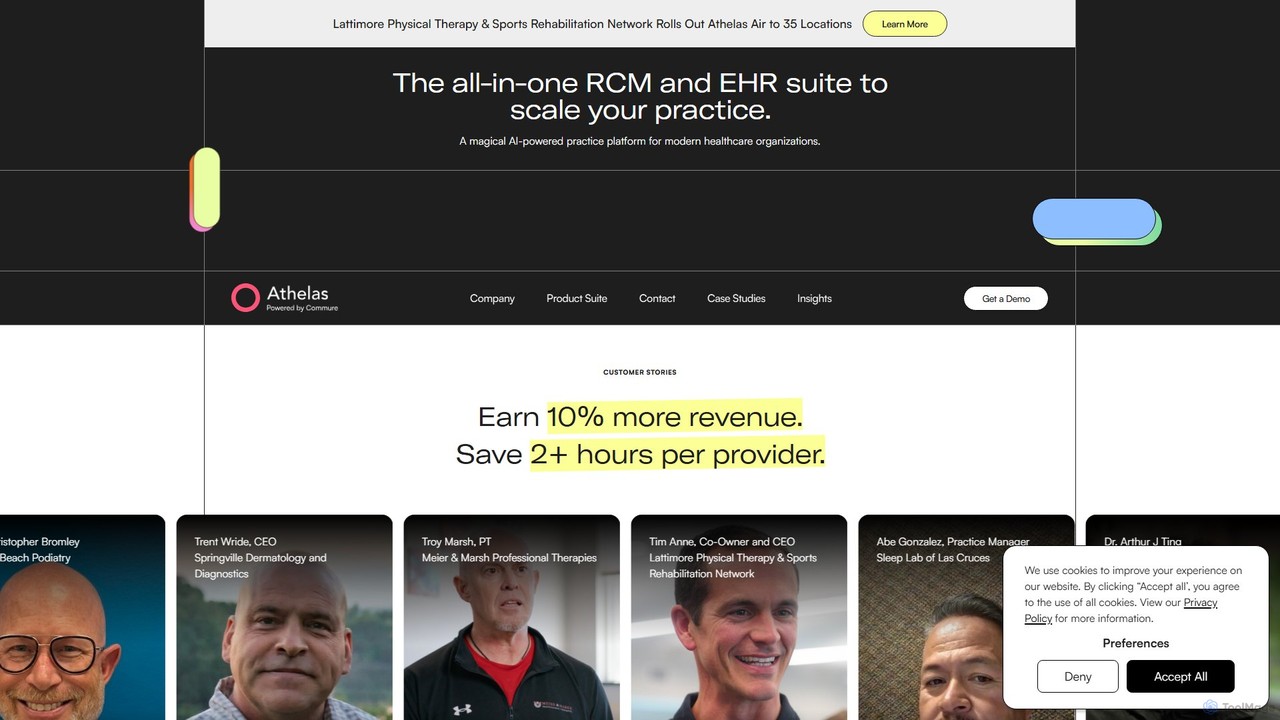
Athelas is an AI-powered platform designed to streamline healthcare operations. It combines an all-in-one Revenue Cycle Management (RCM) and Electronic Health Record (EHR) suite with advanced tools like an Ambient AI Scribe, autonomous coding, and an AI receptionist. The platform helps medical practices increase revenue, save clinician time, reduce administrative burdens, and improve patient care by automating documentation, billing, and scheduling.

Revenue Cycle Management
Visits 298.5KFavorites 140Likes 127
Medicodio

Medicodio

Medicodio is an AI-powered medical coding assistant designed to enhance revenue cycle management. It utilizes advanced AI, ML, and NLP to analyze patient records, suggest accurate medical codes, and accelerate the coding process. By combining automation with expert human verification, Medicodio increases coding accuracy by up to 85% and speed by 45%, significantly reducing claim denials and coder burnout.

Revenue Cycle Management
Visits 7.8KFavorites 154Likes 151

About Revenue Cycle Management

Revenue Cycle Management (RCM) AI tools are specialized platforms that leverage artificial intelligence to automate and optimize financial processes within organizations, primarily in healthcare. These tools utilize machine learning and predictive analytics to streamline workflows from patient registration to final payment, enhancing efficiency and accuracy. They are crucial for reducing operational costs, minimizing claim denials, and accelerating cash flow for healthcare providers and billing companies.

Core Features

  • Automated Eligibility Verification: Instantly checks patient insurance coverage and benefits, reducing manual effort.
  • Intelligent Claims Scrubbing: Identifies and corrects potential errors in claims before submission, improving first-pass resolution rates.
  • Predictive Denial Management: Analyzes historical data to predict and prevent claim denials, optimizing revenue recovery.
  • AI-driven Patient Billing: Personalizes billing statements and follow-up communications to improve collection rates.
  • Fraud Detection: Flags suspicious patterns and anomalies in claims to prevent fraudulent activities.

Applicable Scenarios

Healthcare providers (hospitals, clinics), medical billing companies, and insurance payers utilize RCM AI tools to manage patient financial journeys. They are applied in front-office operations for patient intake, mid-cycle for coding and claims submission, and back-office for denial management and collections.

How to Choose

When selecting an RCM AI tool, consider its integration capabilities with existing EHR/PMS systems, compliance with healthcare regulations (e.g., HIPAA), accuracy of predictions and automation, scalability to handle varying claim volumes, and comprehensive reporting features for performance insights.

Revenue Cycle Management use cases

1

Automating Insurance Eligibility Checks

Healthcare administrative staff use AI-powered RCM tools to instantly verify patient insurance eligibility and benefits before appointments. By integrating with payer systems, these tools automatically retrieve real-time coverage details, reducing manual phone calls and data entry. This prevents claim rejections due to invalid or expired coverage, ensuring accurate billing from the outset and improving front-office efficiency.

2

Predictive Claims Denial Management

Billing departments leverage RCM AI to analyze vast amounts of historical claims data, identifying patterns and common reasons for denials. The AI then proactively flags potential issues in new claims before submission, suggesting corrections or additional documentation. This predictive capability significantly improves first-pass resolution rates, reduces rework, and accelerates revenue collection by minimizing costly and time-consuming appeals.

3

Optimizing Patient Payment Collections

AI RCM tools personalize patient billing and collection strategies. By analyzing patient demographics, payment history, and communication preferences, the AI determines the optimal timing, channel (email, SMS, portal), and messaging for payment reminders and statements. This tailored approach improves patient engagement, increases self-pay collection rates, and reduces the need for costly manual follow-ups, enhancing both revenue and patient satisfaction.

4

Intelligent Medical Coding Assistance

Medical coders utilize AI RCM tools to enhance the accuracy and efficiency of coding. The AI analyzes clinical documentation, patient records, and physician notes to suggest appropriate CPT, ICD-10, and HCPCS codes. This not only reduces human error and the risk of compliance issues but also accelerates the coding process, ensuring claims are submitted with the correct codes for maximum reimbursement and fewer denials.

5

Fraud Detection in Claims Processing

Insurance companies and billing auditors deploy AI RCM solutions to detect and prevent fraudulent claims. The AI algorithms analyze vast datasets of claims, identifying unusual patterns, anomalies, and statistical outliers that may indicate fraudulent activity. This proactive detection helps prevent financial losses, ensures compliance, and maintains the integrity of the billing and reimbursement ecosystem by flagging suspicious submissions for human review.

6

Streamlining Accounts Receivable Follow-up

AI RCM tools automate and prioritize the follow-up process for outstanding accounts receivable. The AI analyzes factors like claim age, payer response patterns, and expected reimbursement to identify high-value or easily resolvable claims. This allows human staff to focus on complex cases requiring negotiation or detailed investigation, significantly improving the efficiency of AR management and accelerating cash conversion cycles for healthcare organizations.

Revenue Cycle Management FAQ

What are Revenue Cycle Management (RCM) AI tools?

Revenue Cycle Management (RCM) AI tools are software solutions that use artificial intelligence, machine learning, and predictive analytics to automate and optimize financial processes in healthcare. They manage the entire patient financial journey, from appointment scheduling and insurance verification to claims submission, denial management, and final payment collection. Their core purpose is to enhance efficiency, reduce costs, and maximize revenue for healthcare providers.

How do AI RCM tools differ from traditional RCM systems?

Traditional RCM systems are often rule-based and require significant manual intervention for tasks like claims scrubbing, eligibility verification, and denial appeals. AI RCM tools, however, leverage machine learning to learn from data, predict outcomes, and automate complex decision-making. This allows for proactive identification of issues, personalized patient engagement, and continuous process improvement, leading to higher accuracy, faster processing, and superior financial outcomes compared to conventional methods.

What are the main benefits of implementing AI in RCM?

Implementing AI in RCM offers several key benefits. It significantly improves claims accuracy, leading to higher first-pass resolution rates and faster reimbursements. Automation reduces administrative burden and operational costs, freeing up staff for more complex tasks. Predictive analytics minimize denials and optimize collections, boosting overall revenue. Furthermore, AI enhances compliance, reduces fraud, and improves the patient financial experience through personalized communication, contributing to better financial health for healthcare organizations.

What features should I look for in an AI RCM solution?

When selecting an AI RCM solution, prioritize features such as robust integration capabilities with your existing EHR/PMS. Look for advanced analytics for predictive denial management and revenue forecasting. Automated eligibility verification, intelligent claims scrubbing, and AI-driven coding assistance are crucial for efficiency. Strong patient engagement tools, including personalized billing and payment portals, are also vital. Ensure the solution offers comprehensive reporting, compliance with healthcare regulations, and scalability to meet future demands.

Who benefits most from AI Revenue Cycle Management tools?

Healthcare organizations of all sizes, from large hospital systems to small private practices, benefit significantly from AI RCM tools. Medical billing companies can enhance their service offerings and efficiency. Insurance payers also gain from improved fraud detection and streamlined claims processing. Essentially, any entity involved in the financial aspects of healthcare delivery and reimbursement can leverage AI RCM to optimize operations, reduce costs, and improve financial performance.