
ToolMage
Sign in

Best 1 Startup Discovery AI tools for Business

Popular Startup Discovery AI tools in Business include StartupSpotlight, helping you work more efficiently.

StartupSpotlight
Freemium

StartupSpotlight

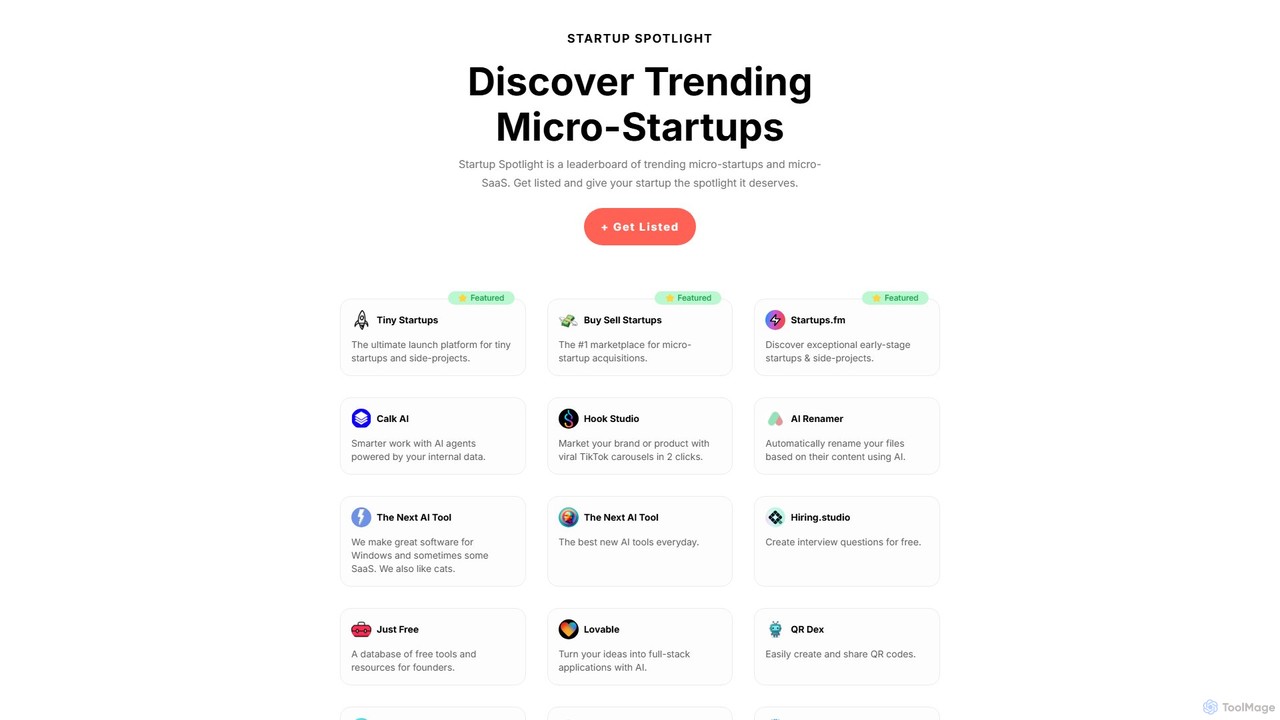
StartupSpotlight is a premier discovery platform dedicated to showcasing trending micro-startups and micro-SaaS products. It serves as a curated directory and launchpad for indie hackers and entrepreneurs, helping them gain visibility and attract early adopters. For tech enthusiasts and investors, it's a go-to resource for finding innovative new tools, side projects, and potential acquisition opportunities in the vibrant startup ecosystem.

Startup Discovery
Visits 5.6KFavorites 147Likes 149

About Startup Discovery

Startup Discovery tools are AI-powered platforms designed to identify, track, and analyze emerging companies and market trends. They utilize machine learning to process vast datasets from sources like funding announcements, patent filings, news, and hiring data. This enables users to uncover high-potential startups, monitor competitive landscapes, and spot investment opportunities with data-driven insights. Unlike traditional databases, these tools offer predictive analytics and real-time signals to forecast growth and identify breakout companies early.

Core Features

  • Predictive Analytics: Employs algorithms to forecast a startup's potential for success, funding likelihood, or future growth trajectory.
  • Real-time Signal Tracking: Monitors diverse data sources for early indicators of momentum, such as key hires, web traffic spikes, or positive media mentions.
  • Market Trend Analysis: Aggregates data to identify emerging technologies, investment patterns, and burgeoning industry sectors.
  • Lookalike Company Discovery: Finds startups with similar characteristics to a specified company for market mapping or competitive analysis.
  • Data Enrichment: Automatically consolidates and enhances startup profiles with comprehensive data from multiple public and private sources.

Use Cases

These tools are primarily used by venture capitalists and angel investors for deal sourcing, corporate development teams for M&A target identification, and market analysts for competitive intelligence. Sales and business development professionals also use them to find high-growth companies to target as potential customers.

How to Choose

When selecting a Startup Discovery tool, consider the breadth and quality of its data sources (global vs. regional), the sophistication of its predictive models, and its integration capabilities with other platforms like CRMs. Also evaluate the user interface for ease of filtering and analysis, as well as the pricing model based on your team's size and data needs.

Startup Discovery use cases

1

Venture Capital Deal Sourcing

An analyst at a venture capital firm uses a Startup Discovery tool to identify early-stage investment opportunities in the fintech sector. They set up alerts for companies that have recently raised a pre-seed round, have founders with previous exit experience, and show a month-over-month web traffic growth of over 20%. The platform automatically surfaces a curated list of five promising startups, allowing the analyst to bypass hours of manual research on news sites and databases, and focus directly on outreach and due diligence.

2

Corporate M&A Target Identification

A corporate development manager at a large enterprise needs to find potential acquisition targets to expand their AI capabilities. Using a discovery platform, they filter for private companies in the machine learning space with 50-100 employees, specific patent filings related to natural language processing, and key technical talent from top universities. The tool generates a shortlist of 15 companies, complete with enriched data on their technology stack and leadership team, significantly accelerating the initial screening process for M&A.

3

Sales Prospecting for High-Growth Accounts

A sales team at a SaaS company targets fast-growing tech startups as ideal customers. They use a Startup Discovery tool to build a list of companies that have recently received Series A funding and are actively hiring for sales or marketing roles. These signals indicate that the startups have budget and are scaling their commercial operations, making them prime prospects for the SaaS product. The tool integrates with their CRM, automatically creating new leads and saving the sales team significant prospecting time.

4

Market Research and Trend Spotting

A market research analyst is tasked with identifying emerging trends in the sustainable technology sector. They use a Startup Discovery tool to analyze investment flows, patent activity, and hiring patterns over the last 24 months. The platform generates visualizations showing that 'carbon capture' and 'alternative proteins' are the two sub-sectors receiving the most significant increase in funding and talent acquisition. This data-driven insight forms the core of their industry report, providing clients with a clear view of where the market is heading.

5

Recruitment and Talent Sourcing

A technical recruiter specializing in AI talent needs to find senior machine learning engineers. Traditional job boards are saturated. Instead, they use a Startup Discovery tool to identify startups that recently secured significant funding but have not yet announced a major hiring push. This allows the recruiter to proactively reach out to talented engineers at these companies who might soon be looking for new challenges or leadership roles as their companies scale, giving them a competitive edge in sourcing top-tier candidates.

6

Academic Research on Innovation Ecosystems

A university researcher is studying the diffusion of quantum computing technology from labs to commercial ventures. They use a Startup Discovery platform to track the emergence of new companies in this niche, map the professional backgrounds of their founding teams (e.g., affiliations with specific universities or research labs), and analyze their funding sources. The tool provides structured, longitudinal data that would be extremely difficult to compile manually, enabling a robust quantitative analysis of how innovation ecosystems form and evolve over time.

Startup Discovery FAQ

What are AI Startup Discovery tools?

AI Startup Discovery tools are specialized software platforms that use artificial intelligence to identify, analyze, and track emerging startup companies. They go beyond simple directories by processing vast amounts of unstructured data (like news, job postings, and patent filings) to provide predictive insights, identify growth signals, and map market trends. Their primary goal is to help investors, corporations, and researchers find promising companies before they become widely known.

How do I choose the right Startup Discovery platform?

Choosing the right platform depends on your specific needs. Consider these key factors:

  • Data Coverage: Does the platform cover the geographic regions, industries, and company stages you are interested in?
  • Analytical Features: Do you need basic search and filtering, or advanced predictive analytics and trend analysis?
  • Data Freshness: How frequently is the data updated? Real-time or near real-time updates are crucial for timely opportunities.
  • Integrations: Can it integrate with your existing workflow tools, such as a CRM or communication platforms like Slack?
  • User Interface: Is the platform intuitive and easy to use for your team, allowing for complex queries without extensive training?
What's the difference between a Startup Discovery tool and a traditional business directory?

The key difference lies in their core function and technology. A traditional business directory (like Crunchbase or PitchBook in their basic forms) acts as a static database of factual information that is often manually curated. A Startup Discovery tool is a dynamic, AI-powered platform. It not only aggregates factual data but also analyzes real-time signals (like hiring trends and web traffic) to provide predictive insights and identify momentum, helping users discover opportunities proactively rather than reactively.

What key data points do these tools track?

Startup Discovery tools track a wide array of data points to build a comprehensive profile and generate insights. Common data points include:

  • Funding Information: Investment rounds, amounts, dates, and investors.
  • Firmographics: Company size, location, founding date, and industry classification.
  • People Data: Founder backgrounds, key executive hires, and employee growth rates.
  • Technology Signals: Tech stack used, patent filings, and open-source contributions.
  • Growth Indicators: Web traffic changes, social media engagement, app downloads, and media mentions.
Who are the primary users of Startup Discovery tools?

The primary users are professionals who need to stay ahead of market trends and identify emerging opportunities. This includes:

  • Venture Capitalists & Angel Investors: For sourcing new investment deals and tracking portfolio companies' competitors.
  • Corporate Development & M&A Teams: To identify potential acquisition targets, partners, or disruptive threats.
  • Market Researchers & Analysts: For gathering data on industry trends, competitive landscapes, and innovation patterns.
  • Sales & Business Development Professionals: To find and qualify high-growth companies as potential customers.