
Business Best in category 1 results Startup Validation AI Tool

Popular AI tools in the Startup Validation field of Business include CraftiqueAI, etc., helping you quickly improve efficiency.

CraftiqueAI

CraftiqueAI

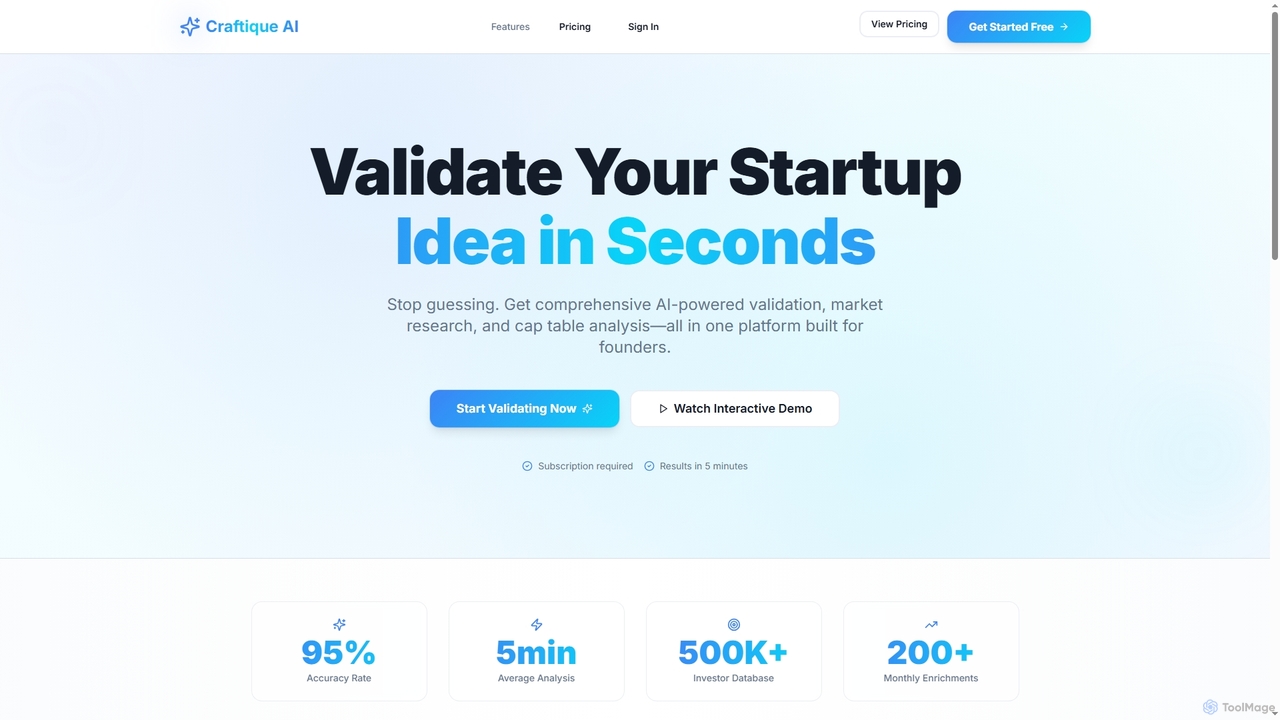
CraftiqueAI is an AI-powered platform designed for founders to validate startup ideas, conduct comprehensive market research, and perform …

2.8K

About Startup Validation

Startup Validation tools are AI-powered platforms designed to help entrepreneurs and businesses test and refine new ideas, products, or services before significant investment. These tools leverage data analysis, user feedback, and rapid prototyping to validate market demand and reduce risk. They enable quick iteration and informed decision-making, ensuring a stronger product-market fit within the broader business development lifecycle.

Core Features

  • Market Research & Analysis: Identify target audiences, market size, and emerging trends to inform product development.
  • MVP & Landing Page Builders: Quickly create minimum viable products or dedicated landing pages to test demand and gather initial interest.
  • Survey & Feedback Collection: Design and distribute surveys, conduct interviews, and collect qualitative/quantitative data from potential users.
  • A/B Testing Capabilities: Compare different versions of product features, messaging, or pricing to identify optimal strategies.
  • Competitor Analysis: Analyze existing solutions and market players to identify unique selling propositions and market gaps.

Applicable Scenarios

Entrepreneurs use these tools to de-risk new ventures by testing core assumptions. Product managers validate new features or product lines before committing development resources. Small businesses explore new market segments or refine their service offerings based on real user feedback.

How to Choose

When selecting a Startup Validation tool, consider its support for various validation methodologies (e.g., surveys, A/B tests, user interviews). Evaluate the ease of use and speed of setting up experiments, as rapid iteration is key. Assess its integration capabilities with other marketing and analytics platforms, and ensure it provides clear, actionable reporting and insights.

Startup ValidationUse Cases

1

Validating a New SaaS Feature Idea

A product manager for a SaaS company wants to gauge interest in a potential new feature before committing significant development resources. They use a startup validation tool to create a mock-up or a simple landing page describing the feature, then run targeted A/B tests with existing users or a specific audience segment. By analyzing click-through rates, survey responses, and sign-up intentions, they can determine if the feature has sufficient demand and refine its value proposition, saving months of unnecessary development work.

2

Testing a Mobile App Concept's Market Fit

An aspiring entrepreneur has an innovative idea for a mobile app but needs to validate its market fit before investing in full development. They utilize a validation tool to create a clickable prototype or a series of wireframes, then conduct user interviews and surveys with a target demographic. The tool helps them gather feedback on usability, desired features, and pricing expectations, allowing them to refine the app's core functionality and design based on real user insights, significantly reducing the risk of building an unwanted product.

3

Market Research for a Niche Product Launch

A small business plans to launch a highly specialized niche product and needs to understand its potential customer base and optimal pricing strategy. They deploy a startup validation tool to conduct targeted surveys and focus groups within specific online communities. The tool's analytics help them identify key demographics, pain points, and willingness to pay, enabling them to tailor their product messaging and pricing to resonate effectively with their niche market, ensuring a more successful launch.

4

Optimizing E-commerce Product Page Conversions

An e-commerce manager wants to improve the conversion rate of a specific product page. They use a startup validation tool to conduct A/B tests on different elements of the page, such as headline variations, call-to-action button colors, product image layouts, or testimonial placements. By systematically testing these variations and analyzing the resulting conversion data, they can identify which elements drive more sales, leading to data-backed optimizations that directly impact revenue without guesswork.

5

Gathering Feedback on a Beta Product

A startup has developed a beta version of their product and needs to collect comprehensive feedback from early adopters to refine it before a public launch. They leverage a validation tool to distribute targeted surveys, conduct in-app feedback prompts, and facilitate user interviews. The tool helps them categorize feedback, identify critical bugs, understand user pain points, and prioritize feature enhancements, ensuring the final product addresses real user needs and offers a superior experience, accelerating time to market with a polished offering.

6

Assessing Demand for a New Subscription Service

A content creator or entrepreneur plans to launch a new subscription-based service (e.g., premium newsletter, exclusive content platform) and needs to validate its value proposition and pricing tiers. They use a validation tool to create a simple sign-up page outlining the benefits and different subscription options. By tracking early interest, pre-registrations, and conducting surveys on perceived value, they can fine-tune their offering and pricing model to maximize subscriber acquisition and retention, ensuring the service is viable before a full rollout.

Startup ValidationFrequently Asked Questions