Business Best in category 1 results Tool Discovery AI Tool

Popular AI tools in the Tool Discovery field of Business include mavtools, etc., helping you quickly improve efficiency.

Free
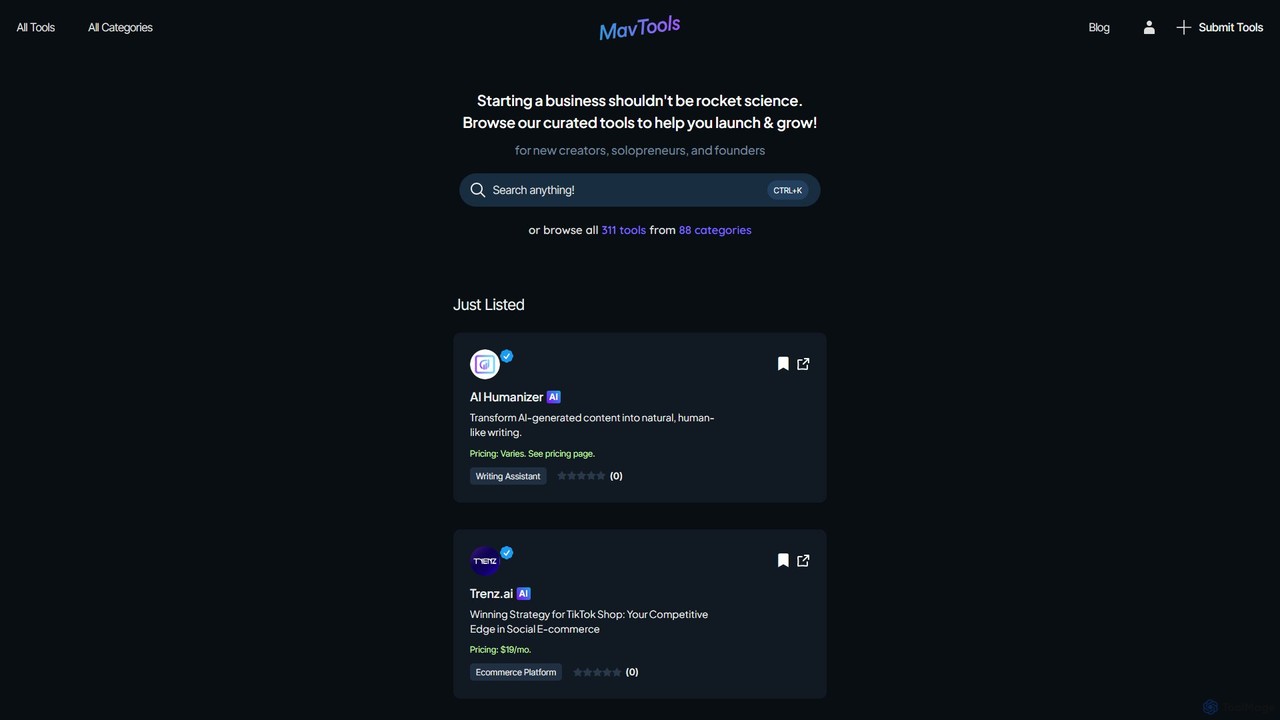
mavtools

mavtools

A curated directory of battle-tested SaaS, applications, and AI tools designed for new creators, solopreneurs, and founders. It …

24.3K

About Tool Discovery

Tool Discovery platforms are specialized search engines and directories designed to help users find, compare, and select the right software and AI tools. These platforms utilize curated databases and intelligent filtering systems to categorize tools by function, industry, and pricing. They streamline the complex process of technology procurement, saving businesses significant time and reducing the risk of choosing unsuitable software. This provides a structured alternative to general web searches, offering verified information and side-by-side comparisons.

Core Features

  • Curated Tool Database: Access a comprehensive, categorized library of software and AI tools with verified details.
  • Advanced Search & Filtering: Use specific criteria like features, pricing models, and integrations to narrow down options quickly.
  • AI-Powered Recommendations: Receive personalized tool suggestions based on your industry, business size, and project requirements.
  • Side-by-Side Comparison: Directly compare features, pricing, and user ratings of multiple tools on a single interface.
  • User Reviews & Ratings: Leverage community feedback and expert reviews to gauge a tool's real-world performance.

Use Cases

These platforms are valuable for business leaders, IT managers, and department heads tasked with technology acquisition. Startups use them to build their initial tech stack, while established companies rely on them to find modern alternatives to legacy systems. Marketing, sales, and operations teams also use them to find niche solutions that integrate with their existing workflows.

How to Choose

When selecting a tool discovery platform, consider the breadth and depth of its database—does it cover your industry's niche tools? Evaluate the sophistication of its search and filtering capabilities. Check for the quality and recency of user reviews. Finally, assess the user interface and whether it provides clear, unbiased comparison charts to facilitate decision-making.

Tool DiscoveryUse Cases

1

Building a Startup's Initial Tech Stack

A startup founder needs to select essential tools for marketing, sales, and project management on a tight budget. Instead of spending weeks on Google searches, they use a tool discovery platform. They filter by 'Free Tier,' 'For Startups,' and specific integrations like Slack. The platform provides a shortlist of vetted options for each category with side-by-side price and feature comparisons, enabling the founder to build a cost-effective and integrated tech stack in days instead of weeks.

2

Finding a New Marketing Automation Tool

A marketing manager needs to replace their current email software with a more advanced automation platform. Their key requirements are advanced segmentation, A/B testing, and a native Shopify integration. Using a tool discovery service, they input these specific features. The AI recommendation engine suggests three top-rated platforms that meet all criteria, simplifying the evaluation process and helping them schedule demos with the most relevant vendors.

3

Evaluating CRM Software Alternatives

An IT department is tasked with finding a more modern and scalable CRM to replace their outdated system. The team uses a discovery platform to identify top cloud-based CRMs that cater to B2B sales teams. They use the comparison feature to analyze security compliance (e.g., GDPR, SOC 2), API capabilities, and pricing per user. This structured data allows them to create a detailed report for stakeholders, justifying their final recommendation based on objective criteria.

4

Conducting Competitive Market Research

A product manager is developing a new project management app and needs to understand the competitive landscape. They use a tool discovery platform to identify all major and emerging competitors in the space. They analyze feature sets, pricing strategies, and target audiences listed on the platform. This provides a comprehensive overview of market saturation and helps identify potential feature gaps their new product could fill, directly informing the product roadmap.

5

Recommending Software for Clients

A freelance business consultant works with various small businesses, each with unique needs. To provide tailored recommendations, the consultant uses a tool discovery platform as their primary research resource. For a client in the restaurant industry, they can quickly find POS systems with integrated inventory management. For a creative agency, they can find digital asset management tools. This enhances their value by providing fast, data-driven, and unbiased software advice.

6

Streamlining Enterprise Software Procurement

A procurement officer at a large enterprise needs to source a new enterprise resource planning (ERP) system. They leverage a discovery platform's enterprise-focused filters to find vendors with proven track records and specific industry modules. The platform centralizes initial vendor information, saving dozens of hours in preliminary research and allowing the team to focus on in-depth evaluations and negotiations with a pre-vetted shortlist of candidates.

Tool DiscoveryFrequently Asked Questions