
Middesk
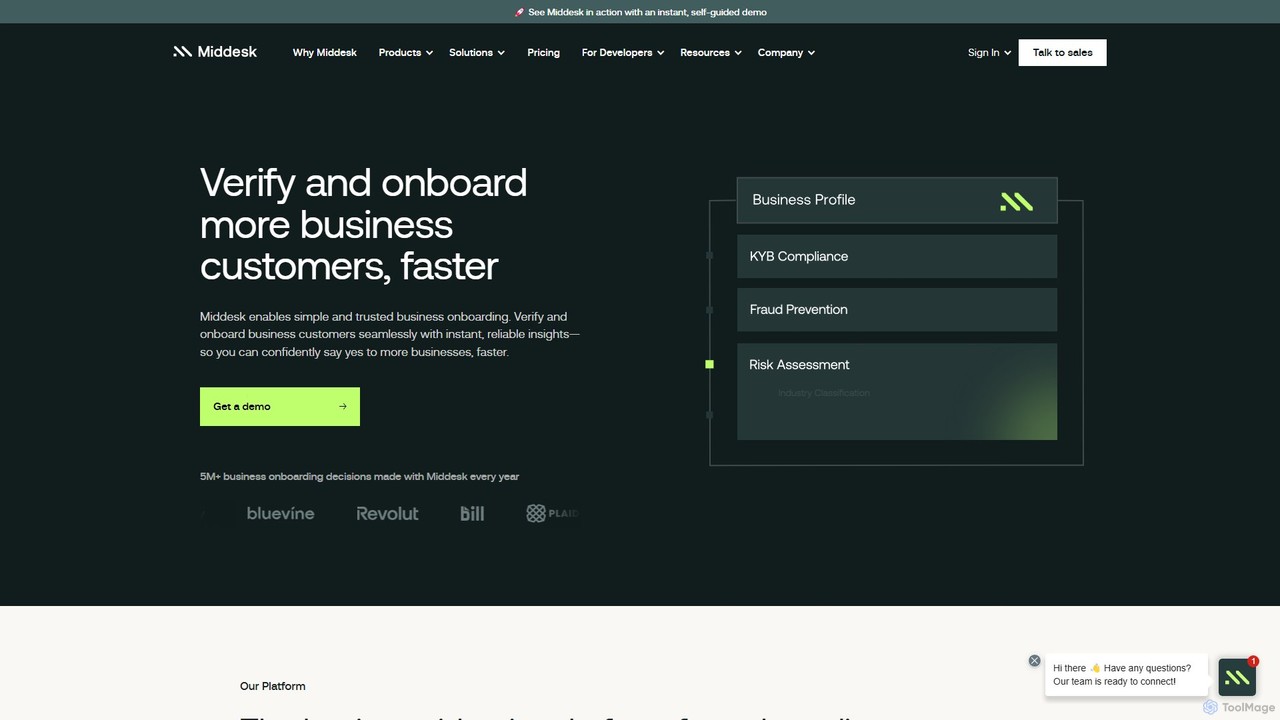
Middesk is a leading business identity platform that automates KYB/KYC compliance, risk assessment, and underwriting. It enables businesses …
Middesk is a leading business identity platform that automates KYB/KYC compliance, risk assessment, and underwriting. It enables businesses to seamlessly verify and onboard commercial customers using direct, real-time data from government sources, reducing fraud and accelerating growth.
About Verification
AI Verification tools are a class of software that uses artificial intelligence to automatically confirm the authenticity and accuracy of identities, documents, and data. These tools leverage technologies like computer vision for document analysis, biometric recognition for identity matching, and machine learning to detect sophisticated fraud patterns. Within a business context, they are essential for streamlining secure customer onboarding, mitigating financial risks, and ensuring compliance with regulations like KYC (Know Your Customer). They provide a scalable, fast, and reliable alternative to manual verification processes.
Core Features
- Identity Verification (KYC/AML): Automatically validates government-issued IDs and cross-references data against global watchlists to meet regulatory requirements.
- Biometric Analysis: Uses facial recognition and liveness detection to match a user's selfie with their ID photo, preventing impersonation fraud.
- Document Authenticity Check: Scans documents like passports or utility bills to detect signs of digital tampering, forgery, or physical alteration.
- Data Validation: Extracts and cross-references information from documents with external databases to confirm its accuracy and consistency.
Applicable Scenarios
These tools are widely used in industries where trust and security are critical. Financial services (FinTech, banking) use them for KYC compliance and fraud prevention. Sharing economy platforms and online marketplaces rely on them to verify users and build a safe community. They are also applied in remote hiring processes to validate applicant credentials and in telecommunications to prevent subscription fraud.
Selection Criteria
When choosing an AI Verification tool, consider its accuracy rate and ability to detect various types of fraud. Evaluate its global coverage, specifically the range of countries and ID document types it supports. Assess the ease of integration via APIs into your existing workflows and ensure the provider complies with data privacy regulations like GDPR and CCPA. Finally, analyze the pricing model—whether it's per-verification or a subscription plan—to align with your business volume.
VerificationUse Cases
Automating Customer Onboarding for FinTech
A compliance officer at a digital bank needs to onboard hundreds of new customers daily while adhering to strict KYC and AML regulations. They integrate an AI Verification tool into their mobile app's registration flow. When a new user signs up, the tool prompts them to capture an image of their government ID and take a selfie. The AI instantly analyzes the ID for authenticity, extracts the data, matches the selfie to the ID photo using facial recognition with liveness detection, and screens the user's name against global sanctions lists. This automates over 95% of verifications, reducing the process from hours to under a minute and allowing compliance staff to focus only on high-risk edge cases.
Securing Peer-to-Peer Rental Marketplaces
The trust and safety manager for a peer-to-peer platform for renting high-value equipment (e.g., cameras, drones) needs to minimize fraud and theft. They implement AI identity verification for all new users. Before a user can list or rent an item, they must verify their identity by submitting their driver's license and a short video selfie. The AI confirms the ID is legitimate and uses liveness detection to ensure the user is a real person, preventing the use of fake or stolen identities. This process significantly increases trust between users, reduces fraudulent listings by over 80%, and provides a verified identity record in case of disputes or theft.
Verifying Credentials in Remote Hiring
An HR manager at a global tech company is responsible for vetting hundreds of remote job applicants from different countries. To streamline background checks, they use an AI verification service. Applicants are asked to upload their university diplomas and professional certifications. The AI tool uses Optical Character Recognition (OCR) to extract key information and then applies forensic analysis to check the document's layout, fonts, and seals against known templates to detect forgery. This reduces the manual verification workload by 90% and helps the HR team quickly identify qualified and trustworthy candidates, accelerating the hiring cycle.
Preventing Account Takeover Fraud
An operations manager at an e-commerce company notices a rise in account takeover (ATO) incidents where fraudsters use stolen credentials. To combat this, they implement AI-powered biometric verification for high-risk actions, such as changing a password or shipping address. When a user attempts such an action, they are prompted to complete a quick liveness check via their device's camera. The AI analyzes the video feed in real-time to confirm it's a live person and not a photo or mask, and matches their face to the one on file. This step-up authentication layer successfully blocks over 98% of ATO attempts without adding significant friction for legitimate users.
Validating Insurance Claim Documents
An insurance claims processor is tasked with reviewing dozens of claims daily, each with multiple supporting documents like police reports, invoices, and medical receipts. To accelerate this and detect fraud, the company uses an AI document verification tool. The processor uploads all documents for a claim. The AI uses OCR to extract data, then cross-references details (names, dates, amounts) across documents to check for inconsistencies. It also analyzes the documents for signs of tampering. The system flags suspicious claims for manual review, allowing the processor to approve legitimate claims 5x faster and focus their expertise on complex cases.
Detecting AI-Generated Content and Deepfakes
A content moderation team at a major news outlet needs to verify the authenticity of user-submitted images and videos to prevent the spread of misinformation. They use an AI verification tool specializing in deepfake and synthetic media detection. When a video is uploaded, the tool analyzes it for subtle artifacts, inconsistent lighting, and unnatural facial movements that are characteristic of AI generation. It provides a confidence score indicating the likelihood that the media is synthetic. This allows moderators to quickly flag or remove manipulated content, protecting the outlet's journalistic integrity and maintaining reader trust.