Landed
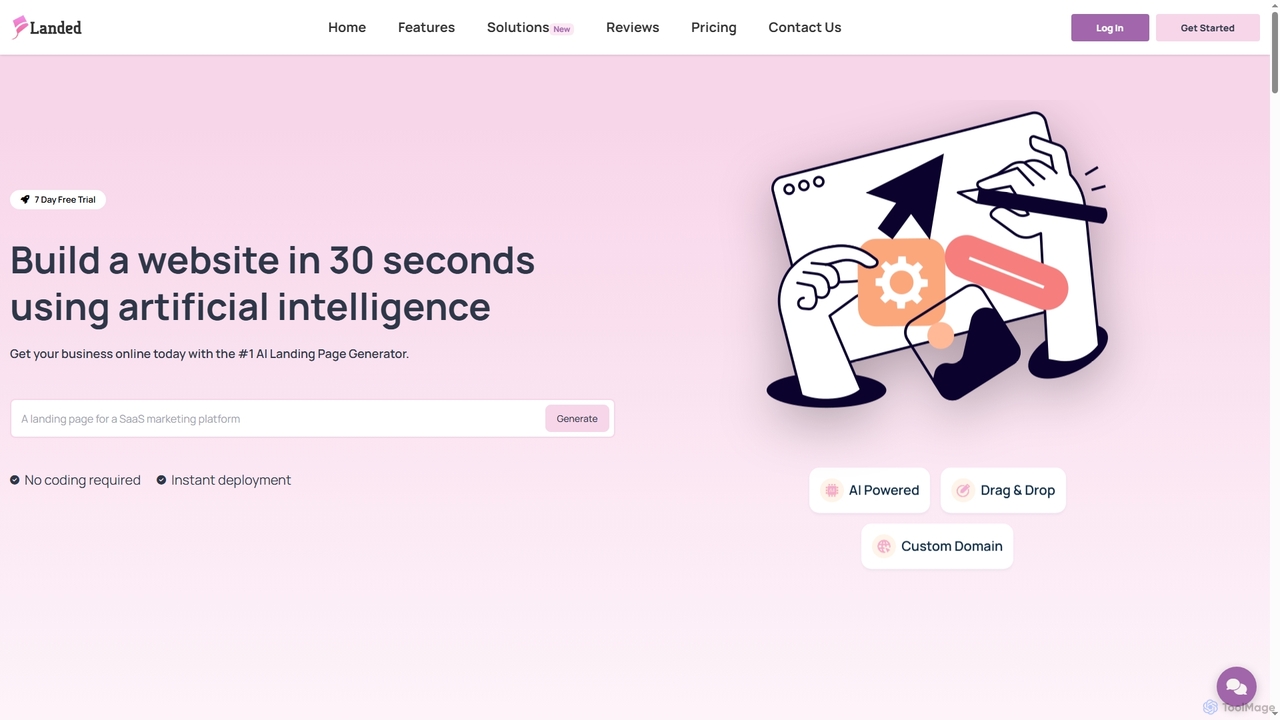
Landed is an AI-powered website builder that enables users to create professional landing pages and websites in seconds …
Landed is an AI-powered website builder that enables users to create professional landing pages and websites in seconds without coding. Describe your business, and its AI generates a unique, customizable site complete with a drag-and-drop editor, custom domain support, and SEO optimization.
About Website Tools
AI Website Tools are a class of software that leverages artificial intelligence to automate and enhance the creation, management, and optimization of websites. These tools utilize machine learning and natural language processing to handle tasks like design generation, content creation, and SEO analysis. Their primary value lies in enabling users, regardless of technical expertise, to build professional, high-performing websites quickly and efficiently. This makes launching a digital presence more accessible and data-driven than traditional methods.
Core Features
- AI-Powered Site Generation: Creates complete website layouts, color schemes, and structures based on simple text descriptions or business types.
- Automated SEO Optimization: Analyzes content and site structure to provide real-time suggestions for keywords, meta tags, and readability to improve search rankings.
- Intelligent Content Creation: Generates marketing copy, blog posts, product descriptions, and other written content tailored to the website's tone and audience.
- Conversion Rate Optimization (CRO): Implements AI-driven A/B testing, heatmaps, and user behavior analysis to identify and suggest improvements for maximizing conversions.
- Smart Analytics and Insights: Translates raw website data into understandable reports and actionable recommendations for growth.
Applicable Scenarios
These tools are widely used by small business owners, entrepreneurs, and marketing professionals who need to establish an online presence without hiring a development team. For instance, a local restaurant can use an AI builder to launch an online ordering site in a day, or a digital agency can use AI SEO tools to manage optimization for multiple clients efficiently. They are also valuable for content creators and bloggers looking to automate content production and improve visibility.
Selection Criteria
When choosing an AI Website Tool, first assess your primary need: are you building a site from scratch, optimizing an existing one, or generating content? Evaluate the tool's ease of use and the level of customization it allows. Consider its integration capabilities with other essential platforms like e-commerce systems, CRMs, or analytics services. Finally, review the pricing models to ensure they align with your budget and scale as your needs grow.

Website ToolsUse Cases
Launch a Small Business Website in Minutes
A local bakery owner, with no coding skills, needs to create an online presence quickly. Using an AI website builder, they simply describe their business, upload a logo, and specify a desired style (e.g., 'warm and rustic'). The AI instantly generates a complete, mobile-responsive website with relevant sections like 'Our Menu,' 'About Us,' and a contact form. It even suggests initial copy and sources royalty-free images of baked goods, reducing the entire process from weeks to under an hour.
Automate On-Page SEO for a Content Blog
A blogger wants to improve their search engine rankings but lacks deep SEO expertise. They connect their blog to an AI SEO tool. For each new post, the tool automatically analyzes the content against a target keyword. It provides a real-time optimization score and suggests specific actions, such as adding related keywords to subheadings, improving the meta description for a better click-through rate, and adding internal links to relevant older posts. This automates a complex task and helps the blogger consistently publish SEO-friendly content.
Generate High-Converting Landing Page Copy
A marketing team is launching a new software product and needs compelling copy for their landing page. Instead of brainstorming from scratch, they use an AI website tool focused on content generation. They input the product name, target audience (e.g., 'project managers'), and key features. The AI generates several variations of headlines, subheadings, feature descriptions, and calls-to-action, all framed with persuasive language. The team can then A/B test these AI-generated options to find the copy that achieves the highest conversion rate, saving significant time and resources.
Personalize the E-commerce User Experience
An online fashion retailer wants to increase sales by showing customers more relevant products. They integrate an AI website tool that analyzes user behavior in real-time, such as clicks, time spent on pages, and past purchases. Based on this data, the AI dynamically adjusts the homepage for each visitor, showcasing personalized product recommendations and promotions. If a user frequently views running shoes, the AI will feature new arrivals in that category, leading to higher engagement and a greater likelihood of purchase compared to a generic, static homepage.
Build an Interactive Portfolio for a Freelancer
A freelance photographer needs a professional portfolio to showcase their work but lacks web design skills. Using an AI portfolio builder, they upload their best photos and provide brief descriptions for each project. The AI analyzes the images' colors and composition to suggest several elegant layouts. It automatically creates galleries, an 'About Me' page with AI-generated text based on their resume, and a contact form. The result is a visually stunning, mobile-friendly portfolio created in a fraction of the time it would take with traditional tools.
A/B Test Website Headlines for Maximum Impact
A SaaS company's marketing manager is unsure which headline on their homepage will attract more sign-ups. They use an AI CRO (Conversion Rate Optimization) tool. The manager provides the original headline and some context about the product. The AI generates five alternative headlines, each with a different psychological angle (e.g., benefit-driven, scarcity, social proof). The tool then automatically sets up an A/B test to show different headlines to different visitors and tracks which one leads to the most clicks on the 'Sign Up' button, providing clear data to make a decision.