
Freemium
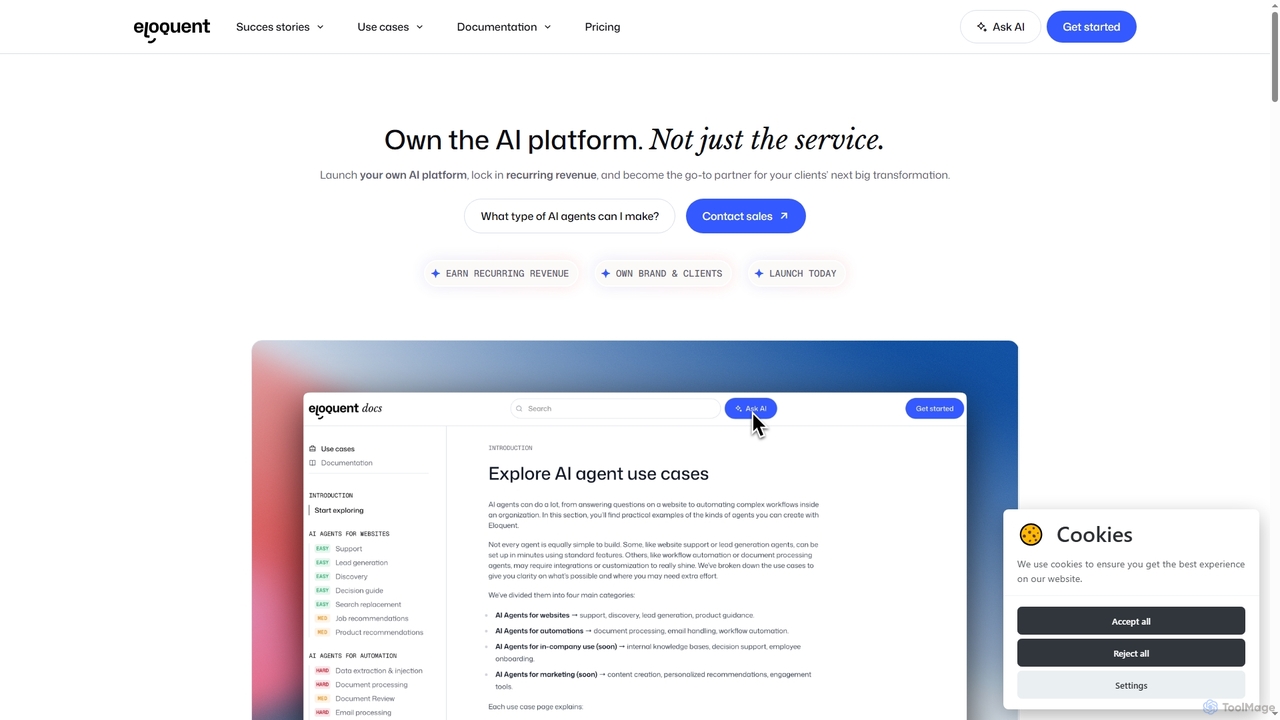
Eloquent
A white-label AI platform that enables agencies and businesses to create, manage, and sell custom AI agents under their own brand, fostering recurring revenue without development costs.
White LabelVisits 7.7KFavorites 145Likes 150
Popular White Label AI tools in Business include Lindo.ai, Vapify, and Eloquent, helping you work more efficiently.
A white-label AI platform that enables agencies and businesses to create, manage, and sell custom AI agents under their own brand, fostering recurring revenue without development costs.
White Label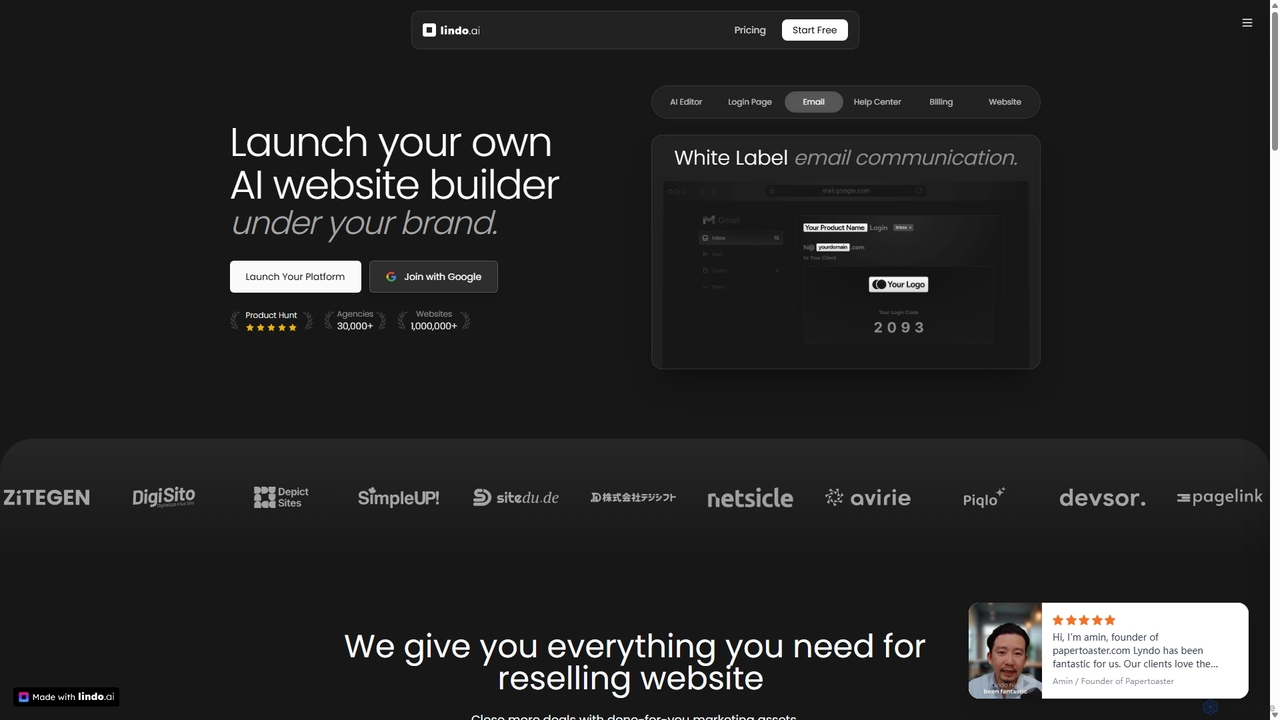
Lindo.ai is a white-label AI website builder that empowers agencies, freelancers, and entrepreneurs to launch their own web design business. It provides a complete platform to create, manage, and bill for stunning websites under your own brand, using AI to automate the heavy lifting. The platform includes a full suite of tools, from an AI content assistant and page creator to client management and marketing assets, enabling users to scale their operations efficiently without needing technical expertise.
White Label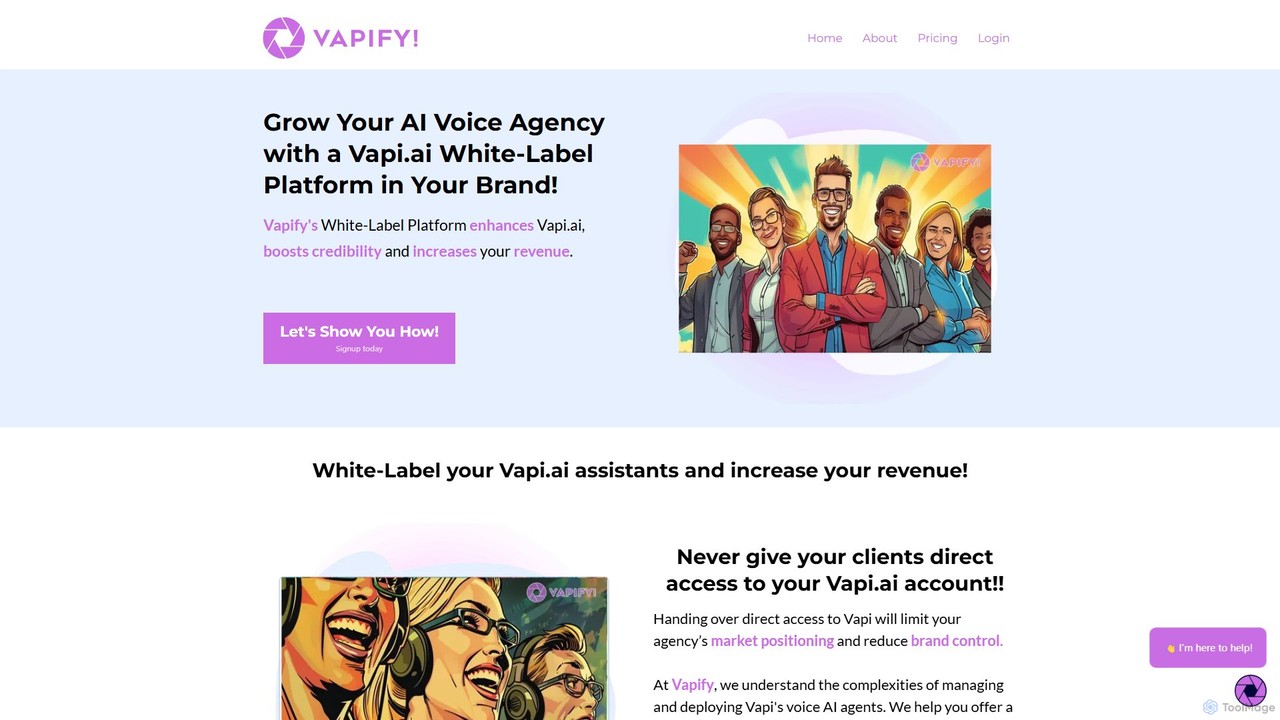
Vapify is a white-label platform for agencies using Vapi.ai. It allows you to rebrand and sell advanced AI voice agent solutions under your own brand, with tools for client management, custom pricing, secure prompt protection, and seamless integration. Empower your agency to increase revenue, enhance brand credibility, and scale your AI voice services.
White LabelWhite Label AI tools are ready-made software solutions that businesses can rebrand, customize, and sell as their own. These platforms provide the complete underlying AI technology and user interface, allowing companies to launch a branded AI service without extensive in-house development. This model significantly accelerates time-to-market and enables entrepreneurs and agencies to offer sophisticated AI capabilities under their unique brand identity, creating new revenue streams from a proven product.
These tools are ideal for digital marketing agencies, SaaS entrepreneurs, business consultants, and web development firms looking to expand their service offerings. For instance, an agency can offer a branded AI-powered social media scheduler to its clients, or a consultant can provide a custom-branded data analytics platform without building it from scratch.
When choosing a White Label AI tool, evaluate the depth of customization—does it go beyond a simple logo swap? Assess the quality and performance of the core AI model. Critically examine the pricing structure, including reseller margins and revenue sharing models. Finally, ensure the provider offers robust technical support for both you and your end-users.
A digital marketing agency wants to add a new, high-margin revenue stream. Instead of spending months and significant capital developing their own AI writer, they subscribe to a white-label AI content generation platform. Within days, they customize the platform with their agency's logo, color scheme, and custom domain. They then create tiered subscription plans and market this new 'Agency AI Writer' to their existing client base of small businesses, offering them a powerful tool for blog posts and social media content under a trusted brand they already work with.
An entrepreneur identifies a market need for an AI-powered customer service chatbot specifically for Shopify stores. Building this from the ground up would be too slow and expensive. They find a white-label AI chatbot provider that offers deep integration capabilities. They rebrand the platform, create pre-built conversation flows tailored for e-commerce (e.g., 'Where is my order?', 'Return policy'), and launch it as 'ShopBot AI'. This allows them to enter the market in weeks, not years, and focus their efforts on marketing and customer acquisition rather than complex AI development.
A business consultant specializes in optimizing supply chains for manufacturing clients. To differentiate their service, they use a white-label AI data analytics tool. After uploading a client's operational data, the tool generates insightful reports on inefficiencies and potential savings. The consultant rebrands the platform's dashboard and report exports with their firm's logo. They now offer a premium 'AI-Powered Audit' service, providing clients with sophisticated, data-driven recommendations presented in a professional, branded format, reinforcing their image as a tech-forward expert.
A web design agency builds websites for various clients, who often struggle to provide high-quality, unique imagery. The agency subscribes to a white-label AI image generator. They integrate it into their client portal under their own brand, calling it 'VisionCraft Studio'. Now, during the design process, they can offer clients an add-on service to generate custom stock photos, icons, and illustrations instantly. This not only solves a common client pain point but also adds a recurring revenue service and positions the agency as an innovative, all-in-one design partner.
A university wants to provide its students with a 24/7 AI-powered tutor and campus guide. They partner with a white-label AI assistant provider. They customize the AI with the university's specific course materials, campus maps, and event schedules. The final product is launched as the 'UniHelper AI' app, featuring the university's branding. Students can use it to get instant answers to academic questions, find building locations, and check library hours, improving the student experience and freeing up administrative staff from repetitive inquiries.
An entrepreneur in Southeast Asia notices that major global AI tools lack nuanced understanding of local languages and cultures. They license a powerful white-label AI platform and invest in fine-tuning it for the regional market. They rebrand the entire interface into local languages, adjust the AI's tone to be more culturally appropriate, and pre-load it with region-specific data and examples. They launch this as a new, localized AI service, successfully capturing a market segment that was underserved by the one-size-fits-all global players.
White Label AI tools are fully developed, ready-to-use software applications that a business can purchase, rebrand with its own logo and colors, and sell to its customers as its own product. Unlike using an API, which requires building an application from scratch, a white-label solution provides the entire package: the AI technology, the user interface, and often user management and billing systems. This model is designed for businesses that want to enter the AI market quickly without the high costs and long timelines of in-house development.
The main difference lies in completeness and speed to market. A White Label AI tool is a complete, ready-to-sell product with a user interface (UI) and backend infrastructure. You primarily focus on branding and marketing. An API (Application Programming Interface), on the other hand, is just a connection to the core AI technology. You must build your own UI, user management, billing, and hosting infrastructure around it.
Choosing the right provider is crucial for your business success. Consider these key factors:
White Label AI tools are best suited for individuals and businesses who have an existing audience or client base and want to quickly monetize an AI service. This includes:
Yes, it is completely legal and is the core principle of the white-label business model. When you subscribe to a white-label service, you are purchasing a license that explicitly grants you the right to rebrand and resell the software as your own. The provider maintains the source code and infrastructure, while you manage the customer-facing brand and relationships. It is essential to read the provider's Terms of Service carefully to understand the specific rights, limitations, and responsibilities involved in the reseller agreement.