ToolMage
Sign in

Best 1 Workshop Planning AI tools for Business

Popular Workshop Planning AI tools in Business include Metodic, helping you work more efficiently.

Metodic
Freemium

Metodic

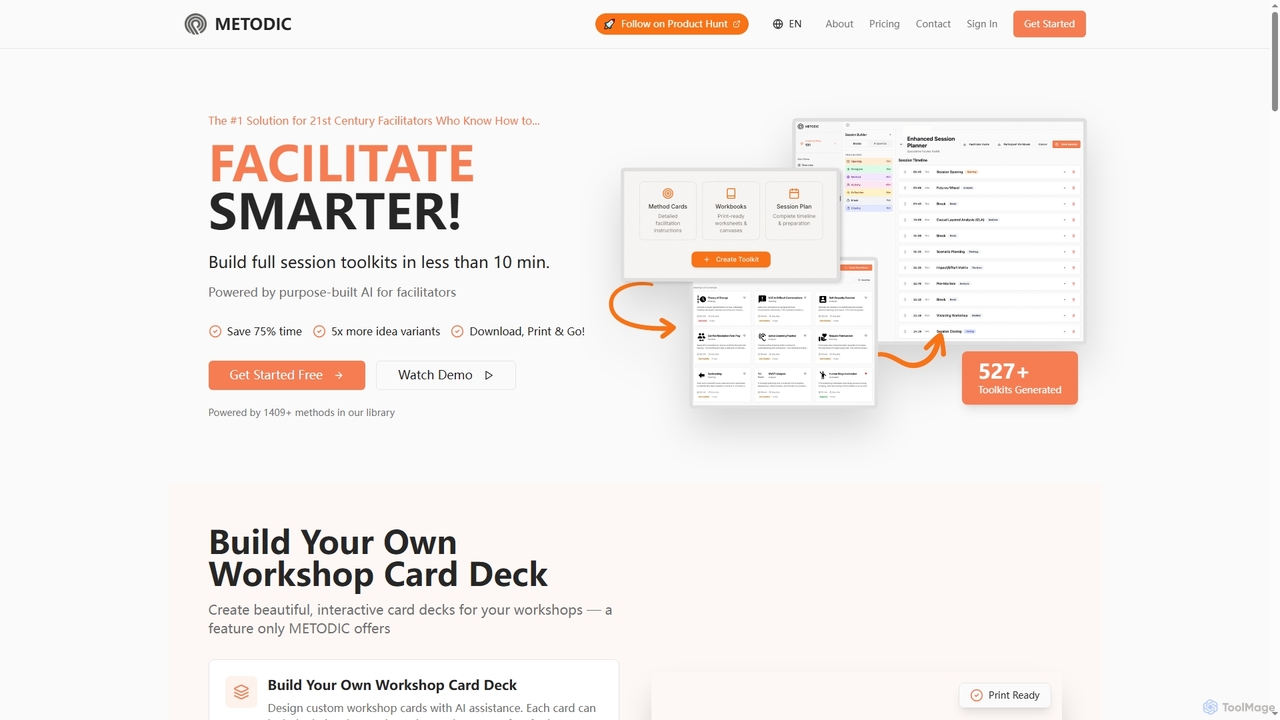
Metodic is an AI-powered platform designed for facilitators to rapidly generate comprehensive session toolkits, method card decks, and session plans. It helps professionals save up to 75% of preparation time, offering tailored content, proven methods, and print-ready materials for engaging workshops and meetings.

Workshop Planning
Visits 6.6KFavorites 137Likes 147

About Workshop Planning

Workshop Planning tools are AI-powered platforms designed to streamline and enhance the entire process of organizing, designing, and executing interactive workshops and collaborative sessions. These tools leverage artificial intelligence to automate tasks such as agenda generation, activity design, participant management, and feedback analysis, ensuring more engaging and productive outcomes. They provide intelligent assistance for crafting dynamic sessions, from corporate training to creative brainstorming, by optimizing content flow and resource allocation. By integrating advanced analytics and generative AI, these solutions empower facilitators and organizers to create impactful experiences with greater efficiency and precision.

Core Features

  • AI-Powered Agenda Generation: Automatically suggests and structures workshop agendas based on objectives, duration, and participant profiles.
  • Interactive Activity Design: Provides templates and AI-driven suggestions for engaging exercises, icebreakers, and collaborative tasks.
  • Participant Management & Engagement: Tools for inviting, tracking, and engaging attendees, including real-time polling and Q&A features.
  • Resource & Time Optimization: Intelligently allocates time slots for activities and suggests necessary materials or digital tools.
  • Feedback Collection & Analysis: Automates post-workshop surveys and uses AI to analyze sentiment and identify key insights for improvement.

Applicable Scenarios

These tools are invaluable for corporate learning and development teams designing employee training programs, product managers facilitating design sprints and ideation sessions, and consultants structuring client engagement workshops. They also benefit educators planning interactive classroom activities and event organizers managing breakout sessions at conferences, ensuring every session is well-structured and impactful.

How to Choose

When selecting an AI workshop planning tool, consider its customization capabilities for different workshop formats, the breadth of its AI-driven content generation features, and its integration with existing communication and project management platforms. Evaluate its collaboration features for co-facilitators, the robustness of its analytics for post-workshop insights, and its user-friendliness for both organizers and participants.

Workshop Planning use cases

1

Automating Corporate Training Program Design

Human Resources and Learning & Development professionals can leverage Workshop Planning AI tools to rapidly design comprehensive employee training programs. By inputting learning objectives and target audience, the AI generates detailed agendas, suggests relevant modules, and recommends interactive exercises. This significantly reduces planning time by up to 60%, ensuring consistent quality and engagement across all training sessions, from onboarding to leadership development.

2

Designing a Strategic Planning Workshop Agenda

A corporate strategy team leader needs to facilitate a two-day strategic planning workshop for senior executives. Using an AI Workshop Planning tool, they input the workshop's objectives, desired outcomes, and available time. The tool then generates a detailed agenda, suggesting appropriate activities like SWOT analysis, vision-setting exercises, and breakout sessions, complete with estimated timings and required materials, saving hours of manual planning.

3

Designing Engaging Corporate Training Workshops

HR and Learning & Development professionals can utilize AI workshop planning tools to rapidly design and customize training programs. By inputting learning objectives, target audience, and available time, the AI generates a structured agenda with suitable activities, discussion prompts, and interactive exercises. This significantly reduces preparation time, ensures content relevance, and enhances participant engagement, leading to more effective skill development and knowledge transfer within organizations.

4

Facilitating Product Ideation & Design Sprints

Product managers and design teams leverage these tools to structure and facilitate intensive ideation and design sprints. The AI can help define sprint goals, allocate time for brainstorming, prototyping, and feedback sessions, and suggest creative problem-solving techniques. This ensures a focused and productive sprint environment, accelerating the product development cycle by efficiently guiding teams through complex problem-solving and innovation processes.

5

Facilitating a Remote Team Building Session

An HR manager for a distributed company wants to organize a virtual team-building workshop to improve cohesion. The AI tool helps by suggesting engaging online icebreakers, collaborative virtual activities, and discussion prompts suitable for remote participants. It also assists in scheduling breaks and managing virtual breakout rooms, ensuring an interactive and inclusive experience across different time zones.

6

Enhancing Strategic Planning Session Facilitation

For leadership teams and consultants, these tools transform strategic planning workshops into highly productive sessions. The AI assists in structuring the agenda to cover key areas like SWOT analysis, goal setting, and action planning, while suggesting prompts for deeper discussion. It also manages participant input and synthesizes ideas in real-time, leading to clearer outcomes and a 40% faster decision-making process during critical strategy reviews.

7

Optimizing Agile Product Design Sprints

Product managers and design teams utilize Workshop Planning AI to efficiently run agile design sprints. The tools help structure the sprint agenda, allocate time for ideation, prototyping, and testing phases, and manage participant roles. They can also suggest creative problem-solving techniques and facilitate rapid feedback collection, accelerating the product development cycle and enabling teams to iterate on concepts 30% faster.

8

Streamlining Team Building & Collaboration Sessions

Team leaders and managers can use AI workshop planning tools to create dynamic and inclusive team-building activities or collaborative problem-solving sessions. The AI assists in generating icebreakers, group challenges, and discussion topics tailored to team size and objectives. This fosters stronger team cohesion, improves communication, and ensures that every team member has an opportunity to contribute effectively, enhancing overall team performance and morale.

9

Developing a Product Design Sprint Outline

A product manager is initiating a design sprint to rapidly prototype a new feature. The Workshop Planning AI assists in structuring the sprint's five-day agenda, allocating time for problem definition, ideation, prototyping, testing, and feedback. It suggests specific design thinking exercises and provides templates for user story mapping and journey mapping, accelerating the sprint setup phase.

10

Coordinating Virtual Conference Breakout Sessions

Event organizers managing large virtual conferences can use these tools to seamlessly coordinate numerous breakout sessions. The AI helps assign participants to relevant groups, distribute session materials, and manage timekeeping across multiple concurrent rooms. It also facilitates post-session reporting and feedback collection, ensuring a smooth attendee experience and providing organizers with comprehensive insights into engagement levels.

11

Automating Academic Seminar & Lecture Planning

Educators and academic researchers can employ these tools to plan interactive seminars, lectures, or study groups. The AI helps structure complex topics into digestible modules, suggests engaging pedagogical activities, and prepares discussion questions to stimulate critical thinking. This allows instructors to deliver more dynamic and student-centric learning experiences, optimizing class time and encouraging deeper understanding of subject matter.

12

Customizing Training Modules for Employee Onboarding

A training specialist needs to create a series of interactive workshops for new employee onboarding across various departments. The AI tool allows them to input different departmental needs and learning objectives. It then generates customized workshop modules, suggesting relevant activities, case studies, and discussion topics for each group, ensuring a tailored and effective onboarding experience.

13

Optimizing Logistics for a Large-Scale Conference Breakout Session

An event planner is organizing a large industry conference with multiple concurrent breakout sessions. The Workshop Planning tool helps in assigning facilitators to specific rooms, managing equipment needs for each session, and optimizing participant flow between different workshops. It provides a centralized dashboard for logistical oversight, minimizing scheduling conflicts and resource bottlenecks.

14

Crafting Interactive Client Discovery & Strategy Sessions

Consultants and sales professionals utilize AI workshop planning tools to design highly interactive client discovery and strategy sessions. By inputting client goals and challenges, the AI can generate a structured agenda that guides conversations, identifies key pain points, and collaboratively develops strategic solutions. This enhances client engagement, builds trust, and ensures that proposed solutions are directly aligned with client needs, leading to more successful partnerships.

15

Creating Engaging Educational Workshops

Educators and independent trainers can design highly interactive and effective educational workshops using AI planning tools. These platforms assist in structuring curriculum, suggesting pedagogical activities, and integrating multimedia content. They also help manage student participation, track progress, and collect immediate feedback, leading to a 25% increase in student engagement and better learning outcomes for diverse subjects.

16

Generating Creative Ideas for a Brainstorming Session

A marketing team needs fresh ideas for an upcoming campaign. The AI Workshop Planning tool can be used to structure a brainstorming session, offering various creative thinking techniques like SCAMPER or reverse brainstorming. It can also generate initial prompts or keywords to kickstart discussions, helping the team overcome creative blocks and produce a wider range of innovative concepts.

17

Optimizing Large-Scale Conference Breakout Sessions

Event organizers for conferences and large gatherings can use these tools to efficiently plan and manage multiple breakout sessions. The AI assists in categorizing topics, assigning facilitators, optimizing room allocations, and ensuring a balanced flow of content across various tracks. This streamlines the logistical complexities of large events, provides a diverse and engaging experience for attendees, and maximizes the value derived from each session.

18

Fostering Team Building and Collaboration Workshops

Team leaders and HR professionals employ Workshop Planning AI to design impactful team-building and collaboration workshops. The tools suggest icebreakers, group activities, and problem-solving challenges tailored to team dynamics and objectives. They also facilitate anonymous feedback and idea generation, fostering a more inclusive environment and improving team cohesion and communication by up to 35%.

Workshop Planning FAQ

What are AI Workshop Planning tools?

AI Workshop Planning tools are software solutions that use artificial intelligence to assist in the design, organization, and execution of workshops, meetings, and collaborative sessions. They automate various tasks, from generating agendas and activities to managing participants and analyzing feedback. Their core purpose is to make workshops more efficient, engaging, and outcome-driven by leveraging AI for intelligent content creation and process optimization.

What are AI Workshop Planning tools?

AI Workshop Planning tools are specialized software platforms that leverage artificial intelligence to assist in the design, organization, and execution of workshops. They automate various aspects, from generating agendas and suggesting content to managing participants and analyzing feedback. Their core purpose is to enhance efficiency, engagement, and the overall effectiveness of any type of workshop, whether virtual, hybrid, or in-person.

What are AI Workshop Planning tools?

AI Workshop Planning tools are software applications that utilize artificial intelligence to assist in the design, organization, and execution of workshops, meetings, and interactive sessions. They automate tasks like agenda creation, activity suggestion, and resource management, aiming to make the planning process more efficient, creative, and data-driven. These tools help facilitators and organizers deliver more impactful and engaging experiences.

How do AI tools enhance the workshop planning process?

AI tools significantly enhance workshop planning by automating repetitive tasks, providing data-driven insights, and suggesting creative content. They can generate tailored agendas, recommend interactive activities based on objectives, optimize time allocation, and even predict potential engagement issues. This automation frees up facilitators to focus on content quality and participant interaction, leading to more dynamic, productive, and impactful workshops with less manual effort.

How do AI Workshop Planning tools differ from general project management software?

While general project management software focuses on task tracking, timelines, and resource allocation for broader projects, AI Workshop Planning tools are specifically tailored for the unique needs of interactive sessions. They offer specialized features like AI-driven agenda generation, activity libraries, participant engagement analytics, and content creation support, which are not typically found in generic project management platforms. They complement, rather than replace, broader project management efforts.

How do I choose the best AI tool for workshop planning?

To choose the best AI workshop planning tool, consider several factors. First, assess its core features, such as AI-driven agenda generation, content suggestions, and participant engagement tools. Second, evaluate its integration capabilities with your existing communication and collaboration platforms (e.g., Zoom, Teams). Third, look at its customization options to ensure it can adapt to your specific workshop types and sizes. Finally, consider its analytics features for post-workshop insights and its pricing model relative to your budget and scalability needs.

What are the key benefits of using AI for workshop planning?

Using AI for workshop planning offers several key benefits, including significant time savings through automation of agenda creation and activity selection. It enhances creativity by suggesting diverse exercises and prompts, leading to more dynamic sessions. AI tools also improve organization by streamlining logistics and resource management, and can boost participant engagement through data-driven insights and tailored content, ultimately leading to more productive outcomes.

What specific tasks can AI Workshop Planning tools automate?

AI Workshop Planning tools can automate a wide range of tasks. They can automatically generate workshop agendas based on objectives, suggest relevant content, icebreakers, and discussion prompts. These tools also streamline participant registration, send automated reminders, and facilitate interactive elements like polls and Q&A sessions. Post-workshop, they can collect and analyze feedback, identifying key themes and areas for improvement, significantly reducing manual effort for organizers.

What key features should I look for in an AI workshop planning solution?

When choosing an AI workshop planning solution, prioritize features like AI-driven agenda generation and content suggestions, robust participant management (invitations, registration, engagement tools), and comprehensive feedback analysis capabilities. Look for tools that offer customizable templates, seamless integration with video conferencing and collaboration platforms, and strong reporting features to measure workshop effectiveness. User-friendliness and scalability are also crucial considerations.

How do AI Workshop Planning tools differ from general project management software?

While both manage tasks, AI Workshop Planning tools are specifically tailored for the unique dynamics of interactive sessions, whereas general project management software focuses on broader task, timeline, and resource tracking. Workshop planning tools offer AI-driven content suggestions, real-time engagement features, and specialized feedback analysis for group dynamics. Project management tools lack these specific AI-powered features for workshop content and participant interaction, making them less effective for designing and facilitating engaging workshops.

What features should I look for when choosing an AI Workshop Planning tool?

When choosing an AI Workshop Planning tool, prioritize features such as intelligent agenda generation, a rich library of customizable activities and templates, and robust collaboration capabilities for team planning. Look for tools that offer participant engagement analytics, seamless integration with video conferencing and calendar platforms, and intuitive user interfaces. Scalability and strong customer support are also important considerations for long-term use.

Can AI workshop planning tools integrate with existing business software?

Yes, many AI workshop planning tools are designed to integrate with a variety of existing business software to create a seamless workflow. Common integrations include calendar applications (Google Calendar, Outlook), video conferencing platforms (Zoom, Microsoft Teams), project management tools (Asana, Trello), and CRM systems. These integrations allow for automated scheduling, participant syncing, and streamlined communication, enhancing overall operational efficiency.

Who benefits most from using AI-powered workshop planning solutions?

A wide range of professionals and organizations benefit from AI-powered workshop planning solutions. This includes corporate trainers and HR departments for employee development, product managers and R&D teams for innovation sprints, consultants for client engagement, and educators for interactive learning. Essentially, anyone responsible for designing, facilitating, or participating in structured collaborative sessions can leverage these tools to achieve better outcomes with greater ease.

Can AI Workshop Planning tools help with virtual workshops?

Yes, AI Workshop Planning tools are highly effective for virtual workshops. Many are designed with remote collaboration in mind, offering features like virtual icebreakers, online brainstorming templates, and integration with popular video conferencing platforms. They can help manage virtual breakout rooms, facilitate real-time polls and Q&A, and analyze online participant engagement, ensuring a smooth and interactive virtual experience.

Who benefits most from using AI Workshop Planning tools?

A wide range of professionals benefits from AI Workshop Planning tools. This includes corporate trainers and HR professionals designing employee development programs, event managers coordinating large conferences with interactive sessions, and team leaders facilitating strategic planning or team-building workshops. Educators creating engaging learning modules and consultants delivering specialized training also find these tools invaluable. Essentially, anyone responsible for designing and running structured, interactive group sessions can significantly enhance their efficiency and impact.