ToolMage
Sign in

Best 4 Job Training AI tools for Career

Popular Job Training AI tools in Career include Turing College, Fullstack Academy, BloomTech, and Refocus, helping you work more efficiently.

Refocus
Paid

Refocus

Refocus is a global online educational platform offering intensive, job-oriented courses in high-demand digital fields like Data Analytics, Digital Marketing, and Project Management. It focuses on practical skills, mentorship, and career support to help individuals switch to or advance in the tech industry.

Job Training
Visits 10.3KFavorites 135Likes 143
BloomTech
Paid

BloomTech

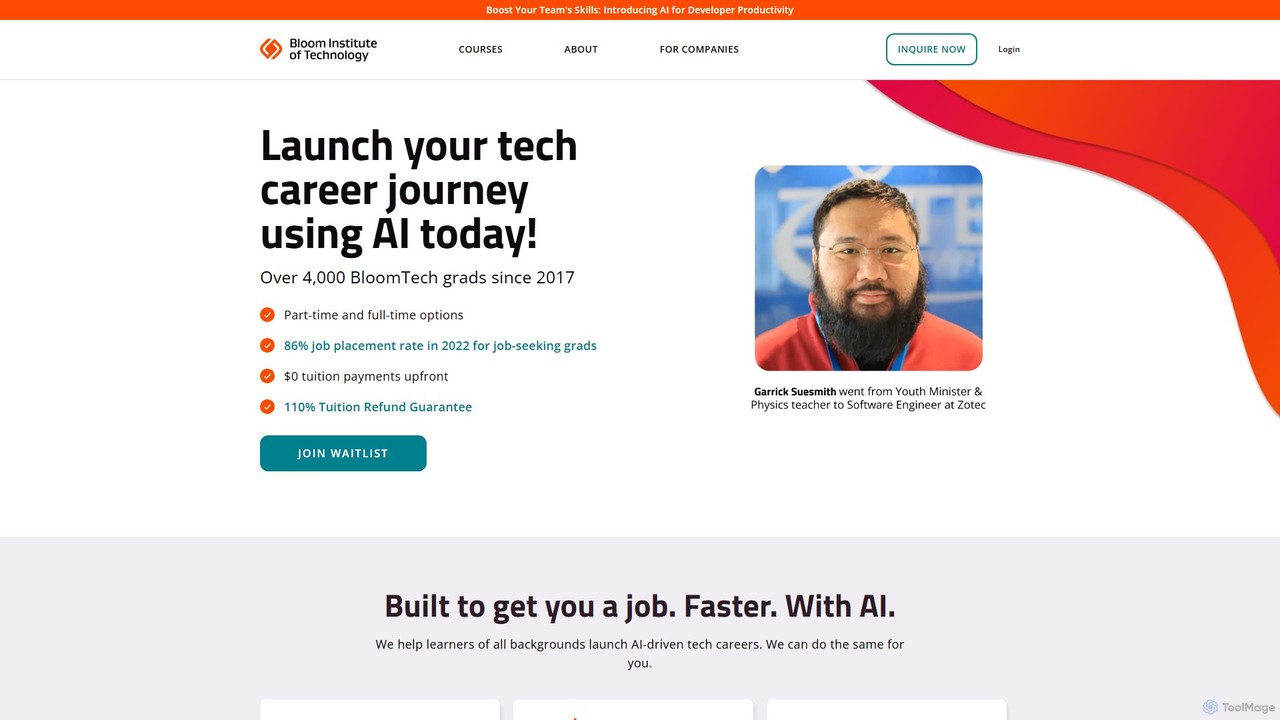
BloomTech is an AI-powered online coding and data science bootcamp designed to launch or advance your tech career. It offers flexible, job-focused training with comprehensive career support, multiple tuition options including deferred payment, and a 110% tuition refund guarantee. The curriculum integrates AI to prepare students for modern tech roles.

Job Training
Visits 40.5KFavorites 115Likes 116
Fullstack Academy
Paid

Fullstack Academy

Fullstack Academy is a leading online tech bootcamp offering immersive, live training in high-demand fields like AI & Machine Learning, Software Engineering, Cybersecurity, and Data Analytics. With flexible schedules, it provides expert instruction, hands-on projects, and 1-on-1 career coaching to prepare students for successful tech careers at top companies like Google and Amazon.

Job Training
Visits 56.8KFavorites 142Likes 144
Turing College
Paid

Turing College

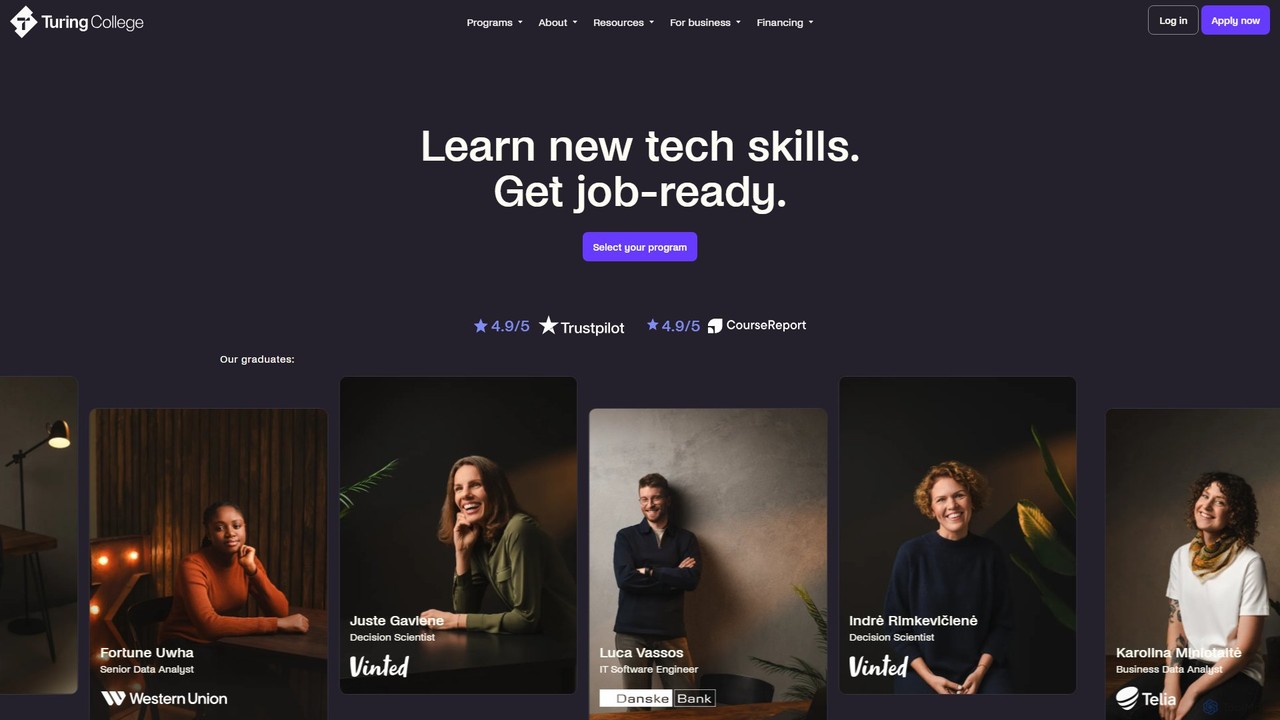
Turing College is an online educational platform for busy professionals seeking to master in-demand tech skills. It offers self-paced, project-based courses in Data Science, AI, Software Engineering, and Data Analytics. With 1-on-1 mentorship from industry experts and a focus on practical, real-world projects, Turing College prepares students for career changes or advancements, boasting a high employment rate for its graduates. The flexible learning model allows students to build a job-ready portfolio around their own schedules.

Job Training
Visits 175.7KFavorites 141Likes 154

About Job Training

AI Job Training tools are platforms that leverage artificial intelligence to deliver personalized and adaptive learning experiences for professional development. These tools often use machine learning and natural language processing to create interactive simulations, analyze performance, and tailor content to individual needs. They are designed to bridge skill gaps, enhance employee competencies, and improve on-the-job performance through data-driven, practical training. Unlike static online courses, AI training platforms provide dynamic, real-time feedback in a safe, simulated environment.

Core Features

  • Personalized Learning Paths: The AI assesses a user's current skills and career goals to generate a customized training curriculum.
  • Interactive Role-Playing Simulations: Users can practice real-world scenarios, such as sales negotiations or customer support calls, with AI-powered avatars.
  • Instant Performance Analytics: Provides immediate, data-backed feedback on user performance, identifying specific areas for improvement.
  • Skill Gap Analysis: Automatically identifies discrepancies between an employee's skills and the requirements of their role or career path.
  • Adaptive Content Delivery: The system adjusts the difficulty and content of training modules in real-time based on the user's progress.

Use Cases

These tools are widely adopted in corporate environments for employee onboarding, leadership development, and upskilling initiatives. Sales teams use them to refine negotiation tactics, customer service departments to improve conflict resolution skills, and healthcare organizations for clinical communication training.

How to Choose

When selecting an AI Job Training tool, evaluate the realism and relevance of its simulations. Consider the depth of its performance analytics and feedback mechanisms. Assess its ability to integrate with your existing Learning Management Systems (LMS) or HR software, and review the scalability of its platform for team or enterprise-wide deployment.

Job Training use cases

1

Refining Sales Negotiation Skills with AI Avatars

A junior sales representative needs to improve their ability to handle client objections. Using an AI Job Training platform, they engage in simulated negotiation calls with an AI avatar that is programmed with common customer pushbacks and questions. The AI analyzes the representative's word choice, tone of voice, and response timing. After each session, the platform provides a detailed report highlighting strengths and weaknesses, suggesting alternative phrasing, and offering targeted micro-learning modules to address specific skill gaps, such as active listening or value propositioning. This allows for risk-free practice and rapid skill acquisition before facing real clients.

2

Practicing De-escalation for Customer Support

Customer support agents in a call center use an AI simulation tool to practice managing difficult conversations. The platform presents them with scenarios involving frustrated or angry customers, portrayed by AI avatars with realistic emotional responses. The agent must use empathy, active listening, and problem-solving skills to de-escalate the situation. The AI provides real-time feedback on their communication style, flagging phrases that might escalate tension and suggesting more effective alternatives. This training helps agents build confidence and emotional resilience, leading to improved customer satisfaction and agent well-being.

3

Developing Leadership and Management Competencies

A newly promoted team manager uses an AI coaching tool to prepare for challenging leadership tasks. They can role-play scenarios like delivering constructive criticism to an underperforming employee, mediating a conflict between team members, or communicating a difficult organizational change. The AI coach evaluates their communication strategy, clarity, and empathy, offering private, non-judgmental feedback. This confidential practice space helps the manager hone their soft skills and build the confidence needed to lead their team effectively, fostering a more positive and productive work environment.

4

Accelerating Technical Onboarding for Engineers

A tech company uses an AI-powered platform to onboard new software engineers. Instead of relying solely on documentation, new hires engage with an interactive coding environment that simulates real-world development tasks and challenges specific to the company's codebase. The AI acts as a virtual mentor, providing instant feedback on code quality, efficiency, and adherence to best practices. It can also identify knowledge gaps and automatically recommend relevant internal documentation or training modules, significantly reducing the time it takes for new engineers to become productive contributors.

5

Enhancing Safety Procedures with VR Simulations

In a manufacturing or industrial setting, employees use AI-driven Virtual Reality (VR) training to learn how to operate heavy machinery and respond to emergency situations. The AI creates dynamic, realistic scenarios, such as equipment malfunctions or chemical spills, that would be too dangerous or costly to replicate in real life. It tracks the user's actions, adherence to safety protocols, and reaction times, providing a comprehensive performance review. This immersive training method improves knowledge retention and ensures that employees are fully prepared to handle critical situations safely and effectively.

6

Improving Remote Team Communication Skills

A globally distributed team uses an AI tool that integrates with their video conferencing platform to improve collaboration. The AI analyzes communication dynamics during virtual meetings, providing post-meeting insights to the team. It can identify patterns such as who speaks the most, whether participants frequently interrupt each other, or if the sentiment of the conversation is positive or negative. Based on this data, the tool offers actionable suggestions for fostering more inclusive discussions, ensuring clearer communication, and improving overall meeting effectiveness for the remote workforce.

Job Training FAQ

What are AI Job Training tools?

AI Job Training tools are software platforms that use artificial intelligence to create personalized, interactive, and data-driven professional development experiences. They go beyond traditional e-learning by offering features like realistic role-playing simulations with AI avatars, real-time performance feedback, and adaptive learning paths tailored to individual skill gaps. These tools are primarily used to develop practical skills, such as sales, customer service, leadership, and communication, in a controlled and measurable environment.

How do I choose the right AI Job Training platform?

To choose the right platform, consider these factors:

  • Content Relevance: Ensure the platform's simulation scenarios and training modules are highly relevant to your industry and specific job roles.
  • Feedback Quality: Evaluate the depth and actionability of the AI-generated feedback. Does it analyze multiple aspects like language, tone, and strategy?
  • Integration Capabilities: Check if the tool can integrate with your existing systems, such as an LMS (Learning Management System) or CRM (Customer Relationship Management).
  • Analytics and Reporting: Assess the platform's ability to track progress and provide clear, insightful reports on individual and team skill development.
What's the difference between AI Job Training and traditional e-learning?

The key difference lies in interactivity and personalization. Traditional e-learning typically involves passive consumption of content like videos and quizzes with a one-size-fits-all approach. AI Job Training, in contrast, is an active, "learn-by-doing" experience. It uses AI to create dynamic simulations that adapt to the user's actions and provides immediate, personalized feedback. While e-learning is good for knowledge transfer, AI training excels at building and honing practical, real-world skills.

What key skills can be developed using AI Job Training tools?

AI Job Training tools are particularly effective for developing both soft and hard skills that require practice. Common examples include:

  • Communication Skills: Sales negotiation, public speaking, conflict resolution, and customer service interactions.
  • Leadership and Management: Giving feedback, coaching, delegation, and managing difficult conversations.
  • Technical Skills: Practicing complex software workflows, coding challenges, or operating specialized equipment in simulated environments.
  • Procedural Compliance: Training on safety protocols, regulatory compliance, and standardized operational procedures.
How does AI provide feedback in professional training simulations?

AI provides feedback by analyzing multiple data points during a user's interaction with a simulation. It uses Natural Language Processing (NLP) to assess word choice, sentiment, and the relevance of a user's responses. Some platforms also analyze vocal tone, speaking pace, and filler word usage through speech recognition. The AI compares this data against a model of ideal performance or predefined success metrics to generate instant, objective, and specific feedback, pinpointing exactly where the user can improve.