Career Best in category 1 results Resume Analysis AI Tool

Popular AI tools in the Resume Analysis field of Career include ResumeChecker, etc., helping you quickly improve efficiency.

ResumeChecker

ResumeChecker

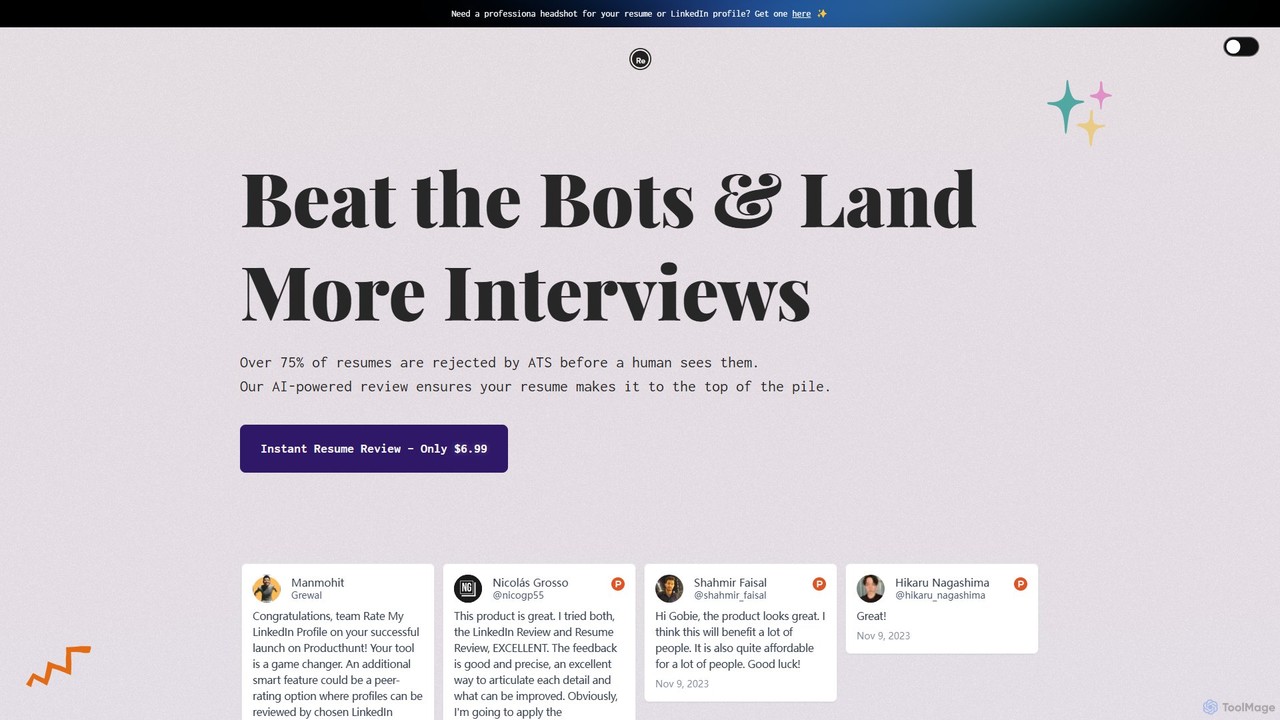
An AI-powered tool that analyzes your resume to help you beat Applicant Tracking Systems (ATS). It provides an …

3.0K

About Resume Analysis

Resume Analysis tools are AI-powered platforms that automate the process of parsing, screening, and evaluating candidate resumes. Leveraging Natural Language Processing (NLP) and machine learning, these tools extract structured data like skills, experience, and education from various file formats. Their primary value lies in dramatically accelerating the initial stages of recruitment, allowing hiring teams to quickly identify the most qualified applicants from a large pool. As a specialized component within the broader Career technology ecosystem, they provide the critical intelligence needed for efficient talent acquisition.

Core Features

  • Automated Resume Parsing: Extracts and categorizes key information such as contact details, work history, skills, and education from unstructured resume files (PDF, DOCX, etc.).
  • Job-to-Resume Matching: Scores and ranks candidates by comparing the content of their resume against the requirements listed in a job description.
  • Skill & Keyword Extraction: Identifies specific skills, qualifications, and keywords relevant to a role, providing a quick overview of a candidate's expertise.
  • Candidate Ranking & Shortlisting: Automatically generates a ranked list of applicants based on predefined criteria, helping recruiters focus on the top talent.
  • Bias Reduction Features: Includes options to anonymize resumes by hiding demographic information like name, gender, or age to promote fairer, skill-based evaluations.

Applicable Scenarios

These tools are most beneficial for corporate HR departments, recruitment agencies, and talent acquisition specialists who handle high volumes of applications. They are particularly effective in industries with competitive hiring, such as technology, finance, and healthcare, where screening hundreds of resumes for a single position is common. They streamline workflows for both individual recruiters and large hiring teams.

Selection Criteria

When choosing a Resume Analysis tool, consider its parsing accuracy across diverse resume formats and layouts. Evaluate its integration capabilities with your existing Applicant Tracking System (ATS) for a seamless workflow. Assess the level of customization available for scoring rules and keywords to fit specific roles. Finally, verify its compliance with data privacy regulations (like GDPR) and its effectiveness in mitigating unconscious bias.

Resume AnalysisUse Cases

1

High-Volume Technical Recruitment Screening

A corporate recruiter at a large tech company is tasked with filling a Senior Software Engineer position that has attracted over 500 applications. Manually reviewing each resume would take several days. By using a Resume Analysis tool, the recruiter uploads the job description and all applications. The AI instantly parses each resume, scores candidates based on required skills like 'Python,' 'AWS,' and 'Microservices,' and provides a ranked shortlist of the top 50 candidates. This reduces the initial screening time from 3-4 days to under an hour, allowing the recruiter to focus on engaging with the most qualified individuals.

2

Agency-Based Candidate-to-Job Matching

A recruitment agency maintains a database of thousands of candidate profiles. When a new client provides a job opening for a 'Marketing Manager,' an agency recruiter uses the Resume Analysis tool to scan their entire database. The tool identifies and ranks candidates whose resumes show strong alignment with the client's requirements, such as 'SEO strategy,' 'PPC campaigns,' and 'team leadership.' This enables the agency to present a high-quality shortlist to the client within hours, significantly improving their placement speed and client satisfaction.

3

Enhancing Diversity and Inclusion in Hiring

An organization's HR department is committed to improving diversity in its hiring process. They configure their Resume Analysis tool to enable its bias reduction features. The software automatically redacts information such as candidate names, photos, university names, and graduation years from all resumes before they are reviewed by hiring managers. This ensures that the initial shortlisting is based solely on skills, experience, and qualifications, helping to mitigate unconscious bias and create a more equitable evaluation process for all applicants.

4

Internal Talent Mobility and Project Staffing

A multinational corporation needs to assemble a cross-functional team for a new internal AI project. Instead of hiring externally, the project manager uses a Resume Analysis tool to scan the company's internal database of employee profiles and past performance reviews. The tool identifies current employees who possess the necessary skills, such as 'machine learning,' 'project management,' and 'data visualization,' even if those skills are not part of their current job title. This facilitates internal mobility and helps the company leverage existing talent effectively.

5

Standardizing Campus Recruitment Processes

A company's university recruitment team attends multiple career fairs and receives hundreds of resumes from students with varied backgrounds and resume formats. They use a Resume Analysis tool to process all collected resumes in a standardized way. The tool extracts key academic information, internships, and relevant project experience, then scores each student against the criteria for their internship or entry-level programs. This creates a consistent and fair evaluation system, allowing the team to efficiently manage a high volume of student applications.

6

Proactive Sourcing of Passive Candidates

A talent sourcer is proactively looking for candidates for a hard-to-fill cybersecurity role. They gather profiles from professional networks and industry forums, saving them as PDF files. They then use the Resume Analysis tool to parse these profiles and match them against the detailed job requirements. The tool helps identify individuals with rare skill combinations who may not be actively applying for jobs but are a strong fit. This allows the sourcer to build a targeted outreach list of high-potential passive candidates.

Resume AnalysisFrequently Asked Questions