Yesr
Yesr is an AI-powered salary negotiator designed specifically for software engineers. It acts as a personal career coach, …
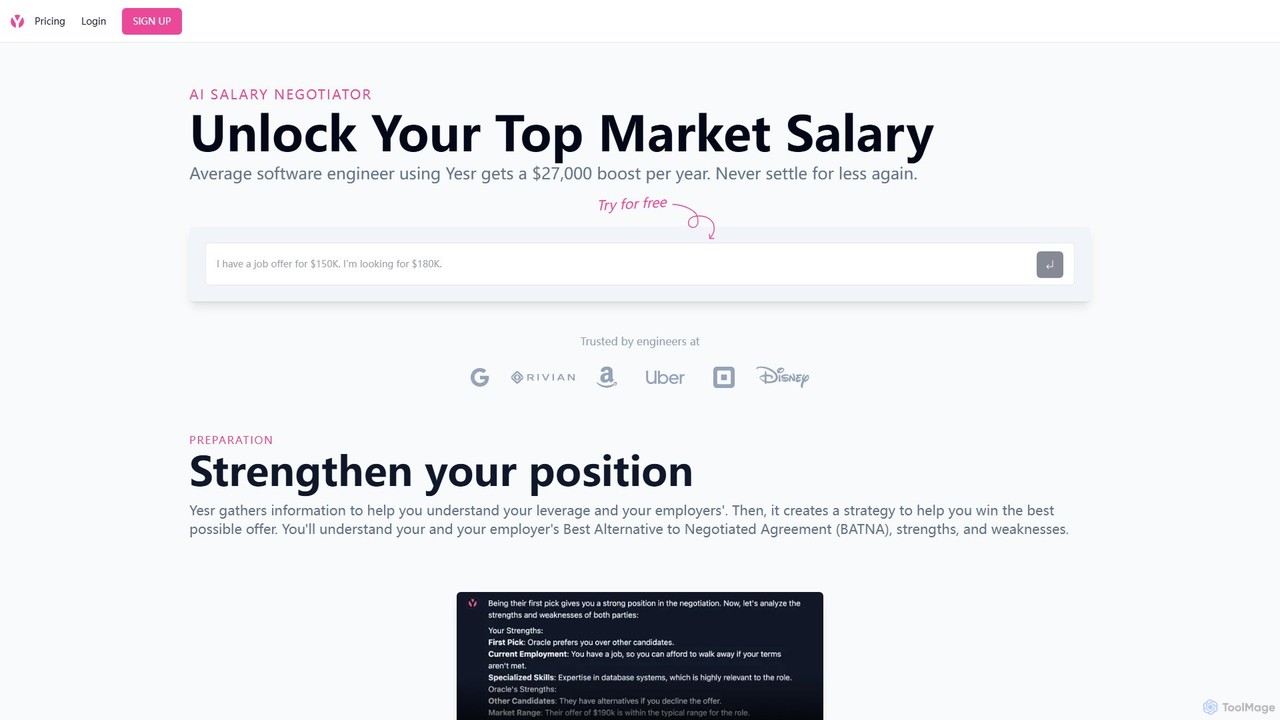
Yesr is an AI-powered salary negotiator designed specifically for software engineers. It acts as a personal career coach, providing data-driven strategies, advanced negotiation techniques, and interactive role-playing to help you confidently secure the highest possible salary. On average, users achieve a $27,000 annual salary increase.
About Salary Negotiation
AI Salary Negotiation tools are specialized applications designed to empower professionals in compensation discussions. They leverage large datasets of market salary information and natural language processing to analyze job offers, benchmark compensation, and generate persuasive negotiation arguments. These tools help users understand their market value, build confidence, and strategically navigate conversations to secure a more favorable salary and benefits package. Unlike general career platforms, they provide targeted, data-driven insights specifically for the negotiation phase of one's career.
Core Features
- Market Salary Analysis: Provides real-time, role-specific salary benchmarks based on location, experience, and industry.
- Offer Letter Review: Analyzes the complete compensation package, including base salary, bonuses, equity, and benefits.
- Negotiation Script Generation: Creates personalized talking points, counter-offer emails, and communication strategies.
- Skills and Value Assessment: Helps articulate your skills and accomplishments in terms of market value to justify a higher salary.
- Practice Scenarios: Simulates negotiation conversations to help users build confidence and refine their approach.
Use Cases
These tools are primarily used by job seekers evaluating new offers, current employees preparing for performance reviews or promotion discussions, and freelancers setting project rates. They are particularly valuable for professionals in tech, finance, marketing, and other fields where compensation structures can be complex and highly variable, requiring data-backed negotiation tactics.
How to Choose
When selecting an AI Salary Negotiation tool, consider the recency and source of its market data. Evaluate the depth of its offer analysis—does it cover equity and non-salary benefits? Assess the level of personalization in its script generation and whether it provides interactive coaching or practice features to build practical skills. Finally, consider the user interface and overall ease of use.

Salary NegotiationUse Cases
Analyze a New Job Offer for a Tech Role
A software engineer receives a job offer from a startup. They input the offer details—base salary, stock options (ISOs), and signing bonus—into an AI negotiation tool. The AI instantly benchmarks the offer against real-time market data for similar roles in their city, revealing the base salary is competitive but the equity portion is 15% below the average. The tool then generates a polite and data-backed email draft to the recruiter, highlighting their enthusiasm for the role while requesting a conversation to discuss adjusting the equity component to better align with industry standards.
Prepare for an Annual Performance Review
A marketing manager is preparing for their annual review and wants to request a raise. They use an AI tool to input their current salary, key achievements from the past year (e.g., 'led a campaign that increased leads by 30%'), and job responsibilities. The AI analyzes this information against market trends and salary data for marketing managers with similar experience. It provides a recommended salary range to target and generates structured talking points. These points help the manager clearly articulate their value and contributions, linking them directly to business outcomes, making the request for a raise confident and well-reasoned.
Negotiate a Promotion-Based Salary Increase
An analyst is promoted to a senior analyst role. The initial salary increase offered is modest. The employee uses an AI tool to compare the new offer against the market rate for a 'Senior Analyst' in their industry and location, not just an incremental raise on their previous salary. The tool confirms a significant gap. It then helps draft a negotiation script that thanks management for the promotion, expresses excitement for the new responsibilities, and presents the market data as a basis for discussing a revised salary that truly reflects the new level of seniority and responsibility.
Evaluate Competing Job Offers with Complex Variables
A sales executive receives two job offers. Offer A has a higher base salary, while Offer B has a lower base but a more lucrative, uncapped commission structure and better health benefits. Using an AI tool, the executive inputs all components of both offers. The AI calculates the total potential compensation for Offer B under different performance scenarios (e.g., meeting 80%, 100%, and 120% of quota) and quantifies the monetary value of the superior benefits. This provides a clear, side-by-side comparison of the total value proposition, enabling a decision based on comprehensive data rather than just the base salary figure.
Set Competitive Rates for a Freelance Project
A freelance UX designer is asked to quote a price for a three-month website redesign project. Unsure of the current market rates, they use an AI negotiation tool. They input the project scope, required skills (e.g., Figma, user research), project duration, and client industry. The AI analyzes data from thousands of freelance contracts and provides a recommended project fee range (e.g., $15,000 - $20,000) and an equivalent hourly rate. It also generates bullet points for their proposal that justify this rate based on the complexity of the work and their specific expertise, empowering them to bid confidently and avoid underpricing their services.
Build Confidence for a First-Time Negotiator
A recent graduate receives their first full-time job offer. They are nervous about negotiating and unsure what to say. They use an AI tool that offers interactive practice scenarios. The AI simulates a conversation with a recruiter, allowing the graduate to practice their responses to common questions like 'What are your salary expectations?'. The tool provides real-time feedback on their phrasing and tone. It also generates a simple, professional script they can adapt, focusing on their excitement for the role and asking if there is any flexibility in the initial offer. This process demystifies negotiation and builds the confidence needed to have the conversation.