Rescale
Rescale is a cloud-based High Performance Computing (HPC) platform designed to accelerate engineering and scientific R&D. It provides …
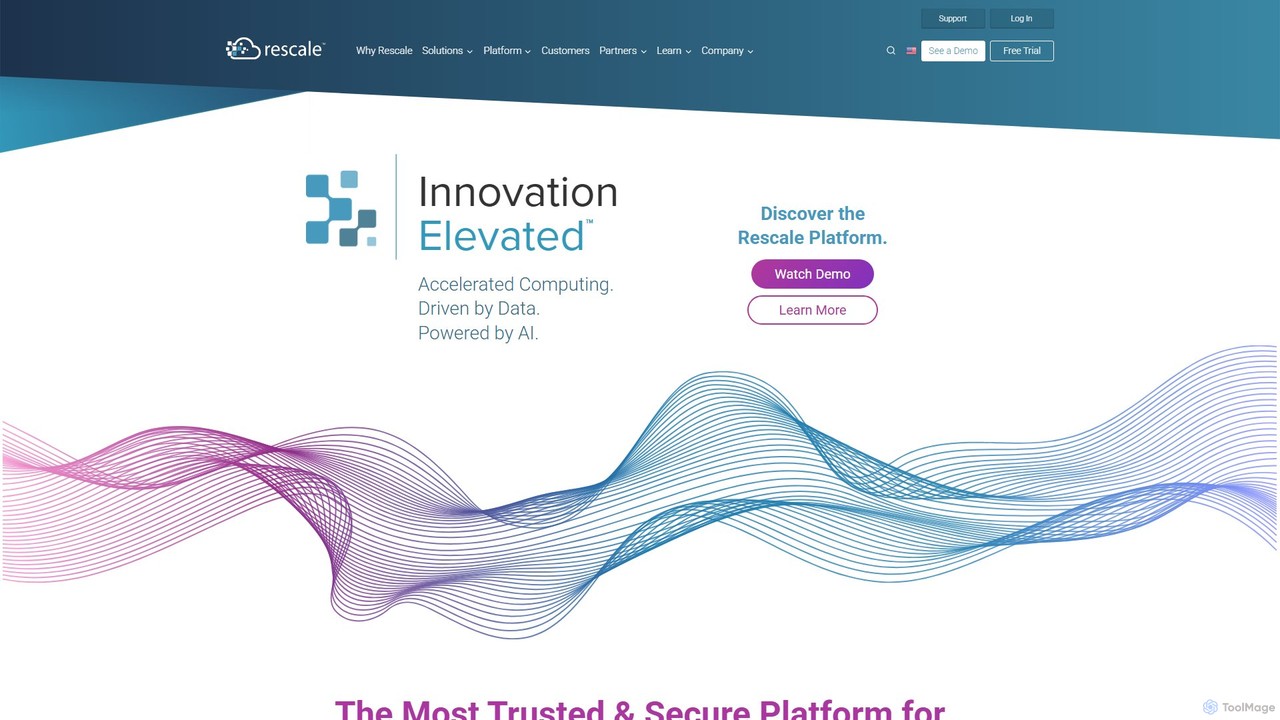
Rescale is a cloud-based High Performance Computing (HPC) platform designed to accelerate engineering and scientific R&D. It provides on-demand access to a multi-cloud infrastructure, a vast catalog of simulation and AI software, and a unified environment for managing complex workflows, data, and security. It empowers organizations in aerospace, automotive, life sciences, and more to innovate faster and more efficiently.
About High Performance Computing (Hpc)
High Performance Computing (HPC) refers to the aggregation of computing power to deliver significantly higher performance than a typical workstation or server, enabling the solution of complex computational problems. These systems leverage parallel processing and distributed architectures, often incorporating specialized hardware like GPUs and FPGAs, to execute massive calculations at speed. Within the broader context of cloud computing, HPC offers scalable and on-demand access to these powerful resources, democratizing advanced computational capabilities for various industries.
Core Features
- Parallel Processing: Distributes computational tasks across multiple processors or nodes simultaneously for faster execution.
- Specialized Accelerators: Integrates GPUs, FPGAs, and other hardware to enhance processing of specific, computationally intensive workloads.
- High-Speed Interconnects: Utilizes low-latency, high-bandwidth networks for rapid data exchange between computing nodes in a cluster.
- Distributed File Systems: Manages and provides efficient access to massive datasets across a cluster of machines.
- Workload Management: Schedules, monitors, and optimizes the execution of complex computational jobs across the HPC environment.
Applicable Scenarios
HPC is essential for fields requiring intensive data processing and complex simulations. It supports scientific research in physics, chemistry, and biology, engineering design for aerospace and automotive industries, and advanced analytics in finance. Researchers and engineers rely on HPC to model intricate systems and process vast amounts of data that would overwhelm conventional computing resources.
How to Choose
When selecting an HPC solution, consider the specific performance requirements for your workloads, including CPU/GPU needs and memory capacity. Evaluate scalability options to ensure the system can grow with your demands, and assess the total cost of ownership, including infrastructure, software licenses, and data transfer. Compatibility with existing software and robust data management capabilities are also crucial for seamless integration and efficient operation.

High Performance Computing (Hpc)Use Cases
Drug Discovery and Genomics Research
Pharmaceutical researchers utilize HPC to simulate molecular dynamics, predict protein folding, and analyze vast genomic datasets. This accelerates the identification of potential drug candidates and understanding of genetic diseases, significantly reducing the time and cost associated with traditional laboratory experiments.
Advanced Weather Forecasting and Climate Modeling
Meteorologists and climate scientists employ HPC clusters to run highly complex atmospheric and oceanic models. These simulations process enormous volumes of real-time data to generate accurate long-range weather predictions and project future climate change scenarios, aiding disaster preparedness and policy-making.
Financial Risk Analysis and Algorithmic Trading
Financial institutions leverage HPC for Monte Carlo simulations, option pricing, and backtesting complex algorithmic trading strategies. This enables rapid evaluation of market risks, optimization of investment portfolios, and execution of high-frequency trades with minimal latency, providing a competitive edge.
Automotive and Aerospace Engineering Simulations
Engineers in the automotive and aerospace sectors use HPC for computational fluid dynamics (CFD) and finite element analysis (FEA). This allows for virtual crash testing, aerodynamic optimization, and structural integrity analysis of new designs, reducing the need for expensive physical prototypes and accelerating product development cycles.
Large-Scale AI Model Training
AI researchers and developers rely on HPC, particularly GPU-accelerated clusters, to train massive deep learning models, such as large language models (LLMs) and advanced computer vision systems. This enables the processing of petabytes of data and billions of parameters, leading to more sophisticated and accurate AI applications.
Oil and Gas Exploration and Reservoir Simulation
Geophysicists and petroleum engineers use HPC to process and interpret seismic data, creating detailed subsurface images to identify potential oil and gas reserves. Additionally, reservoir simulations predict fluid flow and production over time, optimizing drilling strategies and maximizing resource extraction efficiency.