AI Humanizer
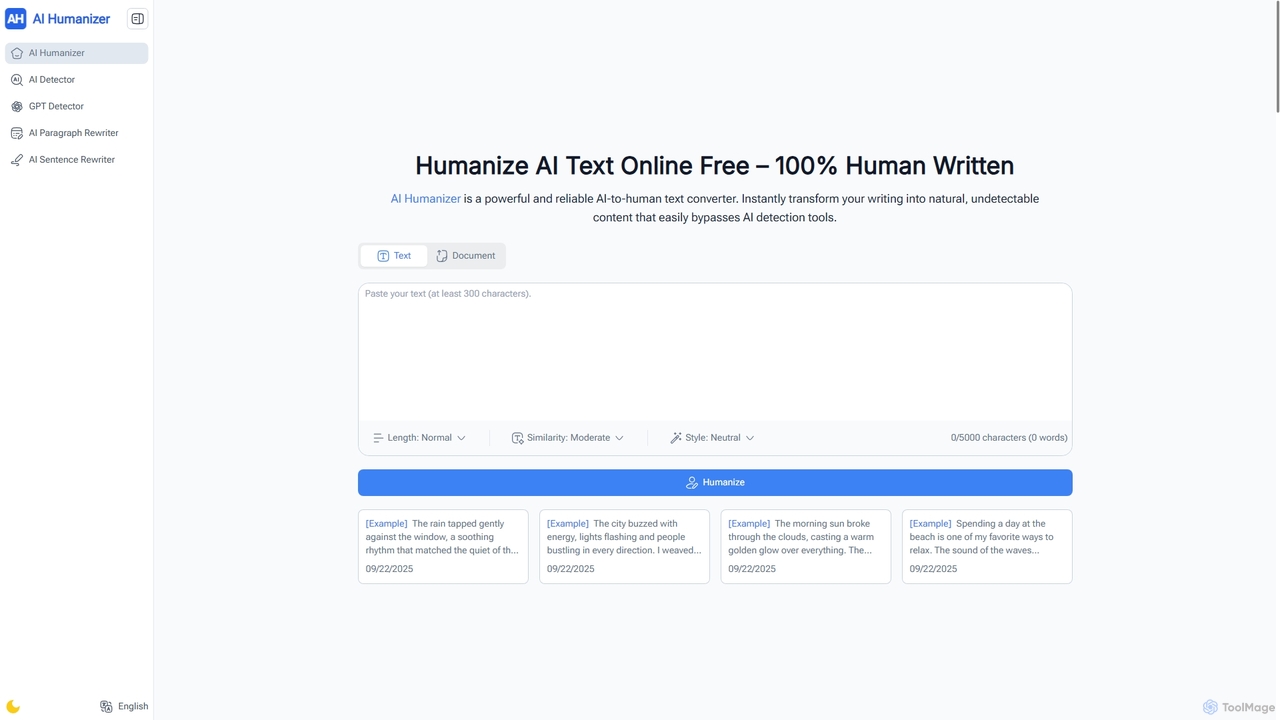
AI Humanizer is a comprehensive online platform offering a suite of free tools to transform AI-generated text into …
AI Humanizer is a comprehensive online platform offering a suite of free tools to transform AI-generated text into natural, human-like content, accurately detect AI writing, and rewrite sentences or paragraphs in various styles. It helps users bypass AI detection, enhance readability, and maintain authenticity across academic, professional, and creative writing, all without requiring any sign-up or hidden fees.
About Ai Detection
AI Detection tools are specialized applications designed to determine whether content, primarily text, was generated by an artificial intelligence model. They operate by analyzing linguistic patterns, sentence structure, predictability (perplexity), and variations in word choice (burstiness) that are characteristic of machine-generated text. These tools are essential for educators, publishers, and SEO professionals to uphold academic integrity, verify content authenticity, and prevent the proliferation of low-quality, AI-generated content. Unlike content creation tools that produce material, AI detectors serve a critical verification and analysis role.
Core Features
- AI Content Scoring: Provides a percentage score indicating the likelihood that content was written by AI versus a human.
- Text Highlighting: Visually marks specific sentences or paragraphs that are most likely AI-generated, allowing for detailed review.
- Model Identification: Some advanced tools can attempt to identify which specific AI model (e.g., GPT-4, Claude) may have been used.
- Plagiarism Comparison: Often integrated with plagiarism checkers to provide a comprehensive analysis of both originality and authorship.
- Bulk Analysis: Allows users to upload multiple files or URLs at once for efficient screening of large volumes of content.
Use Cases
AI Detection tools are widely used in academia by teachers and institutions to check student submissions for AI-assisted plagiarism. In the publishing and digital marketing industries, content managers and SEO specialists use them to vet articles from writers, ensuring content meets originality guidelines and avoids search engine penalties. They are also valuable in recruitment for screening candidate applications.
How to Choose
When selecting an AI Detection tool, prioritize its accuracy and low rate of false positives. Evaluate its ability to detect content from the latest and most advanced AI models. Consider whether it offers integrations with your existing platforms, such as Learning Management Systems (LMS) or Content Management Systems (CMS). Finally, assess the pricing model based on your expected volume of analysis, whether it's by word count, document, or a subscription plan.

Ai DetectionUse Cases
Upholding Academic Integrity in Education
An educator at a university is tasked with grading dozens of student essays. To ensure fairness and uphold academic standards, they use an AI detection tool to scan each submission. The tool provides a report for each essay, highlighting passages with a high probability of being AI-generated. This allows the educator to identify potential academic dishonesty and initiate a conversation with the student, using the report as a starting point for discussion rather than a final verdict. This process helps maintain the integrity of the educational assessment process.
Ensuring Content Authenticity for SEO
A content manager for a digital marketing agency oversees a team of freelance writers. To maintain high-quality standards and comply with search engine guidelines against spammy AI content, every article is processed through an AI detector before publication. The tool flags a submission that scores 95% AI-generated. The manager can then return the article to the writer for a complete rewrite, preventing the publication of low-value content that could harm the website's search rankings and brand reputation.
Screening Candidate Submissions in Recruitment
A human resources department receives hundreds of applications for a technical writer position, each with a required writing sample. To efficiently filter candidates and assess genuine writing skills, an HR specialist uses an AI detection tool to perform a batch analysis of all samples. The tool helps identify applications that rely heavily on AI assistance, allowing the recruitment team to focus on candidates who demonstrate authentic writing and communication abilities, leading to a more effective hiring process.
Moderating User-Generated Content on Platforms
The moderator of a large online forum or review website faces a challenge with spam and fake reviews generated by bots. By integrating an AI detection API, the platform can automatically scan new posts and comments. Content that is flagged as highly likely to be AI-generated is quarantined for human review or automatically removed. This proactive approach helps maintain the authenticity of user interactions and protects the community from manipulative or low-quality automated content.
Verifying Originality in Publishing and Media
An editor at a digital magazine receives pitches and drafts from various contributors. To protect the publication's reputation for original, high-quality journalism, the editorial workflow includes a mandatory AI detection step. This ensures that all published articles are the genuine work of the credited author. It helps prevent embarrassing situations where the magazine might unknowingly publish content that is largely generated by an AI, thus preserving reader trust and editorial credibility.
Analyzing Legal and Research Documents
A paralegal or junior researcher is compiling a literature review or summarizing case law. A senior partner uses an AI detection tool to review the draft. The purpose is not just to check for plagiarism but to ensure the junior colleague has engaged critically with the material rather than simply using an AI to summarize sources. The tool helps verify that the analysis and synthesis are the result of human intellect, which is critical for developing legal arguments and ensuring the quality of research.