WebAssistants.ai
WebAssistants.ai offers custom AI assistants and expert consulting services to integrate and optimize AI for your business. They …
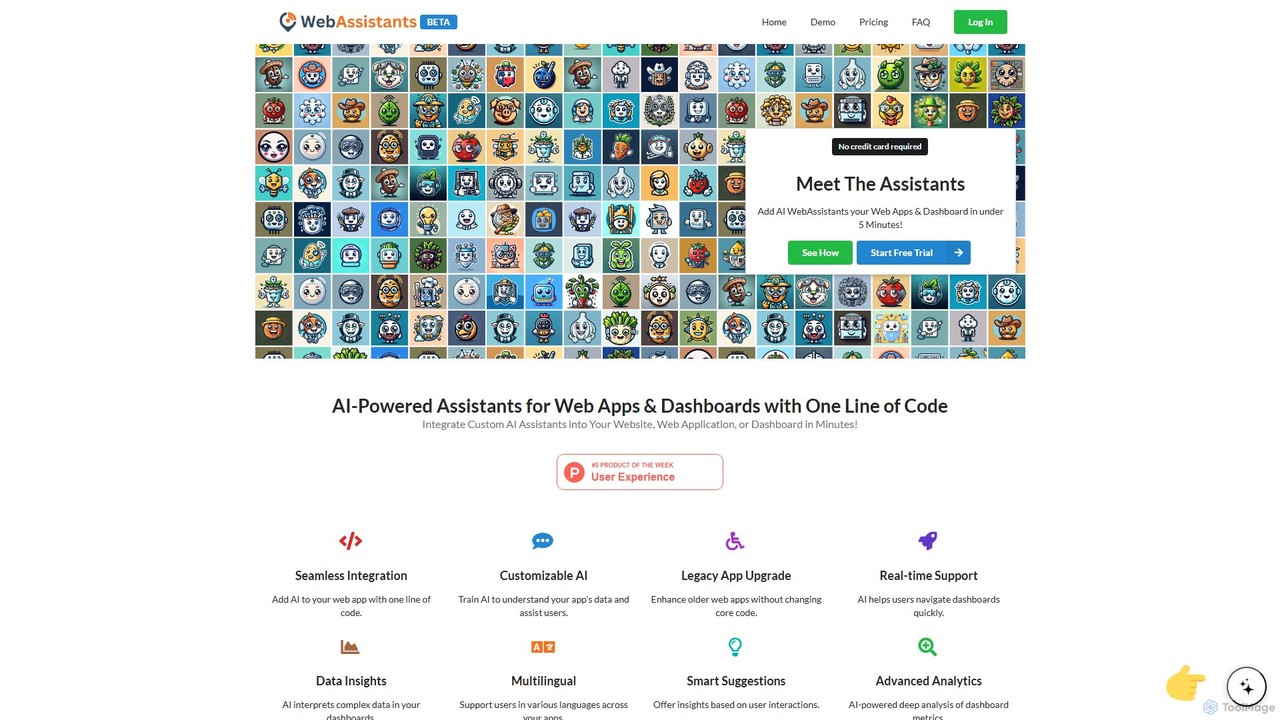
WebAssistants.ai offers custom AI assistants and expert consulting services to integrate and optimize AI for your business. They build tailored solutions, from data analysis dashboards to automated HR tools, designed to align with your specific goals and seamlessly integrate into your website and existing systems.
About Custom Chatbots
Custom Chatbots are AI tools that allow you to build and train conversational agents using your own specific data. These tools utilize Large Language Models (LLMs) and Retrieval-Augmented Generation (RAG) to analyze documents, websites, or knowledge bases, enabling the chatbot to provide accurate, context-aware answers. This approach transforms static information into an interactive, on-demand resource, serving as a specialized expert for your customers or team. Unlike generic bots, Custom Chatbots reflect your unique brand voice and knowledge base.
Core Features
- Data Source Integration: Connect and train the bot on various data types, including websites, PDFs, text documents, and knowledge bases like Notion or Confluence.
- No-Code Builder: An intuitive visual interface for designing conversation flows, customizing appearance, and training the AI without writing any code.
- Persona and Tone Customization: Define the chatbot's personality, communication style, and language to align with your brand identity.
- Multi-channel Deployment: Easily embed the finished chatbot on websites, or integrate it into messaging platforms like Slack, WhatsApp, or Telegram.
- Conversation Analytics: Access dashboards to monitor user interactions, track query types, and identify areas for improving the knowledge base.
Use Cases
Custom Chatbots are widely used for enhancing customer support by providing instant, 24/7 answers to specific product or service questions. Internally, companies deploy them as knowledge management assistants, giving employees immediate access to company policies, technical documentation, and project information. They are also effective in lead generation, engaging website visitors by answering detailed questions and qualifying their interest.
How to Choose
When selecting a Custom Chatbot tool, first evaluate its data source compatibility and the ease of updating the knowledge base. Consider the level of customization available for the bot's persona, appearance, and response logic. Assess the platform's ease of use—whether it's a true no-code solution or requires some technical skill. Finally, review the deployment options and integration capabilities with your existing systems, along with the pricing model, which is often based on message volume or data size.

Custom ChatbotsUse Cases
Internal Knowledge Base for Employees
An HR department uses a custom chatbot builder to create an internal assistant. They upload all company policy PDFs, benefits guides, and onboarding documents. The bot is then embedded in the company's intranet. New and existing employees can ask questions in natural language like 'What is the policy for parental leave?' or 'How do I submit an expense report?' and receive instant, accurate answers sourced directly from the official documents. This reduces the repetitive query load on the HR team by over 60% and provides employees with 24/7 access to information.
E-commerce Product Advisor Chatbot
An online electronics store trains a custom chatbot on its entire product catalog, including technical specifications, user manuals, and customer reviews. The chatbot is placed on product pages and the homepage. It acts as a virtual sales assistant, helping customers compare products ('Compare the iPhone 15 Pro with the Samsung S24'), answer specific feature questions ('Does this laptop have a backlit keyboard?'), and recommend accessories. This provides a personalized shopping experience, increases conversion rates, and reduces the number of basic support tickets.
SaaS Onboarding and Support Assistant
A software-as-a-service (SaaS) company creates a custom chatbot trained on its extensive help documentation, API guides, and video tutorial transcripts. The bot is integrated into their application's dashboard. When new users sign up, the bot proactively guides them through key features. If a user gets stuck, they can ask the bot 'How do I integrate with Google Calendar?' and get a step-by-step guide with links to the relevant documentation. This improves user activation rates and frees up the human support team to handle more complex technical issues.
Lead Qualification for B2B Services
A digital marketing agency places a custom chatbot on its website's homepage and services pages. The bot is trained on their case studies, service descriptions, and pricing information. It engages visitors with questions like 'What is your biggest marketing challenge?'. Based on the answers, it provides relevant information, suggests appropriate services, and can even schedule a consultation with a sales representative if the visitor meets certain qualification criteria. This automates the top of the sales funnel, ensuring the sales team only spends time on high-potential leads.
University Course and Admissions Information Bot
A university's admissions office builds a custom chatbot trained on the entire course catalog, admission requirements, tuition fee structures, and campus life FAQs. The bot is deployed on the university's website to assist prospective students 24/7. It can answer complex queries like 'What are the prerequisites for the computer science major?' or 'Tell me about scholarships for international students.' This provides immediate support to applicants across different time zones and reduces the email and phone call volume for the admissions staff, allowing them to focus on application reviews.
Personalized Online Course Tutoring Bot
An online educator who sells a course on digital marketing creates a custom chatbot trained on all their course modules, video transcripts, and supplementary reading materials. This bot is offered to enrolled students as a 24/7 tutor. Students can ask specific questions like 'Can you explain the difference between SEO and SEM again?' or 'What are the key components of a successful email campaign?'. The bot provides detailed, instant answers based on the course content, helping to reinforce learning and improve student satisfaction and completion rates without requiring the educator's constant availability.