ToolMage
Sign in

Best 25 Chatbots AI tools for Entertainment

Popular Chatbots AI tools in Entertainment include character.ai, Candy AI, Talkie AI, Dopple.ai, StoryChan, Lollipop, GPT6, Clona, Aroused.ai, and Chatmate AI, helping you work more efficiently.

Ask Famous People
Freemium

Ask Famous People

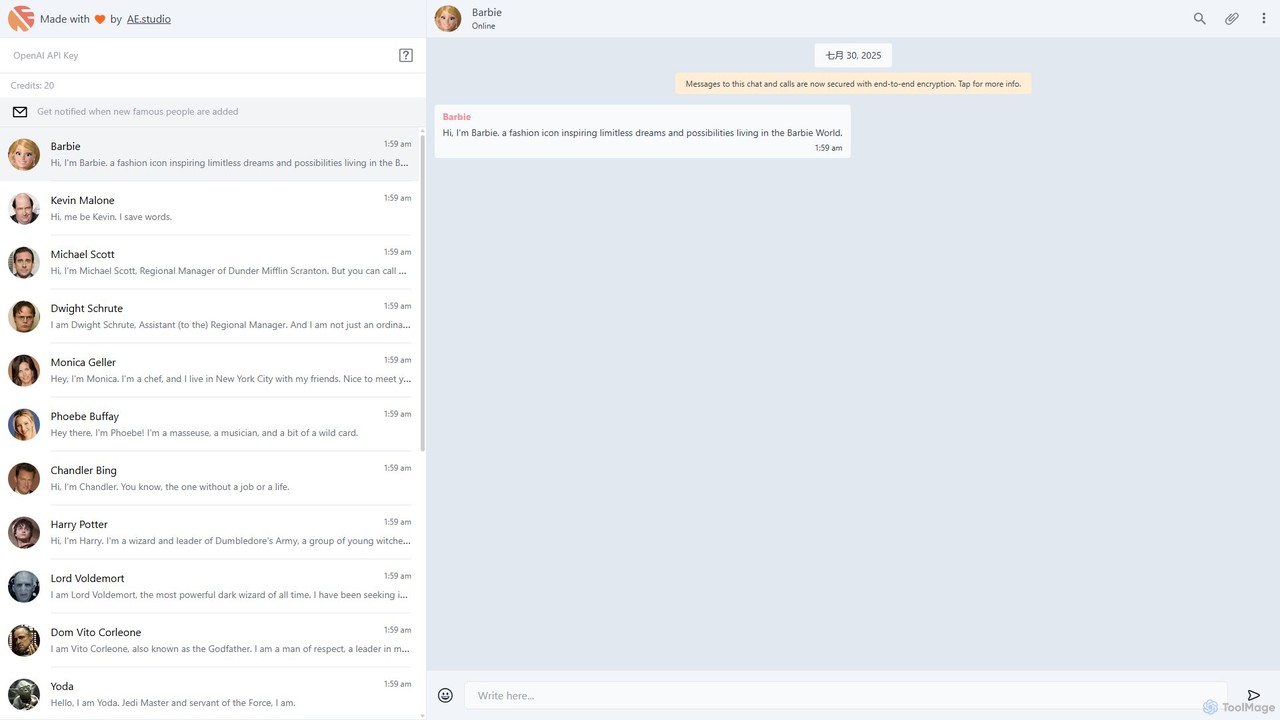
Engage in interactive conversations with AI-powered personas of historical figures, celebrities, and fictional characters. A unique platform for entertainment, education, and creative inspiration.

Interactive Learning
Visits 7.2KFavorites 113Likes 122
About Chatbots

Chatbots are AI-powered conversational agents designed to simulate human-like conversations through text or voice interfaces. Leveraging natural language processing (NLP) and machine learning, these tools can understand user queries, provide relevant information, and perform tasks automatically. They enhance user experience by offering instant support, personalized interactions, and efficient information retrieval across various platforms, from websites to messaging apps.

Core Features

  • Natural Language Understanding (NLU): Interprets user intent and context from free-form text or speech.
  • Dialogue Management: Maintains conversation flow, remembers context, and guides users through complex interactions.
  • Personalization: Adapts responses and recommendations based on user history, preferences, and data.
  • Multi-channel Deployment: Integrates seamlessly across websites, mobile apps, social media, and messaging platforms.
  • Integration Capabilities: Connects with CRM, ERP, and other business systems to access and update information.

Use Cases

Chatbots are widely adopted across industries to streamline operations and improve customer engagement. They serve as virtual assistants for customer support, automate lead qualification in sales, and provide instant answers to frequently asked questions. In the context of entertainment, chatbots can offer interactive storytelling, personalized game guides, or engaging conversational experiences for fans.

How to Choose

When selecting a chatbot solution, consider its natural language understanding capabilities, ensuring it can accurately interpret diverse user inputs. Evaluate its integration potential with existing business systems and the ease of deployment across desired channels. Assess the level of customization offered for dialogue flows and branding, alongside scalability to handle varying user volumes and robust analytics for performance monitoring.

Featured tool rankings

Chatbots use cases

1

Automating Customer Support Inquiries

Customer service teams can deploy AI chatbots to handle a high volume of routine inquiries, such as checking order status, providing product information, or resetting passwords. The chatbot instantly responds to common questions 24/7, freeing human agents to focus on complex issues. This significantly reduces response times and improves overall customer satisfaction by offering immediate assistance.

2

Generating Qualified Sales Leads

Marketing and sales teams utilize chatbots on websites to engage visitors, ask qualifying questions, and gather contact information. The chatbot can identify potential leads based on their responses, provide relevant product details, and even schedule demos or calls with sales representatives. This automates the initial lead qualification process, ensuring sales teams receive warmer, more promising prospects.

3

Providing Personalized Product Recommendations

E-commerce businesses can integrate chatbots to offer personalized shopping assistance. As users browse, the chatbot can ask about their preferences, budget, and needs, then suggest relevant products or services. This interactive guidance helps users discover items they might like, enhancing the shopping experience and potentially increasing conversion rates by tailoring suggestions to individual tastes.

4

Delivering Interactive Educational Content

Educational platforms and content creators can use chatbots to create engaging learning experiences. A chatbot can act as a virtual tutor, answering student questions, providing explanations, or guiding them through interactive quizzes and exercises. This personalized, on-demand support makes learning more accessible and dynamic, adapting to individual learning paces and styles.

5

Enhancing Employee Onboarding and HR Support

HR departments can deploy internal chatbots to assist new hires with onboarding processes, answer common HR policy questions, or guide employees through benefits enrollment. The chatbot provides instant access to company information and forms, reducing the burden on HR staff and ensuring employees quickly find the information they need, improving efficiency and employee satisfaction.

6

Creating Engaging Entertainment Experiences

Content creators and entertainment companies can leverage chatbots for interactive storytelling, character interaction, or personalized game guides. A chatbot can allow users to converse with fictional characters, influence narrative paths, or receive dynamic tips within a game. This deepens user immersion and engagement, offering novel ways to experience digital content beyond passive consumption.

Chatbots FAQ

What are AI Chatbots?

AI Chatbots are computer programs that simulate and process human conversation, either written or spoken, allowing humans to interact with digital devices as if they were communicating with a real person. They utilize artificial intelligence, particularly natural language processing (NLP) and machine learning, to understand user intent, analyze sentiment, and provide relevant, context-aware responses. Their primary goal is to automate communication and provide instant support or information.

How do AI Chatbots work?

AI Chatbots typically work by combining Natural Language Processing (NLP) and Machine Learning (ML). When a user inputs text or speech, NLP components like Natural Language Understanding (NLU) interpret the user's intent and extract key entities. Machine learning models then process this information, compare it against a knowledge base or trained data, and generate an appropriate response. Advanced chatbots also use Natural Language Generation (NLG) to create human-like replies and dialogue management systems to maintain conversation context.

What's the difference between AI Chatbots and rule-based Chatbots?

The main difference lies in their intelligence and flexibility. Rule-based chatbots operate on predefined rules, scripts, and keyword matching; they can only answer questions they are explicitly programmed for. If a query falls outside their rules, they fail. AI chatbots, conversely, use machine learning to understand context, intent, and even sentiment, allowing them to handle more complex, varied, and ambiguous queries. They can learn and improve over time, offering a more human-like and adaptable conversational experience.

What are the key benefits of using Chatbots for businesses?

Businesses benefit significantly from chatbots through enhanced customer service, operational efficiency, and lead generation. Chatbots provide 24/7 instant support, reducing response times and improving customer satisfaction. They automate routine tasks, freeing human staff for more complex work, thereby cutting operational costs. Additionally, chatbots can proactively engage website visitors, qualify leads, and guide users through sales funnels, contributing to increased conversions and revenue.

How can Chatbots enhance user engagement in entertainment?

In entertainment, chatbots can create highly interactive and personalized experiences. They can serve as virtual characters in games, allowing players to converse and influence narratives. For content platforms, chatbots can recommend personalized content, offer interactive quizzes, or facilitate fan discussions. This direct, conversational interaction deepens user immersion, fosters a sense of connection, and provides novel ways for audiences to engage with stories, characters, and media.