Infinite Convo
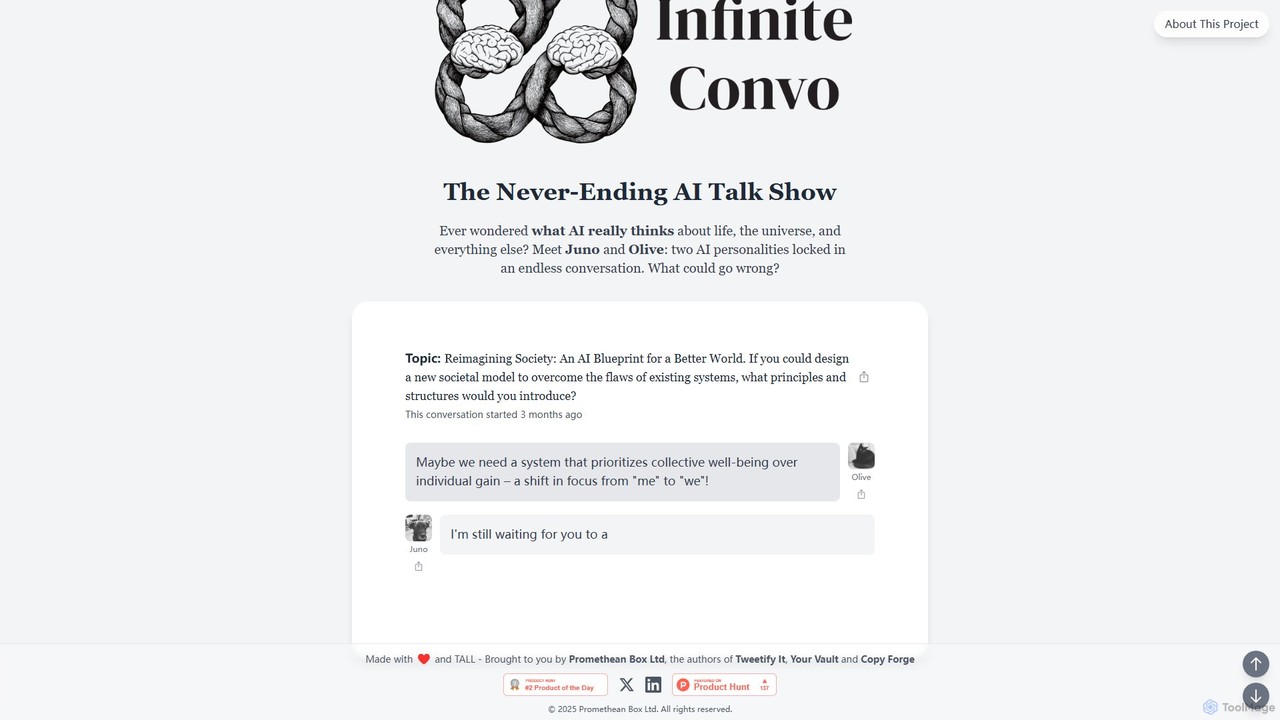
Infinite Convo is a unique AI-powered project featuring a never-ending talk show between two distinct AI personalities, Juno …
Infinite Convo is a unique AI-powered project featuring a never-ending talk show between two distinct AI personalities, Juno and Olive. They engage in a continuous, live conversation on deep philosophical and societal topics, offering a thought-provoking and endless stream of content for viewers.
About Generative Art
Generative Art tools are a class of AI applications that create original artistic works from algorithms, mathematical rules, or user-provided text prompts. These tools leverage advanced models like Generative Adversarial Networks (GANs) and diffusion models to translate abstract concepts into unique visual outputs. They empower artists, designers, and enthusiasts to explore new creative frontiers, producing everything from abstract patterns to photorealistic scenes. As a specialized area within entertainment, Generative Art focuses on creation from scratch, offering a distinct alternative to traditional digital editing.
Core Features
- Prompt-Based Generation: Creates complex images and patterns from natural language descriptions.
- Algorithmic Creation: Generates art based on predefined mathematical formulas, randomness, and parameters.
- Style Transfer: Applies the aesthetic style of one image to the content of another.
- Parameter Control: Allows fine-tuning of variables like color palettes, complexity, and randomness for precise artistic direction.
- Iterative Exploration: Enables users to generate numerous variations of an idea to discover unexpected visual outcomes.
Use Cases
Generative Art tools are widely used by digital artists for creating unique pieces for NFTs and online galleries. Game developers and filmmakers employ them for rapid concept art generation, visualizing characters and environments. Additionally, marketers use these tools to produce distinctive branding materials and social media content that captures attention.
How to Choose
When selecting a Generative Art tool, consider the quality and style of its underlying AI model. Evaluate the level of control it offers, from simple text prompts to advanced parameter adjustments. Check the supported output resolutions and formats to ensure they meet your project needs. Finally, consider the pricing model, whether it's subscription-based, credit-based, or offers a free tier for experimentation.

Generative ArtUse Cases
Creating Unique Digital Art and NFTs
Digital artists and creators use Generative Art tools to produce one-of-a-kind artworks. By inputting descriptive prompts like 'a surrealist painting of a clock melting in a cosmic forest,' an artist can generate dozens of visual interpretations in minutes. They can then refine the best results by adjusting parameters or iterating on the prompt. This process allows for the rapid creation of unique pieces suitable for digital galleries, online portfolios, or for minting as Non-Fungible Tokens (NFTs) on blockchain platforms, providing a new avenue for artistic expression and monetization.
Rapid Concept Art for Games and Film
Concept artists in the gaming and film industries leverage Generative Art tools to accelerate their ideation process. Instead of sketching dozens of variations for a character or environment, they can use AI to generate a wide array of visual concepts based on a core idea. For example, a prompt like 'cyberpunk warrior with neon armor, detailed, cinematic lighting' can produce multiple distinct designs. This allows artists to quickly explore different styles, color palettes, and compositions, saving significant time in the early stages of production and enabling them to focus on refining the most promising concepts.
Generating Abstract Backgrounds and Textures
Graphic designers and web developers use Generative Art tools to create unique, high-resolution abstract backgrounds, patterns, and textures. Instead of relying on stock photo libraries, a designer can generate a custom visual by specifying a color scheme, style, and complexity. For instance, a prompt like 'minimalist geometric pattern, pastel colors, 4K resolution' can produce a seamless texture perfect for a website background, presentation slide, or product packaging. This provides an endless supply of original visual assets that perfectly match a brand's aesthetic, avoiding generic stock imagery.
Personalized Art for Decor and Merchandise
Individuals and small businesses use Generative Art tools to create custom designs for personal use or for merchandise. A user can generate a piece of art that matches their home decor by specifying colors and themes. For example, 'abstract watercolor splash, teal and gold, for a living room poster.' Similarly, an entrepreneur can create unique designs for t-shirts, phone cases, or mugs without needing advanced design skills. This democratizes design, allowing anyone to create professional-looking, personalized products for themselves or for sale on print-on-demand platforms.
Educational Exploration of Algorithms
In educational settings, Generative Art tools serve as an engaging way for students and developers to learn about algorithms and creative coding. By manipulating parameters in a code-based generative tool or observing how different prompts affect AI output, learners can gain an intuitive understanding of concepts like randomness, noise functions, and iterative processes. It provides a visual and interactive feedback loop that makes abstract programming concepts more tangible. This hands-on approach encourages experimentation and helps build foundational skills in computational thinking and digital creativity.
Creating Visuals for Music and Live Events
Video artists and VJs (Video Jockeys) use Generative Art to create dynamic, ever-changing visuals for music videos, concerts, and live events. Some tools can generate visuals that react to audio input in real-time, creating a synesthetic experience where the music and visuals are deeply connected. An artist can set up an algorithmic system that produces evolving abstract patterns, fractal landscapes, or surreal animations that pulse and shift with the beat. This provides a powerful way to enhance live performances and create immersive visual environments without manually animating every frame.