ToolMage
Sign in

Best 1 Interactive Stories AI tools for Entertainment

Popular Interactive Stories AI tools in Entertainment include TalesMio, helping you work more efficiently.

TalesMio
Paid

TalesMio

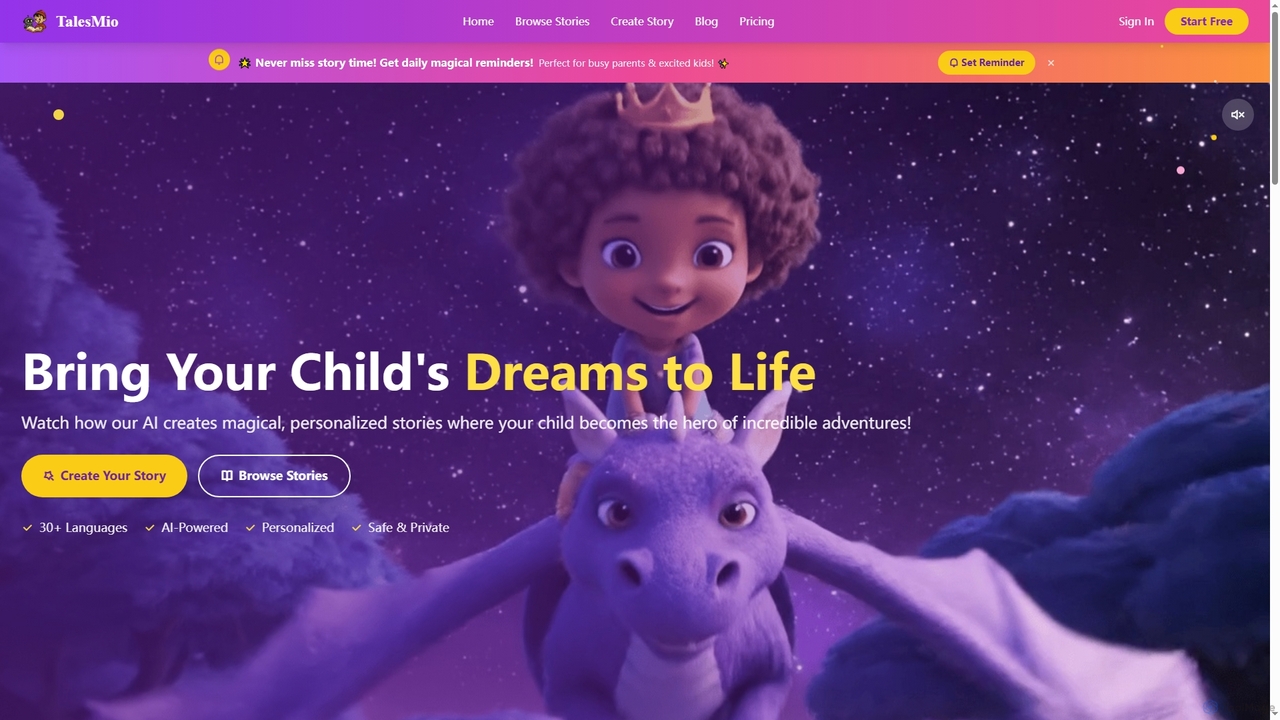
TalesMio is an AI-powered platform that transforms children's dreams into personalized, interactive stories. Parents can create unique adventures where their child becomes the hero, complete with professional narration, vivid illustrations, and magical sound effects, fostering imagination and a love for reading in a safe, ad-free environment.

Story Generation
Visits 5.6KFavorites 136Likes 120

About Interactive Stories

AI Interactive Stories tools are a class of applications that use artificial intelligence to generate dynamic narratives where user choices directly influence the plot, character interactions, and outcomes. These tools leverage large language models (LLMs) and procedural generation algorithms to create complex, branching storylines in real-time. Their primary value lies in creating deeply personal and replayable experiences, making them powerful assets for entertainment, education, and training. Unlike static story generators, they offer a truly responsive world that reacts to player input.

Core Features

  • Branching Narrative Generation: Automatically creates multiple plot paths and endings based on user decisions.
  • Dynamic Character AI: Generates NPCs (Non-Player Characters) with memories and personalities that evolve based on interactions.
  • World State Management: Tracks changes in the story world, ensuring choices have lasting consequences.
  • Multi-modal Output: Can produce stories not just as text, but also with accompanying AI-generated images, sound effects, or voiceovers.
  • Natural Language Input: Allows users to interact by typing commands or dialogue in plain language, not just selecting from a menu.

Use Cases

These tools are particularly valuable in game development for creating responsive quests and dialogues, in corporate training for building decision-making simulations, and in education for creating engaging learning modules. Marketers also use them to craft interactive advertisements that adapt to customer preferences, providing a personalized brand experience.

How to Choose

When selecting an AI Interactive Story tool, consider the complexity of the branching logic it supports—can it handle intricate, multi-layered plots? Evaluate the depth of its character AI and its ability to maintain context. For developers, the availability of an API for integration is crucial. Also, assess the quality and coherence of the generated content and the level of customization offered for tone, style, and world-building.

Interactive Stories use cases

1

Developing Complex NPC Dialogues for Games

An indie game developer is creating a role-playing game (RPG) with a rich world but lacks the resources for a large writing team. They use an AI Interactive Story tool to generate branching dialogue trees for dozens of non-player characters (NPCs). By defining each NPC's personality, background, and knowledge, the AI creates thousands of lines of coherent, in-character dialogue that react dynamically to the player's choices. This approach saves hundreds of hours of manual writing and allows for a more immersive and reactive game world than would otherwise be possible for a small team.

2

Creating Corporate Training Simulations

A human resources manager needs to train new sales representatives on handling difficult client negotiations. Instead of traditional role-playing, they use an AI tool to build an interactive simulation. The manager sets up a scenario with an AI-powered 'client' who has specific objections and a variable mood. Trainees interact with the client using natural language, and their choices in dialogue and strategy lead to different outcomes, such as closing the deal, losing the client, or escalating the issue. The AI provides instant feedback on their performance, offering a safe and repeatable environment to practice critical skills.

3

Generating Personalized Bedtime Stories

A parent wants to create unique and engaging bedtime stories for their child. Using an AI interactive story app, they input key details: the child's name as the main character, their favorite animal as a sidekick, and a setting like a 'magical candy forest'. The AI generates the beginning of a story and presents the child with choices at key moments, such as 'Do you cross the chocolate river or follow the gingerbread path?'. Each choice dynamically alters the rest of the story, creating a new adventure every night. This makes storytime more personal and encourages the child's imagination and decision-making skills.

4

Prototyping Narrative Game Mechanics

A game design team is exploring new ideas for a narrative-driven game. Before committing to extensive coding and writing, they use an AI interactive story tool as a rapid prototyping platform. They can quickly test different narrative structures, choice-consequence systems, and character interaction models. For example, they can simulate how a 'reputation' system would affect dialogue options across an entire town. This allows the team to iterate on core game mechanics and story concepts in days instead of months, ensuring the final design is engaging and well-thought-out before full production begins.

5

Crafting Interactive Marketing Campaigns

A marketing agency for a travel company wants to create a more engaging ad than a simple video. They build a short, interactive story titled 'Your Perfect Weekend Getaway'. Users answer questions like 'Do you prefer relaxing on a beach or hiking in the mountains?'. Based on their answers, the AI-driven story unfolds differently, showing them images and descriptions of a vacation tailored to their preferences. The story concludes with a personalized travel package recommendation and a direct booking link. This approach leads to higher user engagement and better conversion rates compared to static advertising.

6

Exploring Creative Writing and Worldbuilding

A fantasy author is developing a new world but is experiencing writer's block regarding a key character's motivations. They use an AI interactive story tool to role-play as that character within their own fictional setting. The author inputs the world's rules and history, then interacts with AI-generated characters and events. By making choices from the character's perspective, the author discovers new plot hooks, deepens the character's personality, and stress-tests their world's consistency. This process serves as a powerful brainstorming aid, helping to overcome creative hurdles and add unforeseen depth to their narrative.

Interactive Stories FAQ

What are AI Interactive Stories tools?

AI Interactive Stories tools are applications that use artificial intelligence, primarily large language models, to generate dynamic, choice-driven narratives. Unlike a standard AI story generator that produces a linear text, these tools create branching plots where the user's decisions actively shape the story's direction, character relationships, and final outcome. They essentially function as simulators for creating 'choose your own adventure' style experiences, games, or training modules with a high degree of variability and personalization.

How do AI Interactive Stories differ from traditional video games?

The primary difference lies in the degree of dynamic generation. Most traditional video games, even those with branching narratives, rely on pre-written scripts and a finite number of choices and outcomes. AI Interactive Stories, however, can generate new content, dialogue, and even plot points on the fly in response to a wider range of user inputs, including natural language. This allows for a potentially infinite number of unique story paths and a level of reactivity that is difficult to achieve with pre-scripted content alone. They are more like a guided improvisation with an AI Dungeon Master than a fixed, playable movie.

Who can benefit from using AI Interactive Story tools?

A wide range of users can benefit from these tools. Key groups include:

  • Game Developers: For rapidly prototyping narrative ideas and creating dynamic, replayable content for NPCs and quests.
  • Educators and Trainers: To build engaging simulations for teaching complex subjects or soft skills like negotiation and leadership.
  • Writers and Creatives: As a brainstorming tool to overcome writer's block, explore plot possibilities, and develop characters.
  • Marketers: To create personalized and interactive ad campaigns that increase customer engagement.
  • Hobbyists and Enthusiasts: For personal entertainment, creating unique stories to share with friends, or simply exploring the creative potential of AI.
What are the key features to look for in an AI Interactive Story tool?

When evaluating these tools, focus on features that control the narrative's quality and flexibility. Look for:

  • Context Window & Memory: The tool's ability to remember past events and choices is crucial for a coherent story. A larger context window means better long-term consistency.
  • Customization & Worldbuilding: The ability to define your own characters, settings, rules, and lore. This allows you to create a unique experience rather than a generic one.
  • Logic & Rules Engine: Advanced tools allow you to set specific rules (e.g., 'if player has item X, then option Y appears') to guide the AI and ensure key plot points are met.
  • API Access: For developers, an API is essential for integrating the story generation engine into their own games or applications.
  • Content Moderation: Features to prevent the AI from generating inappropriate or unintended content, which is important for public-facing applications.
How do I choose the right AI Interactive Story tool for my project?

Choosing the right tool depends on your specific needs. Consider the following factors:

  • Project Scope: Are you creating a simple text adventure or a complex game with state management? Simpler projects may only need a basic generator, while complex ones require advanced logic and API access.
  • Technical Skill: Some tools offer a user-friendly, no-code interface, while others are developer-focused and require programming knowledge to use their API.
  • Creative Control: How much control do you need over the story? Look for tools that allow deep customization of characters, world rules, and narrative tone.
  • Output Format: Do you need text-only output, or do you require integrated AI image or audio generation? Choose a tool that supports your desired media types.
  • Cost: Tools can range from free, limited versions to expensive enterprise subscriptions. Evaluate the pricing model against your budget and the features you require.