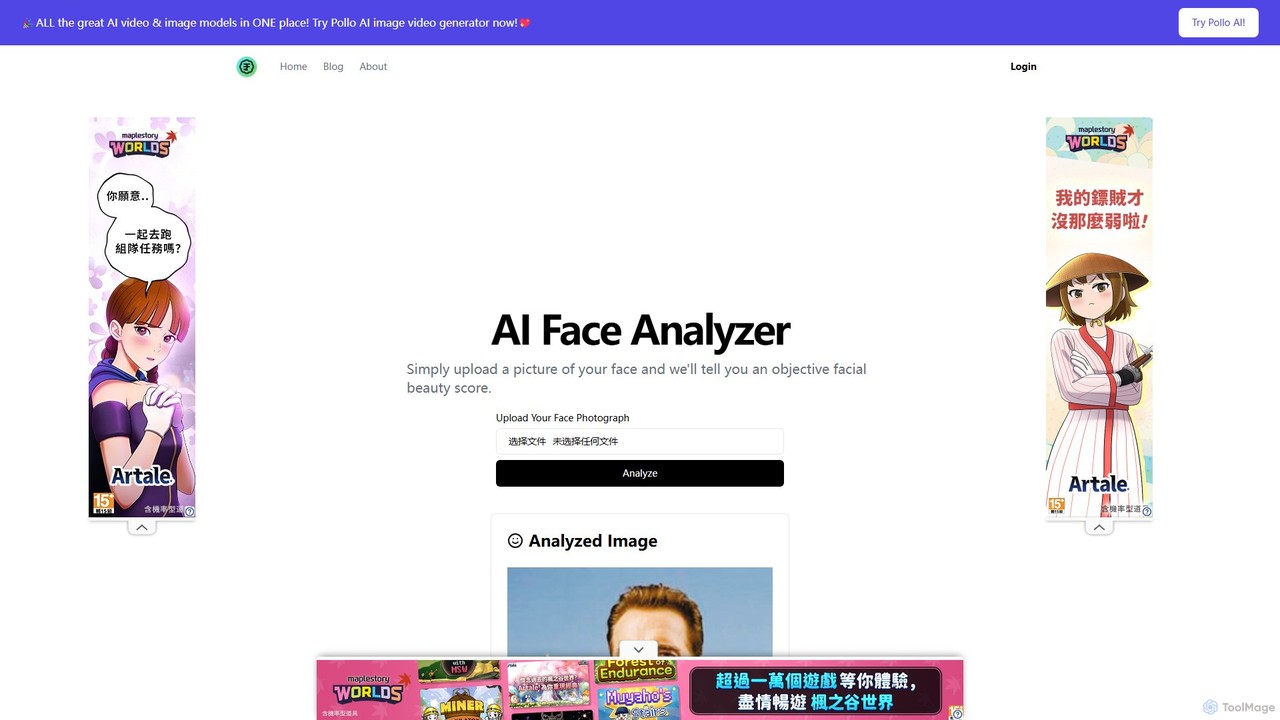
aifaceanalyzer
aifaceanalyzer is an AI-powered tool that analyzes your facial features from an uploaded photo to provide an objective …
aifaceanalyzer is an AI-powered tool that analyzes your facial features from an uploaded photo to provide an objective beauty score. It evaluates aspects like symmetry, proportionality, and skin clarity, offering insights for self-discovery. This tool provides a fun, data-driven perspective on aesthetics, emphasizing that true beauty is subjective and unique to every individual.
About Self Discovery
AI Self Discovery tools are applications that use artificial intelligence to analyze personal data and provide insights into your personality, emotions, and cognitive patterns. These tools often leverage Natural Language Processing (NLP) and machine learning to interpret text from journals, chats, or questionnaires. They offer a private, accessible, and engaging way to explore your inner world, fostering self-awareness and personal growth. Unlike clinical tools, they primarily serve as a modern form of introspection within the realm of personal entertainment and enrichment.
Core Features
- Personality Analysis: Generates detailed personality profiles based on psychological models (like the Big Five) or other systems by analyzing your writing style and content.
- Emotional Trend Tracking: Identifies and visualizes emotional patterns over time from journal entries or mood logs, helping you understand triggers and fluctuations.
- Cognitive Pattern Recognition: Detects recurring themes, thinking styles, and potential cognitive biases in your expressed thoughts.
- Personalized Reflection Prompts: Provides tailored questions and exercises based on your inputs to guide deeper self-exploration.
- Esoteric System Interpretation: Applies AI to interpret systems like astrology or numerology, offering personalized and dynamic readings beyond static descriptions.
Use Cases
These tools are ideal for individuals passionate about personal development, psychology enthusiasts, avid journalers, and anyone curious to understand themselves better. They can be used for daily reflection, exploring creative blocks, or simply as an entertaining way to gain new perspectives on one's own life and decisions.
How to Choose
When selecting an AI Self Discovery tool, prioritize data privacy and security, as you'll be sharing sensitive information. Evaluate the underlying methodology—is it based on scientific models or more interpretive systems? Consider the depth and actionability of the insights provided, and choose an interface that feels intuitive and conducive to thoughtful reflection.

Self DiscoveryUse Cases
Analyze Journal Entries for Emotional Patterns
For individuals who regularly journal, an AI Self Discovery tool can act as a personal data analyst. By granting the tool access to their digital journal entries, the user can receive a comprehensive analysis of their emotional landscape over weeks or months. The AI uses sentiment analysis to identify recurring emotions, pinpoint potential triggers for stress or happiness, and visualize these trends in easy-to-understand charts. This process transforms journaling from a simple recording activity into a powerful tool for self-awareness, helping users objectively see patterns they might otherwise miss.
Generate an AI-Powered Personality Profile
A user curious about their personality beyond standard tests can use an AI tool for a dynamic assessment. Instead of a fixed questionnaire, the tool might analyze a large sample of the user's writing (like blog posts or emails) or engage them in an adaptive conversation. The AI then synthesizes this data to generate a detailed personality profile, often mapping it to frameworks like the Big Five or creating a unique, data-driven archetype. The result is a more nuanced and personalized understanding of one's traits, communication style, and motivations, presented in an engaging and interactive format.
Receive Personalized Reflection Prompts
When feeling stuck or seeking direction, a user can turn to an AI companion for guidance. They can describe their current situation, challenge, or feeling in a few sentences. The AI analyzes this input and, instead of giving advice, generates a series of thought-provoking questions tailored to the user's context. For example, if a user feels unmotivated, the AI might ask, 'What was a time you felt deeply engaged, and what was different then?' This transforms the AI from a passive tool into an active partner in reflection, sparking new lines of thought and facilitating personal breakthroughs.
AI-Powered Dream Interpretation
A user who keeps a dream journal can use an AI tool to explore the subconscious meanings of their dreams. After inputting a description of a dream, the AI cross-references the imagery and narratives with vast databases of symbolism, psychological archetypes (like Jungian concepts), and cultural myths. It then generates several possible interpretations, highlighting recurring themes or symbols across multiple dreams. This provides a structured and insightful way to engage with one's dream world, turning abstract nightly experiences into a source of personal insight and creative inspiration, all within an entertaining context.
Generate a Personalized Astrology Reading
For those interested in esoteric arts, an AI tool can offer a highly personalized astrology reading. The user inputs their precise birth date, time, and location. The AI then calculates their natal chart and, unlike static online reports, generates a dynamic interpretation. It can explain the interplay between different planetary positions, houses, and aspects in natural language, offering insights into personality traits, potential challenges, and life themes. This use case firmly positions these tools in the entertainment category, providing a sophisticated and modern take on a traditional practice of self-exploration.
Identify Cognitive Biases in Your Thinking
A user can describe a recent decision or argument they had. The AI tool, trained on principles of psychology and logic, analyzes the text to identify potential cognitive biases at play. For instance, it might highlight phrases suggesting 'confirmation bias' (only seeking evidence that supports one's view) or 'sunk cost fallacy' (continuing a venture because of past investment). The tool then explains the bias in simple terms and offers a neutral perspective. This application helps users become more aware of their mental shortcuts and thought patterns, promoting more rational and objective thinking in a self-directed, educational way.