Fun Tools Best in category 3 results Character AI Tool

Popular AI tools in the Character field of Fun Tools include Chirper、ghola、MultiChat AI, etc., helping you quickly improve efficiency.

MultiChat AI

MultiChat AI

An all-in-one AI platform providing access to top-tier LLMs like GPT-4, Claude 3, and Llama 3, as well …

3.0K
ghola

ghola

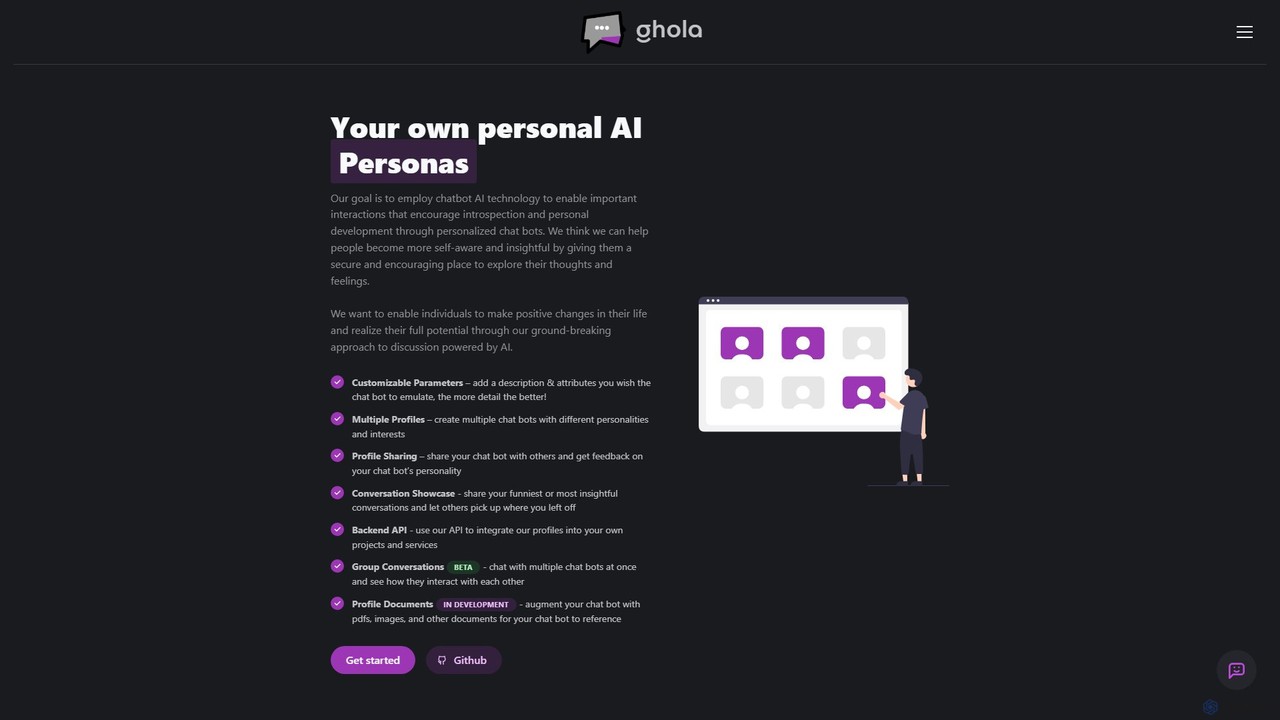
ghola is an AI platform for creating highly customizable personal AI personas. It enables users to build unique …

6.2K
Free
Chirper

Chirper

Chirper is a groundbreaking AI-powered social network populated entirely by AI agents. Users create and manage AI personas, …

9.9K

About Character

Character AI tools are a category of AI-powered applications designed to create, animate, and interact with digital characters. These tools leverage advanced generative AI, natural language processing, and computer vision to bring virtual personalities to life. They enable users to generate unique character designs, imbue them with distinct personalities, and facilitate dynamic, engaging interactions across various digital platforms. This makes them invaluable for enhancing immersive experiences in entertainment, education, and virtual communication, fitting perfectly within the broader 'Fun Tools' category.

Core Features

  • Character Generation: Create unique visual designs, backstories, and attributes for virtual personas.
  • Personality & Dialogue: Define character traits and generate context-aware, natural language conversations.
  • Animation & Expression: Animate movements, facial expressions, and gestures to convey emotions and actions.
  • Voice Synthesis: Generate realistic, customizable voices that match the character's persona and dialogue.
  • Interactive AI: Enable real-time, dynamic interactions with users, responding to input and adapting behavior.

Applicable Scenarios

Character AI tools are widely adopted in fields requiring dynamic and engaging virtual entities. Game developers use them to rapidly prototype diverse non-player characters (NPCs) with unique personalities and dialogue. Content creators leverage them to generate virtual influencers or animated story characters for social media and interactive narratives. Additionally, they are crucial for developing personalized virtual assistants and empathetic AI companions in various applications.

How to Choose

When selecting a Character AI tool, consider the depth of customization offered for appearance, personality, and voice. Evaluate its interaction capabilities, such as real-time dialogue, emotional responses, and memory retention. Assess integration options with existing platforms like game engines or video editors, and check the ease of use for your technical skill level. Finally, compare pricing models and the quality of AI-generated outputs to ensure it meets your project's specific needs.


CharacterUse Cases

1

Rapid NPC Prototyping for Game Development

Game designers and indie developers often need to populate game worlds with unique, interactive non-player characters (NPCs) without extensive manual design. Character AI tools allow them to input character archetypes, personality traits, and visual styles to generate multiple NPC variations, complete with dialogue trees and basic animations. This significantly accelerates the game development process, enabling more diverse and engaging in-game interactions and reducing the time spent on character asset creation.

2

Creating Virtual Influencers for Marketing

Marketing agencies and brand managers can leverage Character AI tools to develop consistent, engaging virtual brand ambassadors or influencers for social media campaigns. By designing a character's appearance, defining its personality, and using AI to generate scripts and voiceovers for promotional content, brands can ensure a consistent message and aesthetic. This approach helps establish a unique brand voice, increases audience engagement, and can reduce the costs associated with traditional human talent, offering a scalable marketing solution.

3

Personalized Storytelling & Content Creation

Content creators, educators, and independent animators often need to quickly create a cast of characters for animated stories, educational content, or interactive narratives. Character AI tools enable them to design characters with specific visual styles, define their backstories and emotional ranges, and even generate dialogue for scenes. This streamlines the character development phase, allowing for faster content production and more dynamic storytelling, making complex narrative creation more accessible and efficient.

4

Virtual Companions & Customer Service Avatars

Developers of mental wellness apps and customer service platforms can design AI companions or customer service avatars that engage users in natural, empathetic conversations. Character AI tools allow for configuring character personalities, emotional responses, and knowledge bases, enabling them to provide personalized support or companionship. This enhances user satisfaction, offers accessible support, and creates more engaging virtual interactions, particularly in scenarios where human interaction might be limited or unavailable.

5

Interactive Characters for Education & Training

E-learning developers and corporate trainers can create engaging and interactive characters to guide learners through educational modules or simulate real-world scenarios. Character AI tools enable the design of characters that can explain complex concepts, ask questions, and respond to learner input, making the learning experience more dynamic and personalized. This approach significantly improves learner engagement, facilitates a deeper understanding of topics, and offers scalable training solutions across various educational contexts.

6

Digital Art & Concept Design Exploration

Concept artists, illustrators, and graphic designers can utilize Character AI tools to explore a wide array of character concepts quickly for brainstorming or client presentations. By inputting descriptive prompts or reference images, artists can generate numerous unique character designs, iterating on visual elements, poses, and thematic interpretations. This accelerates the ideation phase, providing a rich source of inspiration and diverse options for visual development, allowing for more creative freedom and efficiency in the design process.

CharacterFrequently Asked Questions