
ToolMage
Sign in

Best 1 Randomizer AI tools for Fun Tools

Popular Randomizer AI tools in Fun Tools include RandomGenerate.io, helping you work more efficiently.

RandomGenerate.io
Free

RandomGenerate.io

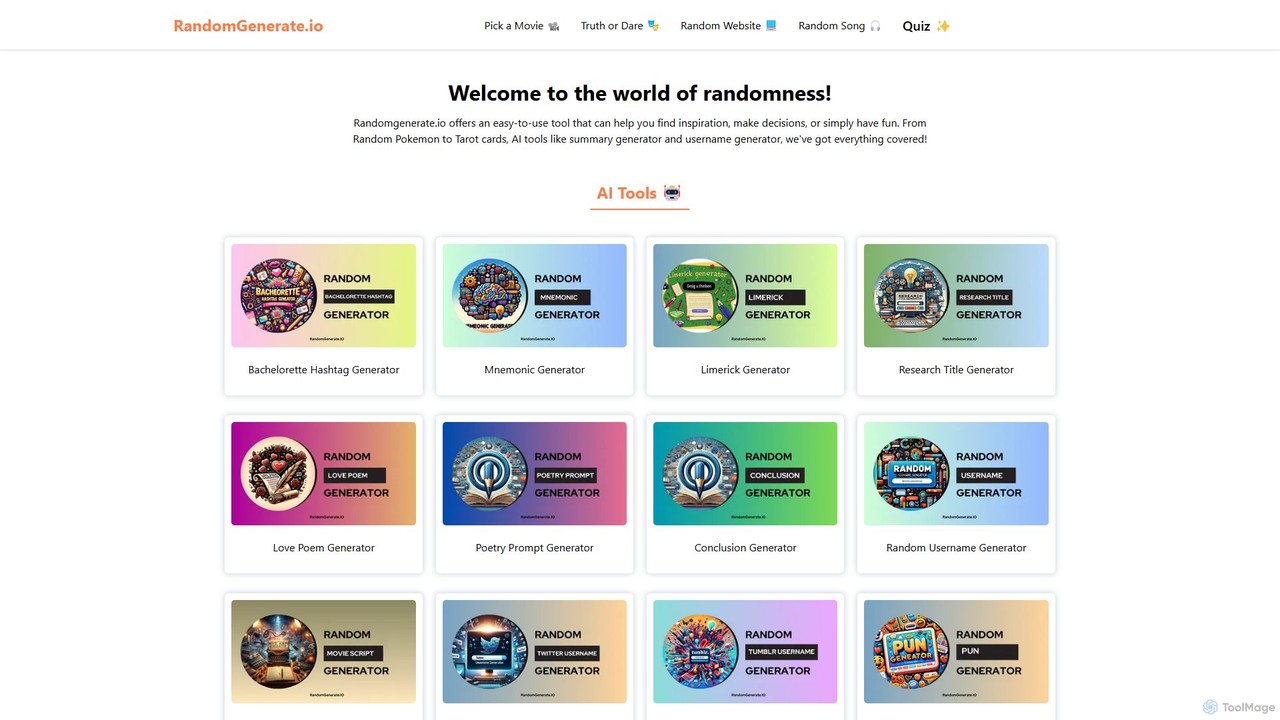
RandomGenerate.io is a comprehensive online platform offering a vast collection of both traditional randomizers and advanced AI-powered generators. It's designed to assist with decision-making, spark creativity, provide entertainment, and support development tasks. From choosing a movie to generating a story, it's a one-stop solution for all your random generation needs, completely free of charge.

Data
Visits 63.2KFavorites 161Likes 154

About Randomizer

Randomizer tools are AI-powered utilities designed to generate unpredictable outputs across various formats. These tools leverage sophisticated algorithms to produce true or pseudo-randomness, providing an element of surprise and impartiality. They are invaluable for tasks requiring unbiased selection, creative inspiration, or simulating real-world unpredictability, serving as a dynamic sub-category within Fun Tools.

Core Features

  • Number Generation: Produces random numbers within specified ranges or distributions.
  • List/Item Selection: Randomly picks one or more items from a user-defined list.
  • Sequence Shuffling: Rearranges the order of elements in a list or set randomly.
  • Decision Making: Simulates chance-based decisions like coin flips or dice rolls.
  • Creative Prompts: Generates random words, ideas, or scenarios for creative tasks.

Applicable Scenarios

Randomizer tools are widely used in game development for generating unpredictable events and loot, in content creation for sparking new ideas, and in educational settings for fair group assignments. They also assist researchers in statistical sampling and individuals in making unbiased daily choices.

How to Choose

When selecting a randomizer, consider the quality of randomness (true vs. pseudo), the types of outputs needed (numbers, text, lists), and the level of customization available. Evaluate its user interface for ease of use and check for API integration if programmatic access is required.

Randomizer use cases

1

Generating Random Events in Game Development

Game developers utilize randomizer tools to introduce unpredictability into their games. This includes generating random enemy encounters, loot drops, map layouts, or weather conditions, significantly enhancing replayability and providing unique experiences for players with each session.

2

Sparking Creative Inspiration for Content Creators

Content creators, writers, and artists employ randomizers to overcome creative blocks. By generating random words, themes, or prompts, these tools help in brainstorming new story ideas, character concepts, artistic directions, or even song lyrics, fostering innovative output.

3

Fair Grouping and Quizzing in Education

Educators and trainers use randomizers to ensure fairness and variety in classrooms. This involves randomly assigning students to groups for projects, selecting individuals for questions during quizzes, or shuffling the order of exam questions to prevent cheating and promote diverse learning experiences.

4

Statistical Sampling and Experiment Randomization

Researchers and data scientists rely on random number generators for robust statistical sampling and experimental design. They use these tools to select random subsets from larger populations or to randomize treatment assignments in clinical trials, ensuring unbiased and representative data collection.

5

Assisting Daily Decision-Making and Entertainment

Individuals often turn to randomizer tools for simple daily decisions, such as choosing a restaurant, a movie to watch, or a destination for a spontaneous trip. They are also popular for party games, raffles, or drawing winners in contests, adding an element of fun and impartiality.

6

Enhancing Security with Strong Password Generation

Security professionals and developers leverage high-quality randomizers to generate strong, unpredictable passwords, encryption keys, and security tokens. This ensures that sensitive data and systems are protected by truly random credentials, significantly reducing the risk of brute-force attacks.

Randomizer FAQ

What are Randomizer tools?

Randomizer tools are digital utilities that produce unpredictable outputs, such as numbers, selections from lists, or shuffled sequences. They are essential for tasks requiring impartiality, generating creative ideas, or simulating chance-based events in various applications, from games to scientific research.

How do Randomizer tools work?

Most digital randomizers use pseudo-random number generators (PRNGs), which employ algorithms to produce sequences that appear random but are deterministic. More advanced tools might incorporate true random number generators (TRNGs) that draw entropy from physical phenomena like atmospheric noise or hardware events for higher unpredictability.

How do I choose the right Randomizer tool?

To choose a suitable randomizer, consider the required quality of randomness (true vs. pseudo), the specific output types you need (e.g., integers, text, complex objects), and the level of customization for parameters like ranges or constraints. Also, evaluate its user-friendliness and potential for integration via APIs.

What are common applications for Randomizer tools?

Common applications include game development (for events, loot), content creation (for ideas, prompts), education (for grouping, quizzes), scientific research (for sampling, experiment design), and personal use (for decision-making, entertainment). They are also crucial in cybersecurity for generating strong keys.

What is the difference between an AI Randomizer and a traditional one?

Traditional randomizers primarily focus on generating statistically random sequences based on algorithms or physical entropy. AI Randomizers, while still relying on randomness, might integrate AI models to generate "intelligent" or context-aware random outputs, such as random story plots that adhere to narrative logic, or varied character traits that fit a specific genre, offering more nuanced and usable random results beyond simple numbers or words.