Developer Tools Best in category 1 results Data AI Tool

Popular AI tools in the Data field of Developer Tools include RandomGenerate.io, etc., helping you quickly improve efficiency.

Free
RandomGenerate.io

RandomGenerate.io

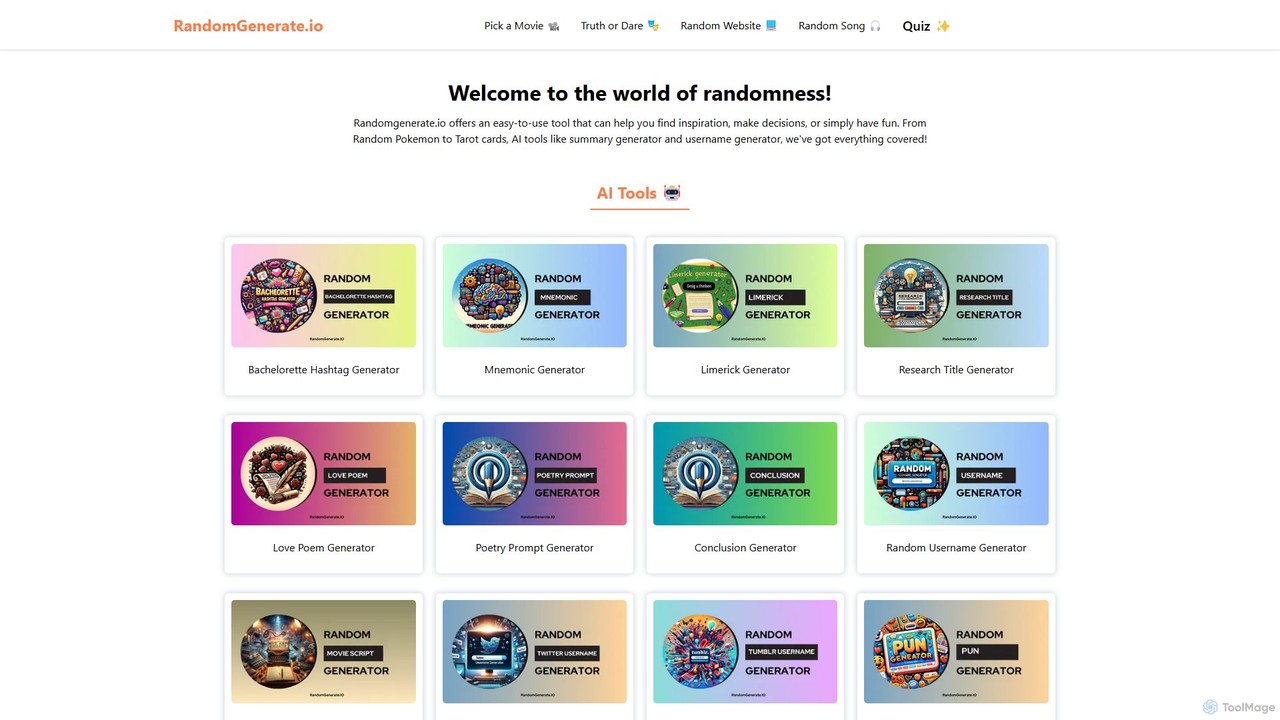
RandomGenerate.io is a comprehensive online platform offering a vast collection of both traditional randomizers and advanced AI-powered generators. …

75.5K

About Data

AI Data tools are a class of developer-focused software for automating and enhancing the preparation, augmentation, and management of data for machine learning models. These tools leverage AI to perform complex tasks such as automated data labeling, synthetic data generation, and quality validation. Their primary value lies in accelerating the MLOps lifecycle and improving the quality of training datasets, which directly leads to more accurate and robust AI models. They are an essential component in the modern developer's toolkit for building high-performance, data-driven applications.

Core Features

  • Automated Data Annotation: Uses AI models to automatically label large volumes of images, text, audio, and video data, significantly reducing manual effort.
  • Synthetic Data Generation: Creates high-quality, artificial data to augment limited datasets, simulate rare scenarios, or protect data privacy.
  • Data Cleaning & Preprocessing: Automatically identifies and corrects errors, inconsistencies, missing values, and outliers in datasets.
  • Data Augmentation: Generates new data samples from existing data by applying realistic transformations, improving model generalization.
  • Feature Engineering Automation: Automatically discovers and constructs predictive features from raw data for use in machine learning models.

Use Cases

These tools are critical for Machine Learning Engineers, Data Scientists, and AI Developers working on projects in computer vision, natural language processing (NLP), autonomous systems, and predictive analytics. For instance, a team developing an autonomous vehicle can use these tools to generate synthetic data for rare driving conditions, while an e-commerce company can automate the labeling of its product catalog for better recommendation engines.

How to Choose

When selecting an AI Data tool, consider its support for your specific data types (e.g., images, text, tabular). Evaluate its integration capabilities with your existing MLOps pipeline, including cloud platforms and training frameworks. Assess its scalability to handle large datasets and its level of customization for specific annotation rules or data generation models. Finally, consider the balance between automated features and the need for human-in-the-loop validation for quality control.

DataUse Cases

1

Accelerating Computer Vision Model Training

A Machine Learning Engineer at a retail tech company is tasked with developing an object detection model to identify products on shelves. Instead of spending weeks manually labeling over 100,000 images, the engineer uses an AI data tool. The tool's pre-trained models automatically suggest labels for 80% of the dataset with high confidence. The engineer and a small team then only need to review and correct the suggestions, reducing the total annotation time from an estimated four weeks to just three days and ensuring a high-quality dataset for training.

2

Generating Synthetic Data for Edge Cases

An AI developer working on an autonomous driving system needs to train a model to handle rare but critical events, like an animal suddenly crossing the road at night. Real-world data for such scenarios is scarce. Using a synthetic data generation tool, the developer creates thousands of photorealistic images and videos depicting various animals, weather conditions, and lighting. This augmented dataset allows the model to train on a diverse range of edge cases, significantly improving its safety and reliability without needing to collect dangerous real-world data.

3

Automating Text Annotation for NLP Models

A data science team at a SaaS company wants to build a sentiment analysis model from thousands of customer reviews. Manual annotation is slow and prone to inconsistency. They employ an AI data platform that uses active learning. Initially, a human annotates a small batch of reviews. The model learns from this and then automatically labels the rest, flagging only the low-confidence predictions for human review. This human-in-the-loop approach accelerates the labeling process by over 5x and results in a more consistently labeled dataset, leading to a higher-performing NLP model.

4

Cleaning Tabular Data for Fraud Detection

An AI developer at a fintech company is building a model to detect fraudulent transactions. The raw dataset contains millions of entries with missing values, inconsistent formatting, and outliers. Using an AI data preparation tool, the developer automates the cleaning process. The tool intelligently imputes missing values based on statistical analysis, standardizes formats like dates and currencies, and flags suspicious outliers for investigation. This automated process cleans the entire dataset in hours instead of weeks, providing a reliable foundation for training an accurate fraud detection model.

5

Augmenting Audio Data for Voice Assistants

A development team is improving a voice assistant's ability to understand commands in noisy environments. Their initial dataset of clean voice recordings is insufficient. They use an AI data augmentation tool to generate thousands of new audio clips. The tool programmatically adds various types of background noise (e.g., street traffic, cafe chatter, music) to the original recordings and creates variations in pitch and speed. This enriched dataset makes the voice assistant model more robust and accurate when used by customers in real-world, non-ideal conditions.

6

Automating Feature Engineering for Predictive Maintenance

A data scientist at an industrial manufacturing plant needs to predict equipment failure from sensor data. Manually creating features from time-series data is complex and time-consuming. They use an AI tool that automates feature engineering. The tool automatically extracts hundreds of potentially predictive features, such as moving averages, frequency components, and statistical properties from the raw sensor readings. It then helps select the most impactful features for the model. This automation allows the data scientist to build and deploy a highly accurate predictive maintenance model in a fraction of the time.

DataFrequently Asked Questions