ToolMage
Sign in

Best 1 Simulation AI tools for Fun Tools

Popular Simulation AI tools in Fun Tools include Lexikon AI, helping you work more efficiently.

Lexikon AI
Freemium

Lexikon AI

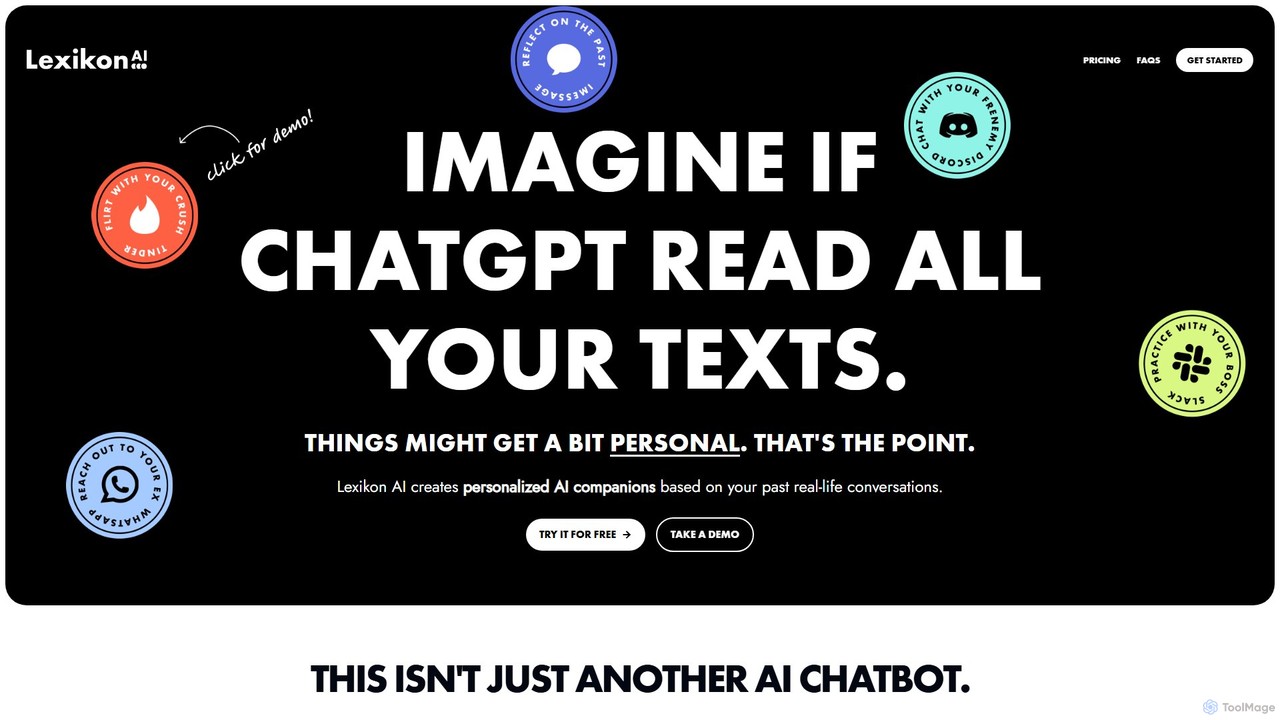
Lexikon AI transforms your past text conversations from any app into personalized AI companions. Simply screen-record a chat, upload it, and in 60 seconds, you can continue the conversation, rehearse difficult dialogues, or gain closure. It's a unique tool for exploring 'what if' scenarios and understanding relationships better, with a strong focus on user privacy.

Simulation
Visits 4.3KFavorites 92Likes 93

About Simulation

Simulation AI tools are a sophisticated class of software that leverage artificial intelligence algorithms to create dynamic, interactive models of real-world or hypothetical systems. These advanced tools enable users to test complex scenarios, predict outcomes, and understand intricate dynamics without physical constraints, offering a safe, cost-effective, and highly flexible environment for experimentation. As a key component within the Fun Tools category, they often provide engaging and immersive experiences, blending cutting-edge analytical capabilities with interactive exploration and discovery, making complex concepts accessible and enjoyable.

Core Features

  • AI-Driven Scenario Generation: These tools can automatically generate diverse and complex scenarios based on defined parameters, exploring a vast range of possibilities far beyond what manual input could achieve, accelerating research and development.
  • Predictive Modeling & Forecasting: Utilizing machine learning, AI simulation tools can accurately forecast future states or behaviors of a system, such as market trends or environmental changes, based on current data and simulated interactions, aiding strategic decision-making.
  • Interactive & Immersive Environments: They offer highly interactive and often immersive virtual spaces where users can manipulate variables, introduce perturbations, and observe real-time changes and consequences, fostering deeper understanding and engagement.
  • Advanced Data Analysis & Visualization: Capable of processing vast amounts of simulation data, these tools present complex insights through intuitive charts, graphs, and visual representations, making data interpretation straightforward and actionable.
  • Adaptive Learning Agents: Many AI simulations incorporate intelligent agents that can learn and adapt their behavior within the simulated environment, mimicking intelligent decision-making processes and providing realistic interactions for training or behavioral studies.

Applicable Scenarios

AI simulation tools prove invaluable across a multitude of fields, from cutting-edge scientific research to immersive entertainment. Game developers utilize them extensively to model complex in-game economies, simulate realistic physics, or train sophisticated AI character behaviors, enhancing player experience. Urban planners leverage these tools to simulate traffic flows, predict city growth patterns, or assess the impact of new infrastructure projects, informing sustainable development. Furthermore, educators and corporate trainers deploy AI simulations to create realistic, risk-free learning environments for high-stakes fields like medicine, aviation, or emergency response, allowing for practical skill development.

How to Choose

When selecting an AI simulation tool, it's crucial to consider the desired level of realism and fidelity required for your specific application, as this directly impacts computational requirements and overall cost. Evaluate the tool's ease of use, customization options, and the flexibility to define your own parameters, ensuring it aligns with your technical expertise and project needs. Look for robust data output and analysis capabilities, including support for various metrics and visualization tools, as well as integration potential with existing software ecosystems. Finally, assess the community support, available learning resources, and the vendor's commitment to ongoing development for long-term usability and scalability.

Featured tool rankings

Simulation use cases

1

Designing Immersive Virtual Worlds for Entertainment

Game developers and virtual reality creators can utilize AI simulation tools to build and test complex virtual environments. By simulating physics, character AI behaviors, and dynamic ecosystems, they can rapidly iterate on world design, ensuring a realistic and engaging experience for players. This allows for the creation of expansive, living worlds where AI agents interact authentically, and environmental factors evolve dynamically, reducing development time and enhancing immersion.

2

Modeling Complex Scientific Experiments

Researchers in fields like biology, chemistry, or physics employ AI simulation to model intricate experiments that are costly, time-consuming, or impossible to conduct physically. For instance, simulating protein folding, chemical reactions at atomic levels, or astronomical phenomena allows scientists to test hypotheses, predict outcomes, and gain insights into fundamental processes, accelerating discovery and reducing the need for expensive lab resources.

3

Optimizing Urban Traffic Flow and Infrastructure

Urban planners and city officials use AI simulation to model traffic patterns, pedestrian movement, and the impact of new infrastructure projects. By simulating various scenarios—such as adding new roads, public transport lines, or smart traffic lights—they can predict congestion points, evaluate efficiency improvements, and make data-driven decisions to optimize urban mobility and reduce environmental impact before costly physical changes are implemented.

4

Training AI Agents for Robotics and Autonomous Systems

Engineers and AI developers leverage simulation environments to train and test autonomous agents, such as robots or self-driving cars, in a safe and controlled virtual space. By simulating diverse real-world conditions, including obstacles, varying weather, and unexpected events, AI agents can learn robust behaviors and decision-making processes without risking physical damage or human safety, significantly accelerating the development cycle for intelligent systems.

5

Strategic Planning and Financial Market Scenario Testing

Business strategists and financial analysts use AI simulation to model complex market dynamics, economic trends, and potential investment outcomes. By simulating various "what-if" scenarios, such as changes in consumer behavior, competitor actions, or regulatory shifts, they can assess risks, identify opportunities, and formulate more resilient business strategies and investment portfolios, leading to more informed and robust decision-making.

6

Developing Realistic Emergency Response Training

Emergency services and disaster management organizations utilize AI simulation to create highly realistic training scenarios for first responders, medical personnel, and crisis management teams. Simulating natural disasters, industrial accidents, or public health emergencies allows trainees to practice critical decision-making, coordination, and resource allocation in a safe, controlled environment, improving preparedness and response effectiveness in real-life situations.

Simulation FAQ

What are AI Simulation tools?

AI Simulation tools are software applications that use artificial intelligence, particularly machine learning and advanced algorithms, to create dynamic models of real-world or hypothetical systems. They enable users to run experiments, predict outcomes, and understand complex interactions within a virtual environment. These tools are characterized by their ability to generate intelligent behaviors, adapt to changing conditions, and process vast datasets to provide actionable insights, making them invaluable for research, development, and training across many industries.

How do AI simulations differ from traditional simulations?

AI simulations significantly differ from traditional simulations primarily in their adaptability and intelligence. Traditional simulations often rely on predefined rules and fixed parameters, offering predictable outcomes based on explicit programming. In contrast, AI simulations incorporate machine learning models and adaptive agents that can learn from data, make autonomous decisions, and evolve their behavior within the simulated environment. This allows for more realistic, nuanced, and less predictable outcomes, better reflecting the complexities of real-world systems and enabling exploration of emergent behaviors.

What are the main benefits of using AI for simulation?

The main benefits of using AI for simulation include enhanced realism, accelerated development, and deeper insights. AI allows simulations to model more complex and adaptive behaviors, leading to more accurate predictions and a better understanding of system dynamics. It significantly speeds up the process of scenario generation and testing, reducing the time and cost associated with physical experimentation. Furthermore, AI-driven analysis of simulation data can uncover hidden patterns and provide actionable intelligence that might be missed by traditional methods, fostering innovation and informed decision-making.

What types of scenarios can AI simulation tools model?

AI simulation tools can model an incredibly diverse range of scenarios across various domains. This includes simulating physical phenomena like fluid dynamics or material stress, complex biological systems such as disease spread or ecological interactions, and social dynamics like crowd behavior or market trends. They are also widely used for modeling technological systems, such as network performance, robotic movements, or autonomous vehicle navigation, as well as for creating immersive virtual training environments for professional skill development.

How can AI simulation tools be used in the "Fun Tools" category?

Within the "Fun Tools" category, AI simulation tools offer unique opportunities for engaging and creative experiences. They can be used to build and explore dynamic virtual worlds, simulate historical events with emergent outcomes, or create interactive storytelling environments where AI characters respond intelligently. Hobbyists and casual users can experiment with virtual ecosystems, design complex Rube Goldberg machines, or even simulate the growth of virtual pets, providing endless hours of interactive learning, entertainment, and creative expression through advanced AI modeling.