ToolMage
Sign in

Best 1 Story Teller AI tools for Fun Tools

Popular Story Teller AI tools in Fun Tools include Novels AI, helping you work more efficiently.

Novels AI
Freemium

Novels AI

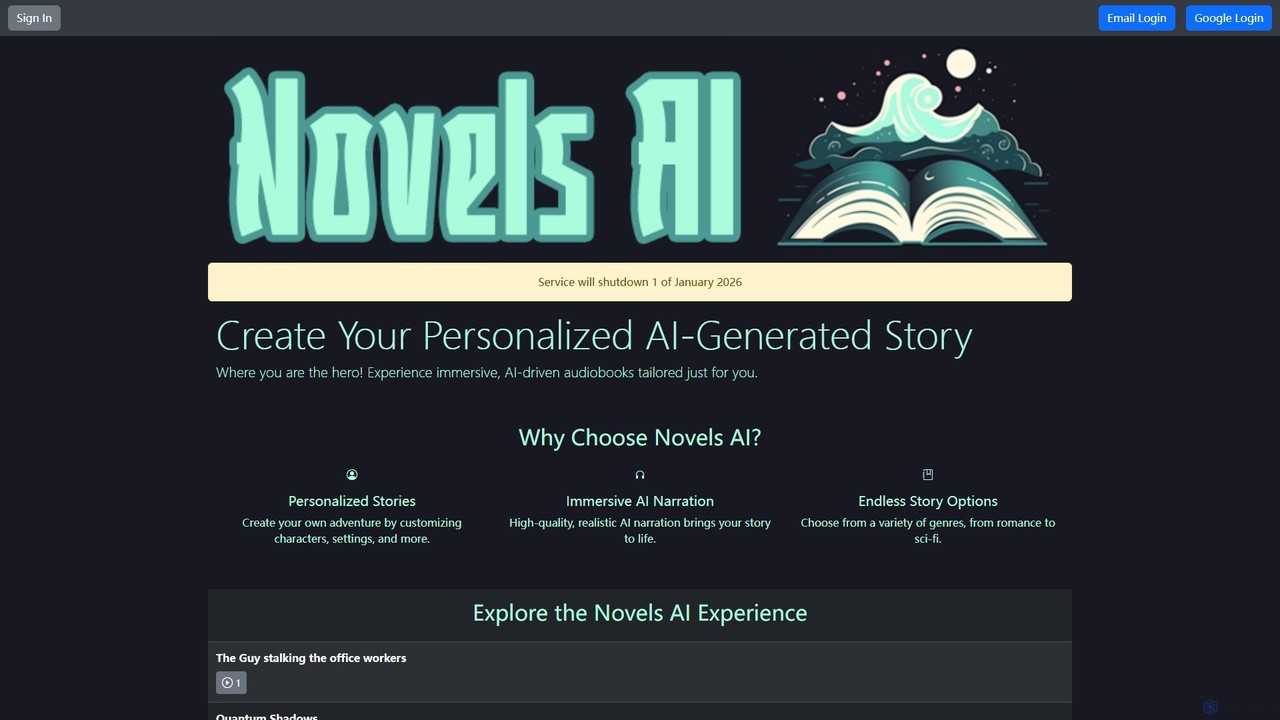
Novels AI is an innovative platform that lets you create personalized, AI-generated audiobooks where you are the main character. Customize characters, settings, and plot across various genres, and listen to your unique story brought to life by high-quality AI narration. Please note: The service is scheduled to shut down on January 1, 2026, and is currently seeking a new owner.

Text To Speech
Visits 10KFavorites 194Likes 171

About Story Teller

AI Story Teller tools are a specialized class of creative AI designed to generate narrative elements or complete stories. They leverage large language models (LLMs) trained on vast libraries of literature to produce plots, characters, dialogues, and scene descriptions based on user prompts. These tools serve as powerful creative partners, helping users overcome writer's block, explore new ideas, and accelerate the content creation process. Unlike general-purpose text generators, AI Story Tellers often provide structured frameworks for managing narrative components like plot arcs and character development.

Core Features

  • Plot Generation: Creates structured story outlines, key plot points, and narrative arcs based on genre and user inputs.
  • Character Development: Generates detailed character profiles, including backstories, personality traits, motivations, and physical descriptions.
  • Dialogue Writing: Produces natural-sounding conversations between characters that reflect their personalities and advance the plot.
  • World-Building: Assists in creating settings, lore, and environmental descriptions for fictional worlds.
  • Genre and Style Adaptation: Allows users to specify a particular genre (e.g., fantasy, sci-fi, mystery) and writing style to ensure tonal consistency.

Use Cases

AI Story Tellers are primarily used by fiction writers, screenwriters, and hobbyists for brainstorming and drafting. Game developers utilize them to create questlines, NPC backstories, and in-game lore. Educators and parents can also use these tools to generate personalized and engaging stories for children, making learning more interactive and fun.

How to Choose

When selecting an AI Story Teller, consider the level of customization offered for plot and character control. Evaluate the quality and coherence of the generated text. Check for genre-specific models if you work in a niche like fantasy or horror. Finally, assess the user interface for ease of use, especially features for organizing story elements like chapters and character sheets.

Story Teller use cases

1

Brainstorming a Novel Plot

A fiction writer facing writer's block uses an AI Story Teller to kickstart their next fantasy novel. By providing a simple premise—'a young librarian discovers a book that writes future events'—the tool generates several distinct plot outlines. These outlines include key turning points, potential subplots involving a secret society, and character arcs for the protagonist and antagonist. The writer can then mix and match elements from these suggestions to build a unique and compelling narrative structure, saving weeks of initial planning.

2

Creating Video Game Quests and Lore

An indie game developer needs to populate their open-world RPG with engaging side quests. Using an AI Story Teller, they input key world elements, such as 'a cursed forest' and 'a forgotten kingdom'. The AI generates several quest ideas, complete with NPC dialogue, objectives, and potential rewards. For example, it might suggest a quest where the player must find three ancient artifacts to lift the forest's curse, providing backstory for each artifact. This allows the developer to rapidly create rich, lore-consistent content without a dedicated writing team.

3

Generating Personalized Bedtime Stories

A parent wants to create unique bedtime stories for their child. Using an AI Story Teller, they can input their child's name, favorite animal (a dragon), and a desired moral (the importance of sharing). The tool then weaves these elements into a short, age-appropriate story about a friendly dragon named Sparky who learns to share his treasure with the forest creatures. The parent can generate a new story every night, customizing characters and themes to keep their child engaged and teach valuable lessons in a fun, imaginative way.

4

Developing a D&D Campaign

A Dungeon Master (DM) is preparing a new Dungeons & Dragons campaign but is short on time. They use an AI Story Teller to flesh out their world. The DM inputs the main theme, 'a political intrigue in a city powered by magic crystals'. The AI generates detailed descriptions of rival factions, key Non-Player Characters (NPCs) with their own motivations and secrets, and several plot hooks to kick off the adventure. This allows the DM to focus on running the game and reacting to player choices, rather than spending hours on world-building from scratch.

5

Scriptwriting Ideas for Short Films

A film student needs to write a script for a 10-minute short film but is struggling with the initial concept. They use an AI Story Teller and set the genre to 'sci-fi mystery' and the tone to 'suspenseful'. The tool generates several loglines and brief scene summaries. One idea, 'An archivist in a futuristic library discovers a data file that predicts her own death,' catches their attention. The student then uses the tool to generate sample dialogue and scene descriptions, providing a solid foundation to build upon and develop into a full script.

6

Crafting Brand Storytelling Content

A marketing specialist for a sustainable coffee brand wants to create a compelling narrative for a new social media campaign. They use an AI Story Teller to develop a story around the brand's origins. By inputting keywords like 'ethical sourcing,' 'family farm,' and 'community,' the AI generates a short story about a farmer named Elena and her journey to cultivate the perfect coffee bean while preserving her ancestral land. The specialist refines this narrative into a series of engaging posts, videos, and articles that connect with customers on an emotional level, strengthening brand loyalty.

Story Teller FAQ

What is an AI Story Teller?

An AI Story Teller is a specialized artificial intelligence tool designed to generate narrative content. Unlike general AI writers, it focuses specifically on the components of storytelling, such as creating plots, developing characters with backstories and motivations, writing dialogue, and building fictional worlds. These tools act as creative assistants for writers, game developers, and content creators, helping them brainstorm ideas, overcome writer's block, and structure their narratives more effectively.

How to choose the right AI Story Teller tool?

When selecting an AI Story Teller, consider these factors:

  • Control and Customization: Look for tools that allow you to guide the story with detailed prompts, character profiles, and plot points. The more control you have, the more the output will align with your vision.
  • Coherence and Quality: Test the tool's ability to maintain narrative consistency over longer texts. A good tool will remember character traits and plot details mentioned earlier.
  • Genre Specialization: Some tools are better suited for specific genres like fantasy, sci-fi, or mystery. Choose one that aligns with your primary writing style.
  • User Interface: A well-designed interface that helps you organize chapters, character notes, and plotlines can significantly improve your workflow.
What's the difference between an AI Story Teller and a general AI writer?

The main difference lies in their focus and features. A general AI writer (like ChatGPT or Claude) is a versatile tool capable of many text-based tasks, including writing stories. However, an AI Story Teller is specifically designed for narrative creation. It often includes specialized features that general writers lack, such as dedicated modules for character management, plot outlining, world-building, and maintaining long-term consistency. This specialized structure makes them more efficient for authors and screenwriters focused purely on crafting complex narratives.

Who can benefit from using AI Story Teller tools?

A wide range of creators can benefit from these tools. This includes:

  • Authors and Novelists: For brainstorming plot ideas, developing characters, and overcoming writer's block.
  • Screenwriters: For outlining scripts, writing dialogue, and creating scene descriptions.
  • Game Developers: For generating questlines, NPC backstories, item descriptions, and in-game lore.
  • Dungeon Masters & TTRPG Players: For creating campaigns, characters, and spontaneous story elements.
  • Educators and Parents: For creating engaging and personalized educational stories for children.
Can AI Story Tellers write a complete, ready-to-publish novel?

Currently, AI Story Tellers are best used as powerful assistants rather than autonomous authors. While they can generate large volumes of coherent text, a ready-to-publish novel requires a level of nuance, emotional depth, and overarching thematic consistency that still benefits greatly from human creativity and judgment. They are excellent for generating first drafts, exploring plot possibilities, and filling in descriptive details, but the final product almost always requires significant editing, refinement, and a personal touch from a human writer to meet professional standards.