ToolMage
Sign in

Best 1 Game Design AI tools for Game Development

Popular Game Design AI tools in Game Development include Ludo.ai, helping you work more efficiently.

Ludo.ai
Freemium

Ludo.ai

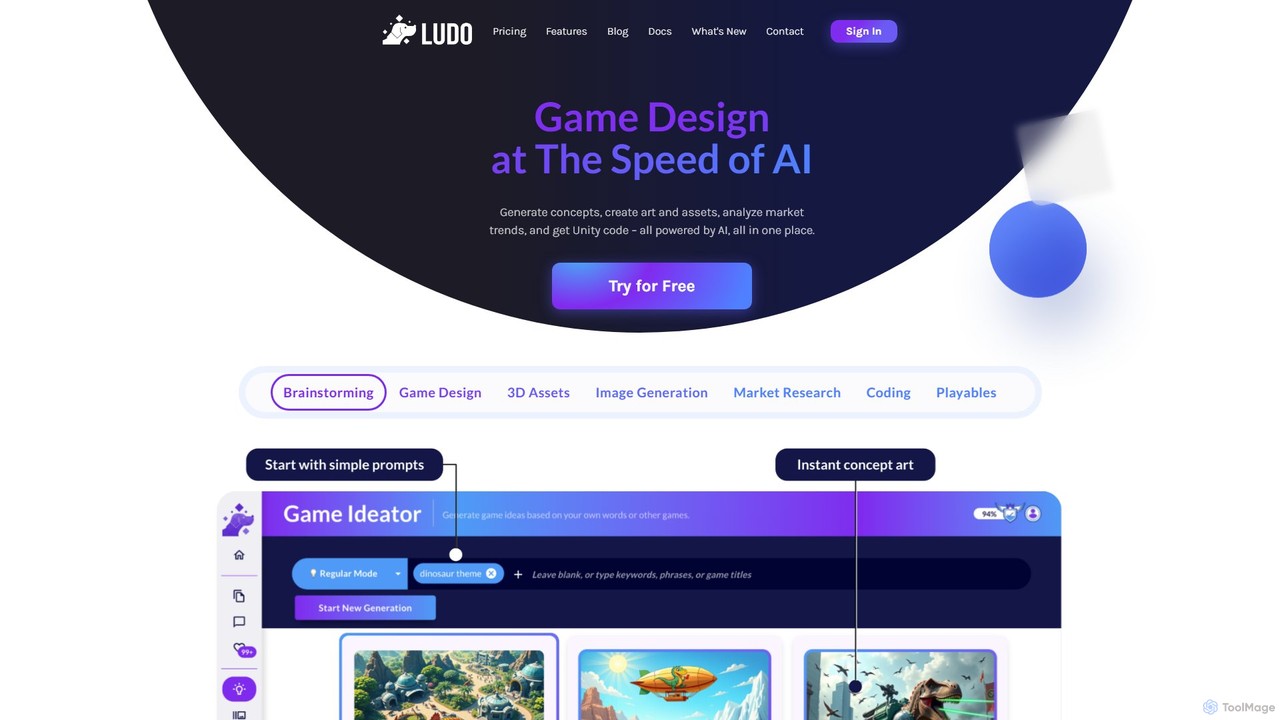
Ludo.ai is an all-in-one AI-powered platform designed to accelerate the game development process. It assists creators from initial brainstorming and concept generation to creating 2D/3D assets, market research, and even generating playable prototypes and code snippets. It's a unified ecosystem for game developers to build hit games faster.

Code Generation
Visits 274.7KFavorites 136Likes 138

About Game Design

AI Game Design tools are a specialized category of software that assists in the conceptualization, balancing, and creation of core game elements. Leveraging generative AI and procedural algorithms, these tools automate the generation of game mechanics, level layouts, narratives, and character concepts. This accelerates the prototyping phase, enables exploration of diverse design possibilities, and helps create more engaging and dynamic player experiences. They act as creative partners, empowering designers to focus on high-level vision and refinement.

Core Features

  • Procedural Content Generation (PCG): Automatically creates game content such as levels, maps, items, and environments based on a set of rules.
  • Game Mechanics & Balancing: Suggests rule sets and simulates gameplay outcomes to help balance difficulty, economies, and character abilities.
  • Narrative & Quest Generation: Generates branching storylines, character dialogues, item descriptions, and complete quest structures.
  • Concept Ideation: Produces visual concepts for characters, creatures, environments, and props to inspire the art direction.
  • Player Behavior Simulation: Models how players might interact with a game's design to identify potential issues or points of friction.

Use Cases

These tools are valuable for indie developers seeking to create vast content with small teams, large studios aiming to accelerate prototyping, and narrative or level designers looking to overcome creative blocks. They are particularly effective in genres requiring high replayability, such as roguelikes, or in large-scale RPGs with extensive world-building needs.

How to Choose

When selecting an AI Game Design tool, consider its specific function—whether it specializes in narrative, level design, or mechanics. Evaluate its integration capabilities with major game engines like Unity or Unreal Engine. Assess the level of user control over the generated output and the tool's ease of use, especially for designers without a programming background.

Featured tool rankings

Game Design use cases

1

Rapid Prototyping of Game Mechanics

A solo indie developer needs to test several core gameplay loop ideas for their new project quickly. Instead of spending weeks coding each prototype, they use an AI game design tool to generate different rule sets, item combinations, and skill trees based on high-level concepts. The tool can simulate short gameplay sessions, providing data on play time and balance. This allows the developer to identify the most engaging mechanics in hours, not weeks, ensuring development effort is focused on a validated and fun concept from the start.

2

Generating Dynamic Questlines and Narratives

A narrative designer for a large RPG is tasked with creating hundreds of side quests to populate the game world. To avoid repetitive 'fetch quests', they use an AI narrative tool. By inputting key lore elements, character archetypes, and desired emotional tones, the tool generates complex, branching quest structures with unique dialogue and objectives. The designer then curates and refines the best outputs, allowing them to produce a vast quantity of high-quality, non-linear content that feels handcrafted and enhances world-building.

3

Procedural Generation of Replayable Level Layouts

A level designer for a roguelike game needs to ensure high replayability by creating endless unique dungeons. Manually designing thousands of levels is impossible. They use an AI-powered procedural content generation (PCG) tool. The designer sets high-level constraints like room types, enemy density, puzzle frequency, and critical path length. The AI then generates countless level variations that adhere to these rules, ensuring each playthrough feels fresh yet balanced. This allows the designer to focus on creating compelling room templates and rules rather than manually placing every tile.

4

Balancing Complex In-Game Economies

A systems designer for a free-to-play mobile game needs to balance the in-game economy to ensure long-term player retention without being exploitative. They use an AI simulation tool to model the flow of virtual currency and resources. By inputting parameters for item drop rates, crafting costs, and player progression speed, the AI runs millions of simulated playthroughs. It identifies potential economic exploits, inflation risks, or progression bottlenecks before the game is launched. This data-driven approach helps create a stable, fair, and engaging economy for all players.

5

Accelerating Concept Art and Asset Ideation

An art director in the pre-production phase needs to explore a wide range of visual styles for a new fantasy game. Instead of relying solely on manual sketches, the art team uses an AI image generator. They provide detailed prompts describing character classes, mythical creatures, and environments (e.g., 'elven warrior with bioluminescent armor in a crystal cave'). The AI produces hundreds of high-quality visual variations in minutes. This vast library of ideas serves as a powerful mood board and inspiration, dramatically speeding up the process of defining the game's final art direction.

6

Generating Believable NPC Dialogue and Behavior

A world designer wants to make the NPCs in their open-world city feel more alive and less robotic. They integrate an AI system to govern NPC behavior and dialogue. Instead of static, repeating lines, the AI generates contextual dialogue based on the time of day, weather, player's reputation, and recent in-game events. Another AI module controls NPC schedules, making them go to work, visit markets, and interact with each other. This creates a more immersive and dynamic world where players feel they are part of a living, breathing environment rather than a static backdrop.

Game Design FAQ

What are AI Game Design tools?

AI Game Design tools are specialized software that use artificial intelligence to assist in creating the core conceptual elements of a video game. Unlike general development tools that might focus on code or performance, these tools specifically target the design process. Key functions include generating game mechanics, creating procedural levels and maps, writing narrative content and dialogue, and simulating game balance. They act as a powerful assistant for designers, automating repetitive tasks and providing inspiration to enhance human creativity.

How do AI Game Design tools differ from general AI Game Development tools?

The primary difference lies in their focus within the game creation pipeline. AI Game Design tools concentrate on the 'what' and 'why' of a game—the creative and conceptual stages. They help generate ideas, rules, stories, and layouts. In contrast, general AI Game Development tools are broader and often address the 'how'—the technical implementation. This can include AI-assisted coding, automated testing and debugging, performance optimization, or generating final game assets like textures and models. Essentially, design tools aid the designer, while development tools can aid programmers, artists, and testers.

Who can benefit most from using AI Game Design tools?

A wide range of creators can benefit, but some key groups include:

  • Indie Developers & Solo Devs: To create large amounts of content (levels, quests, items) and prototype ideas rapidly without a large team.
  • Narrative Designers & Writers: To overcome writer's block, generate branching dialogue, and create rich backstories and lore.
  • Level Designers: To procedurally generate maps for roguelikes or open worlds, ensuring variety and replayability.
  • Systems Designers: To simulate and balance complex in-game economies, skill trees, and combat mechanics.
  • Game Jam Participants: To quickly generate core concepts, mechanics, and content under tight time constraints.
Can AI completely replace human game designers?

No, AI is best viewed as a powerful collaborator, not a replacement. AI excels at generating vast quantities of content, identifying patterns in data, and handling complex calculations for balancing. However, it lacks genuine creativity, emotional understanding, and the ability to craft a cohesive, meaningful player experience. Human designers are essential for setting the creative vision, curating the AI's output, making subjective decisions about what is 'fun', and weaving all the game's elements into a compelling whole. The future of game design is likely a synergy between human creativity and AI efficiency.

What should I consider when choosing an AI Game Design tool?

When selecting a tool, evaluate the following key factors:

  • Specific Function: Does the tool specialize in what you need most, such as narrative generation, level design, concept art, or mechanics balancing?
  • Engine Integration: Check if it can easily export content or integrate with your chosen game engine (e.g., Unity, Unreal Engine, Godot).
  • Control and Customization: How much control do you have over the output? Look for tools that allow you to guide the generation with detailed parameters and constraints.
  • Ease of Use: Consider the learning curve. Is the tool accessible to designers and artists, or does it require programming skills to operate effectively?
  • Output Quality: Review examples of what the tool can produce. Does the quality meet the standards for your project?