It Management Best in category 1 results System Integration AI Tool

Popular AI tools in the System Integration field of It Management include Acqr, etc., helping you quickly improve efficiency.

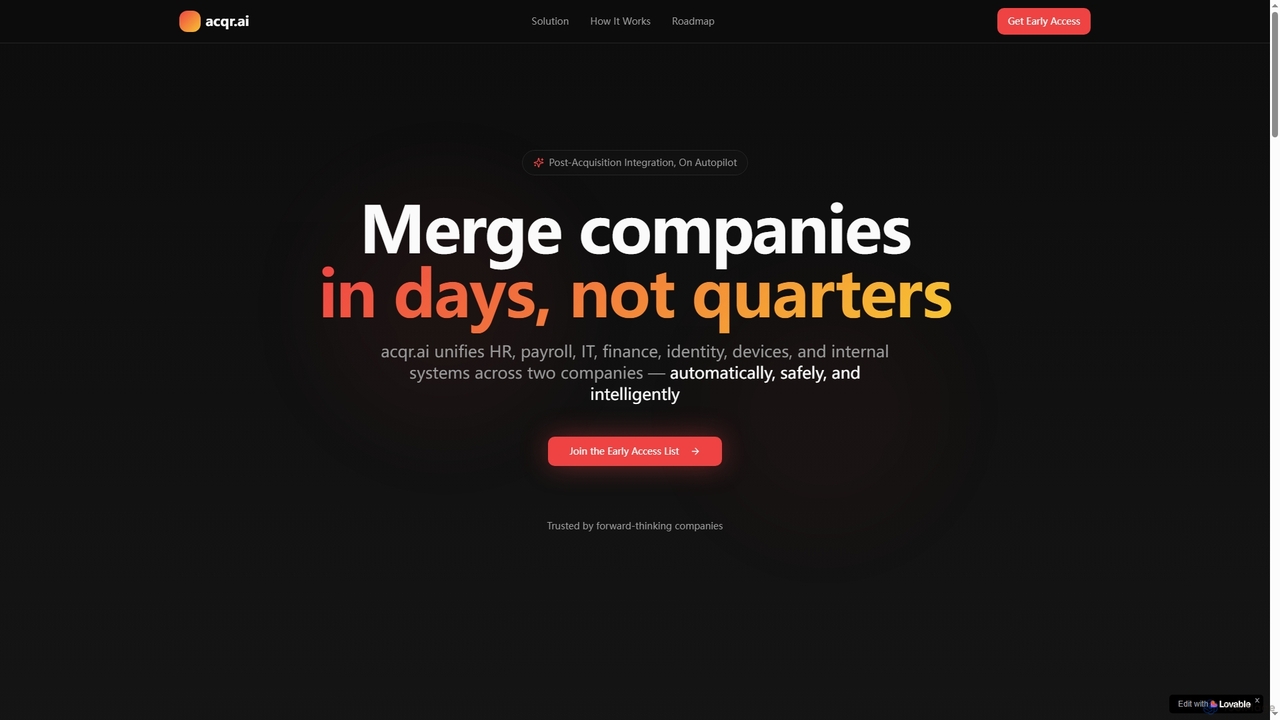
Acqr

Acqr

Acqr is an AI-powered platform designed to automate and streamline post-acquisition integration, unifying HR, payroll, IT, finance, identity, …

2.7K

About System Integration

System Integration tools are AI-powered solutions designed to connect disparate software applications, data sources, and IT systems into a unified, cohesive operational environment. These tools leverage artificial intelligence to automate data flow, harmonize information, and orchestrate complex workflows across an organization's technological landscape. By breaking down data silos and enabling seamless communication between systems, they enhance operational efficiency, improve data consistency, and empower intelligent automation within IT Management frameworks.

Core Features

  • API & Connector Management: Facilitates robust connections between diverse applications and platforms.
  • Data Transformation & Harmonization: Standardizes and cleanses data from various sources for unified processing.
  • Intelligent Workflow Orchestration: Automates and manages complex business processes across integrated systems using AI logic.
  • Real-time Data Synchronization: Ensures consistent and up-to-date information across all connected systems.
  • AI Model Embedding: Integrates pre-trained or custom AI models directly into existing applications and workflows.

Applicable Scenarios

Businesses across various sectors utilize System Integration tools to create a more agile and intelligent IT infrastructure. This includes integrating customer relationship management (CRM) with marketing automation platforms, connecting enterprise resource planning (ERP) systems with supply chain management, and unifying disparate data lakes for advanced AI analytics and business intelligence.

How to Choose

When selecting System Integration tools, prioritize solutions with broad compatibility for your existing systems and a rich library of connectors. Evaluate their scalability to handle future growth and increasing data volumes, robust security features for data protection, and the level of AI capabilities offered for intelligent automation. Consider ease of use, including low-code or no-code options, to accelerate deployment and reduce technical overhead.

System IntegrationUse Cases

1

Automating Data Flow Between CRM and ERP

Sales and operations teams often struggle with disconnected customer and order data across CRM (Customer Relationship Management) and ERP (Enterprise Resource Planning) systems. AI System Integration tools automatically map and synchronize customer profiles, sales orders, inventory levels, and billing information between these platforms. This eliminates manual data entry, reduces errors, and ensures that sales teams have real-time visibility into product availability, while operations can process orders efficiently, accelerating the sales-to-fulfillment cycle by up to 30%.

2

Automating Customer Service Workflows

Customer service managers integrate AI chatbots with CRM systems and ticketing platforms. When a customer query comes in, the AI chatbot handles initial responses, retrieves relevant customer data from the CRM, and automatically creates or updates support tickets, significantly reducing agent workload and improving response times by up to 60%.

3

Streamlining Supply Chain Operations

Manufacturers and logistics companies manage complex supply chains involving multiple vendors, inventory systems, and shipping carriers. AI System Integration tools connect these disparate systems, providing a unified view of the entire supply chain. They automate data exchange for order fulfillment, inventory tracking, and logistics planning, identifying bottlenecks and optimizing routes. This leads to reduced operational costs, improved delivery times, and enhanced responsiveness to market changes, often cutting lead times by 15-20%.

4

Streamlining Supply Chain Operations

Logistics and operations teams connect inventory management, warehouse systems, and transportation platforms with AI-driven demand forecasting. This integration allows for real-time visibility into stock levels, predictive analytics for potential disruptions, and automated reordering, leading to optimized inventory levels and a 20% reduction in operational costs.

5

Consolidating Customer Data for Advanced Analytics

Marketing and data analytics teams often struggle to get a complete view of customer behavior due to data silos across websites, social media, email campaigns, and support tickets. AI System Integration tools aggregate this disparate customer data into a unified data warehouse or data lake. This enables comprehensive customer journey analysis, personalized marketing campaigns, and more accurate predictive analytics, leading to improved customer engagement and a potential increase in conversion rates by 10-25%.

6

Enhancing Financial Fraud Detection

Financial analysts integrate transaction monitoring systems, customer data platforms, and external risk databases with AI-powered anomaly detection engines. This unified view enables the AI to analyze vast amounts of data in real-time, identify suspicious patterns, and flag potential fraudulent activities with higher accuracy, minimizing financial losses.

7

Enabling Hybrid Cloud Environment Management

Enterprises increasingly operate in hybrid cloud environments, combining on-premise infrastructure with multiple public and private cloud services. Managing data and applications across these diverse platforms presents significant challenges. AI System Integration tools provide the necessary connectivity and automation to facilitate secure data migration, workload balancing, and consistent policy enforcement across hybrid cloud infrastructures. This ensures seamless operation, optimizes resource utilization, and enhances overall IT agility, reducing management overhead by up to 20%.

8

Personalizing Marketing Campaigns

Marketing teams integrate customer data platforms (CDP) with email marketing, social media management, and AI content generation tools. The integrated system uses AI to analyze customer behavior, segment audiences, and automatically tailor personalized marketing messages and product recommendations across multiple channels, boosting engagement and conversion rates by 15%.

9

Accelerating M&A Post-Merger Integration

Mergers and acquisitions (M&A) often involve the complex and time-consuming task of integrating the IT systems of two different companies. AI System Integration tools significantly accelerate this process by intelligently analyzing existing systems, identifying common data structures, and automating the merging of databases, applications, and workflows. This reduces the risk of data loss, minimizes operational disruptions, and shortens the overall integration timeline, allowing the newly formed entity to realize synergies and achieve business value faster, potentially cutting integration time by 40-50%.

10

Optimizing IT Operations (AIOps)

IT operations teams integrate network monitoring, server logs, incident management, and performance analytics tools with an AIOps platform. The AI analyzes real-time data streams to detect anomalies, predict potential outages before they occur, and automate incident response, leading to a 30% reduction in downtime and faster problem resolution.

11

Building Custom AI Application Workflows

Developers and data scientists often need to integrate various AI models (e.g., NLP, computer vision, predictive analytics) with existing business applications to create new intelligent workflows. AI System Integration platforms provide low-code/no-code interfaces and pre-built connectors that simplify linking these AI services with enterprise systems like CRM, ERP, or data warehouses. This accelerates the development and deployment of custom AI applications, enabling businesses to leverage AI capabilities more broadly and innovate faster, reducing development cycles by 25-35%.

12

Building Unified Business Intelligence Platforms

Data strategists integrate various departmental databases (sales, marketing, finance, operations) and external market data into a central data warehouse, enhanced by AI for advanced analytics. This creates a single source of truth, enabling comprehensive dashboards, predictive insights, and data-driven decision-making across the entire organization.

System IntegrationFrequently Asked Questions