Patchifi
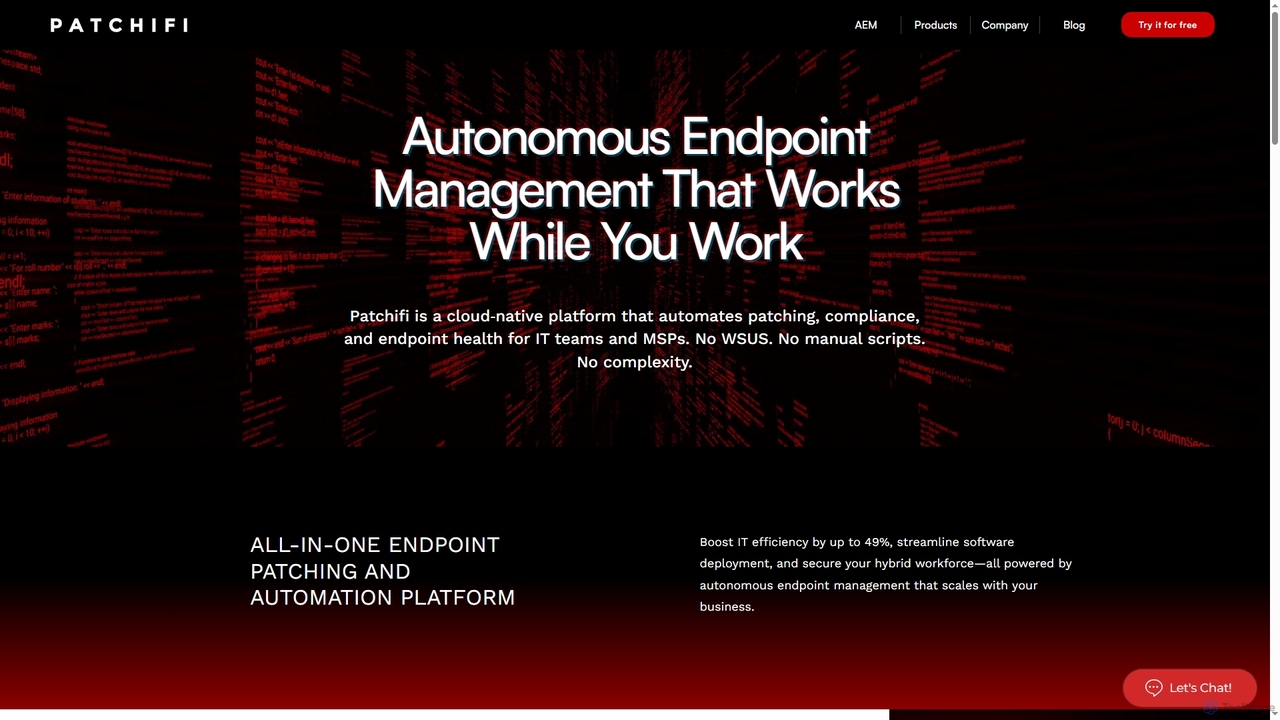
Patchifi is a cloud-native platform that automates endpoint management, patching, and compliance for IT teams and Managed Service …
Patchifi is a cloud-native platform that automates endpoint management, patching, and compliance for IT teams and Managed Service Providers (MSPs). It streamlines software deployment, enhances security, and boosts IT efficiency by up to 49% through intelligent automation, eliminating manual scripts and complexity.
About Endpoint Management
Endpoint Management AI tools are a category of advanced solutions that leverage artificial intelligence to automate, optimize, and secure the lifecycle of all endpoints within an organization's IT infrastructure. These tools utilize machine learning algorithms to analyze device data, predict potential issues, enhance security posture, and streamline operational tasks, making them a crucial component of modern IT management. By intelligently managing devices from deployment to retirement, they ensure compliance, improve performance, and reduce manual intervention.
Core Features
- Automated Provisioning & Configuration: AI-driven setup and customization of new devices, ensuring consistent policy application from day one.
- Intelligent Patch & Update Management: AI identifies, prioritizes, and deploys necessary software updates and security patches across diverse endpoints with minimal disruption.
- Predictive Endpoint Maintenance: Analyzes device health data to anticipate hardware failures or performance bottlenecks, enabling proactive maintenance.
- AI-powered Threat Detection & Response: Real-time anomaly detection and automated remediation of security incidents, enhancing endpoint security.
- Compliance & Policy Enforcement: AI continuously monitors devices to ensure adherence to organizational policies and regulatory standards, flagging deviations automatically.
Applicable Scenarios
Endpoint Management AI tools are indispensable for IT departments in large enterprises, managed service providers (MSPs), and organizations with a significant remote workforce. They are used to manage diverse device fleets, including laptops, desktops, mobile devices, and IoT endpoints. Typical scenarios involve ensuring all devices are secure and compliant, automating routine IT tasks, and providing proactive support to minimize downtime.
Selection Criteria
When choosing an AI Endpoint Management solution, consider its integration capabilities with existing IT systems (e.g., SIEM, ITSM), the breadth of device types it supports, and its scalability to accommodate future growth. Evaluate the sophistication of its AI algorithms for predictive analytics and threat detection, as well as its compliance reporting features. User-friendliness and the level of automation offered are also critical for operational efficiency.

Endpoint ManagementUse Cases
Automating New Employee Device Setup
For IT administrators onboarding new staff, AI Endpoint Management tools automate the entire device provisioning process. Instead of manual configuration, the system uses AI to deploy operating systems, install necessary software, and apply security policies based on the employee's role, ensuring devices are ready for use quickly and consistently. This significantly reduces setup time and human error, allowing IT teams to focus on more strategic tasks.
Proactive Security Threat Remediation
Security operations teams leverage AI Endpoint Management to detect and respond to emerging threats across all devices. The AI continuously monitors endpoint behavior for anomalies, such as unusual network activity or unauthorized software installations. Upon detection, it can automatically isolate the compromised device, roll back malicious changes, or trigger alerts for immediate human intervention, minimizing the impact of cyberattacks.
Optimizing Software Patch Deployment
IT operations managers use these tools to intelligently manage software updates and security patches. AI analyzes network traffic, user activity, and application dependencies to determine the optimal time for patch deployment, avoiding critical business hours. It can also prioritize patches based on vulnerability severity and device criticality, ensuring that the most urgent updates are applied first without disrupting productivity.
Predicting Hardware Failures for Laptops
Help desk and asset management teams utilize AI Endpoint Management to predict potential hardware failures in employee laptops and desktops. By analyzing telemetry data like disk health, battery performance, and CPU temperature, the AI can identify patterns indicative of impending failure. This enables IT to proactively replace components or devices before they fail, preventing downtime and improving user satisfaction.
Ensuring Regulatory Compliance Across Devices
Compliance officers in regulated industries rely on AI Endpoint Management to maintain continuous adherence to industry standards (e.g., GDPR, HIPAA) and internal policies. The AI automatically audits endpoint configurations, software installations, and access controls against predefined compliance baselines. It flags any deviations in real-time and can initiate automated remediation steps, simplifying audits and reducing compliance risks.
Streamlining Remote Troubleshooting for Mobile Devices
Support technicians use AI-powered Endpoint Management to efficiently diagnose and resolve issues on remote mobile devices. The AI can collect diagnostic data, analyze common problems like battery drain or connectivity issues, and suggest automated fixes or guided troubleshooting steps to the user. This reduces the need for physical device access and speeds up resolution times, enhancing support efficiency for a distributed workforce.