ToolMage
Sign in

Best 1 Q&A AI tools for Knowledge Management

Popular Q&A AI tools in Knowledge Management include Querya, helping you work more efficiently.

Querya

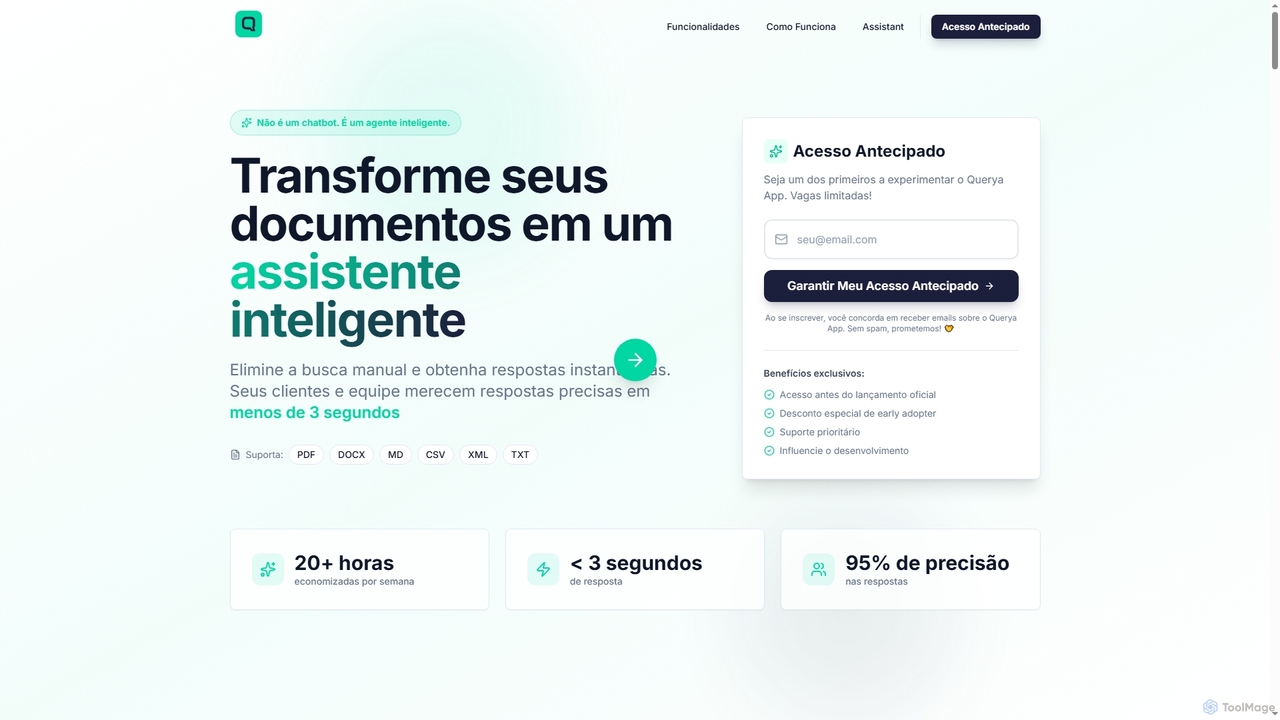
Querya is an intelligent agent that transforms your business documents into an instant knowledge assistant. It eliminates manual searches, providing precise answers from PDFs, DOCX, CSV, and more in under 3 seconds, boosting productivity and customer satisfaction.

Chatbot
Visits 3.4KFavorites 102Likes 109

About Q&A

Q&A AI tools are designed to provide direct, contextually relevant answers to user queries by leveraging advanced natural language processing (NLP) and information retrieval techniques. These tools analyze questions, search vast datasets or specific knowledge bases, and synthesize information to deliver concise and accurate responses. They significantly enhance knowledge accessibility and user interaction, moving beyond traditional keyword search to understand intent and provide immediate solutions.

Core Features

  • Natural Language Understanding (NLU): Interprets complex questions and user intent, even with varied phrasing.
  • Contextual Information Retrieval: Extracts relevant data from specified knowledge bases, documents, or web sources.
  • Answer Synthesis & Generation: Compiles information into coherent, concise, and accurate answers, often in real-time.
  • Source Citation: Provides references or links to the original information sources for verification.
  • Multi-turn Conversation: Maintains context across a series of related questions, enabling more natural interactions.

Applicable Scenarios

Businesses deploy Q&A AI to automatically answer common customer inquiries, reducing agent workload and improving response times. Employees use Q&A systems to quickly find information within company documents, policies, and training materials. Students and researchers can query academic databases or textbooks to get immediate answers to specific questions, aiding in study and literature review.

How to Choose

When selecting a Q&A AI tool, assess its compatibility with existing data sources and ease of content ingestion. Evaluate the tool's ability to provide correct and verifiable answers, including its citation capabilities. Consider the system's capacity to handle a high volume of queries and its response speed. Look for options to fine-tune the AI model with specific domain knowledge and adapt its answering style.

Featured tool rankings

Q&A use cases

1

Automating Customer Service Inquiries

E-commerce businesses can deploy AI Q&A tools to handle a high volume of routine customer questions about order status, product details, or return policies. By integrating with CRM and order management systems, the AI can provide instant, personalized answers 24/7, significantly reducing response times and freeing human agents for complex issues. This leads to higher customer satisfaction and operational efficiency.

2

Automating Customer Service FAQs

E-commerce businesses can implement Q&A AI tools to automatically answer frequently asked questions about products, shipping, returns, and account management. Customers receive instant, accurate responses 24/7, reducing the need for human intervention and improving satisfaction by providing immediate support.

3

Automating Customer Support Responses

E-commerce businesses or SaaS companies deploy Q&A tools on their websites or chat platforms to instantly answer common customer inquiries about products, services, shipping, or troubleshooting. This reduces the need for human agents to handle repetitive questions, allowing them to focus on complex issues and improving overall customer satisfaction with faster resolutions.

4

Internal Knowledge Retrieval for Employees

Large enterprises use Q&A systems to create an intelligent internal knowledge base. Employees can ask questions about company policies, HR benefits, IT support, or project documentation in natural language, receiving immediate and accurate answers without navigating through extensive portals or waiting for colleagues.

5

Streamlining Employee Onboarding

HR departments utilize Q&A AI to create an interactive knowledge base for new hires. Employees can ask questions about company policies, benefits, IT setup, and team structures, receiving immediate, consistent answers without burdening HR staff, accelerating their integration into the company.

6

Enhancing Employee Onboarding & Training

HR departments utilize Q&A tools to create interactive knowledge bases for new hires. Employees can ask questions about company policies, benefits, IT setup, or team structures and receive immediate, accurate answers. This accelerates the onboarding process, reduces the burden on HR and IT support, and ensures new employees quickly become productive members of the team.

7

Educational Content Comprehension and Summarization

Students and educators utilize Q&A tools to quickly grasp complex topics from textbooks, research papers, or lecture notes. By posing specific questions, users can receive concise summaries or explanations of difficult concepts, aiding in study, revision, and deeper understanding of educational material.

8

Facilitating Internal Knowledge Sharing

Large enterprises often struggle with fragmented internal knowledge. An AI Q&A system can centralize information from various departments (e.g., sales, marketing, engineering). Employees can query the system for project details, best practices, or technical specifications, getting precise answers without sifting through countless documents, thus fostering collaboration and informed decision-making.

9

Enhancing Research and Data Discovery

Researchers in scientific or academic fields can use Q&A AI to query large volumes of research papers, journals, and reports. By asking specific questions, they can quickly extract relevant findings, methodologies, and data points, significantly speeding up literature reviews and information synthesis.

10

Interactive Learning and Tutoring

Educational platforms integrate Q&A AI to provide personalized learning support. Students can ask questions about course material, receive explanations, definitions, and examples, and even get hints for problem-solving, fostering a more engaging and self-paced learning experience.

11

Research and Data Synthesis for Analysts

Market researchers or data analysts employ Q&A tools to rapidly extract specific data points, trends, or insights from large volumes of reports, articles, and datasets. This accelerates the research process, enabling quicker synthesis of information and more informed decision-making without manual data sifting.

12

Providing Instant Product Support & Troubleshooting

Software companies or hardware manufacturers can embed Q&A tools into their products or support portals. Users facing issues can describe their problem in natural language and receive step-by-step troubleshooting guides or solutions. This empowers users to self-resolve common problems, reducing support ticket volume and improving the overall user experience with the product.

13

Accelerating Research & Data Discovery

Researchers, analysts, or students can use Q&A tools to quickly extract specific information or summarize complex documents from vast datasets, academic papers, or legal texts. Instead of manual reading, they can pose direct questions and receive concise, evidence-based answers, significantly speeding up literature reviews, data analysis, and report generation processes.

14

Legal Document Analysis and Querying

Legal professionals employ Q&A AI to navigate complex legal documents, contracts, and case precedents. They can ask specific questions about clauses, precedents, or regulations, and the AI quickly identifies and summarizes the relevant sections, saving hours of manual review.

15

Interactive Product Manuals and Guides

Manufacturers or software developers integrate Q&A capabilities into their product manuals or online help guides. Users can ask specific questions about product features, setup instructions, or troubleshooting steps, receiving direct answers rather than searching through lengthy documents, enhancing user experience and product adoption.

16

Creating Interactive Educational Content

Educators and content creators can leverage Q&A tools to build dynamic learning experiences. Students can ask questions about course material, concepts, or assignments and receive personalized explanations or hints. This interactive approach supports self-paced learning, reinforces understanding, and provides immediate feedback, making education more engaging and accessible.

17

Personalized Health Information Access

Healthcare providers or health information platforms can offer Q&A AI for patients to inquire about symptoms, common conditions, medication information, or general health advice. The AI provides reliable, pre-vetted information, empowering patients with knowledge and reducing the load on medical staff for routine queries.

18

Legal and Compliance Information Access

Legal professionals or compliance officers use Q&A tools to quickly find specific clauses, regulations, or precedents within vast legal databases and compliance documents. This ensures rapid access to critical information, reducing research time and helping to maintain adherence to complex legal frameworks.

Q&A FAQ

What are AI Q&A tools?

AI Q&A tools are artificial intelligence applications designed to understand and answer user questions posed in natural language. They leverage advanced NLP to process queries, retrieve relevant information from various sources like documents or databases, and then generate coherent, contextually appropriate responses. These tools are crucial for automating information access and improving user support.

What are AI Q&A tools?

AI Q&A tools are artificial intelligence systems designed to understand user questions posed in natural language and provide direct, accurate answers. They achieve this by processing the query, searching relevant information sources (like documents or databases), and synthesizing the findings into a coherent response, often citing sources.

What are AI Q&A tools?

AI Q&A tools are artificial intelligence systems designed to understand user questions posed in natural language and provide accurate, relevant answers. They differ from traditional search engines by not just finding documents, but by extracting specific information and often generating new, coherent responses based on their understanding of a vast knowledge base. These tools are a specialized form of knowledge management, focusing on interactive information retrieval.

How do AI Q&A tools differ from traditional search engines?

While both retrieve information, traditional search engines primarily return a list of web pages or documents based on keywords. AI Q&A tools, however, focus on understanding the intent behind a question and directly generating a concise answer, often drawing from specific knowledge bases rather than just linking to external sources.

How do AI Q&A tools work?

AI Q&A tools typically work by first using Natural Language Processing (NLP) to understand the user's intent and extract key entities from the question. Then, they query a pre-trained knowledge base or a large language model (LLM) that has been fine-tuned on specific data. The system then retrieves relevant information, synthesizes it, and generates a human-like answer. Some tools also incorporate machine learning to continuously improve answer accuracy based on user feedback and new data.

How do AI Q&A tools differ from traditional search engines?

Traditional search engines primarily return a list of web pages or documents that contain keywords related to your query, requiring you to sift through results. AI Q&A tools, however, aim to provide a direct, synthesized answer to your question, often drawing information from multiple sources and presenting it concisely, without requiring you to click through links. They focus on understanding intent rather than just keywords.

What are the key benefits of using AI Q&A tools?

The main benefits include instant access to information, improved accuracy and consistency of answers, reduced workload for human support staff, enhanced user experience through natural language interaction, and the ability to quickly extract insights from large, unstructured datasets.

What are the key benefits of using AI Q&A tools?

The primary benefits include immediate access to information, significant reduction in response times for customer support or internal queries, and improved consistency in answers. They also free up human resources from repetitive tasks, enhance user satisfaction through quick resolutions, and can operate 24/7, providing continuous support and information retrieval.

What's the difference between AI Q&A tools and chatbots?

While often overlapping, AI Q&A tools primarily focus on providing direct, factual answers to specific questions, often drawing from a defined knowledge base. Chatbots, on the other hand, are designed for conversational interaction, which can include Q&A but also extends to task completion, guiding users through processes, or engaging in more open-ended dialogue. A Q&A tool might be a core component within a more comprehensive chatbot system, but its primary function is information retrieval and response generation.

What factors should I consider when integrating an AI Q&A tool?

When integrating an AI Q&A tool, consider the quality and structure of your existing knowledge base, as the tool's performance heavily relies on the data it can access. Evaluate its ability to integrate seamlessly with your current systems (e.g., CRM, chat platforms), its natural language understanding capabilities for your specific domain, and the ease of training and maintenance for ongoing accuracy and relevance.

How can I choose the best AI Q&A tool for my needs?

When selecting an AI Q&A tool, consider its ability to integrate with your existing knowledge bases, the accuracy and reliability of its answers, its natural language understanding capabilities, scalability for future growth, and options for customization and fine-tuning to your specific domain.

Who benefits most from using AI Q&A tools?

A wide range of users and organizations benefit from AI Q&A tools. This includes customer service departments looking to automate support, HR teams streamlining employee inquiries, IT support for troubleshooting, and large enterprises aiming to improve internal knowledge sharing. Content creators, researchers, and educators also leverage these tools to quickly access information, summarize texts, or create interactive learning experiences, ultimately saving time and improving information accessibility.

Can AI Q&A tools handle complex or ambiguous questions?

Modern AI Q&A tools are increasingly capable of handling complex and even ambiguous questions through advanced NLP and contextual understanding. However, their performance depends heavily on the quality and breadth of the underlying knowledge base and the sophistication of the AI model's training. For highly nuanced or subjective queries, human oversight or escalation may still be necessary.

What should I consider when choosing an AI Q&A tool?

When selecting an AI Q&A tool, consider its accuracy in understanding questions and generating relevant answers, its ability to integrate with your existing data sources (e.g., documents, databases, websites), and its scalability to handle your anticipated query volume. Evaluate customization options for training the AI with your specific domain knowledge, the ease of use for both administrators and end-users, and the level of support and analytics provided by the vendor. Security and data privacy features are also crucial.

Can AI Q&A tools learn and improve over time?

Yes, most advanced AI Q&A tools are designed with machine learning capabilities that allow them to learn and improve. They can refine their understanding of questions and the accuracy of their answers through continuous interaction, user feedback, and by being exposed to new data. This iterative learning process helps them become more effective and reliable over time.