
Dokkio
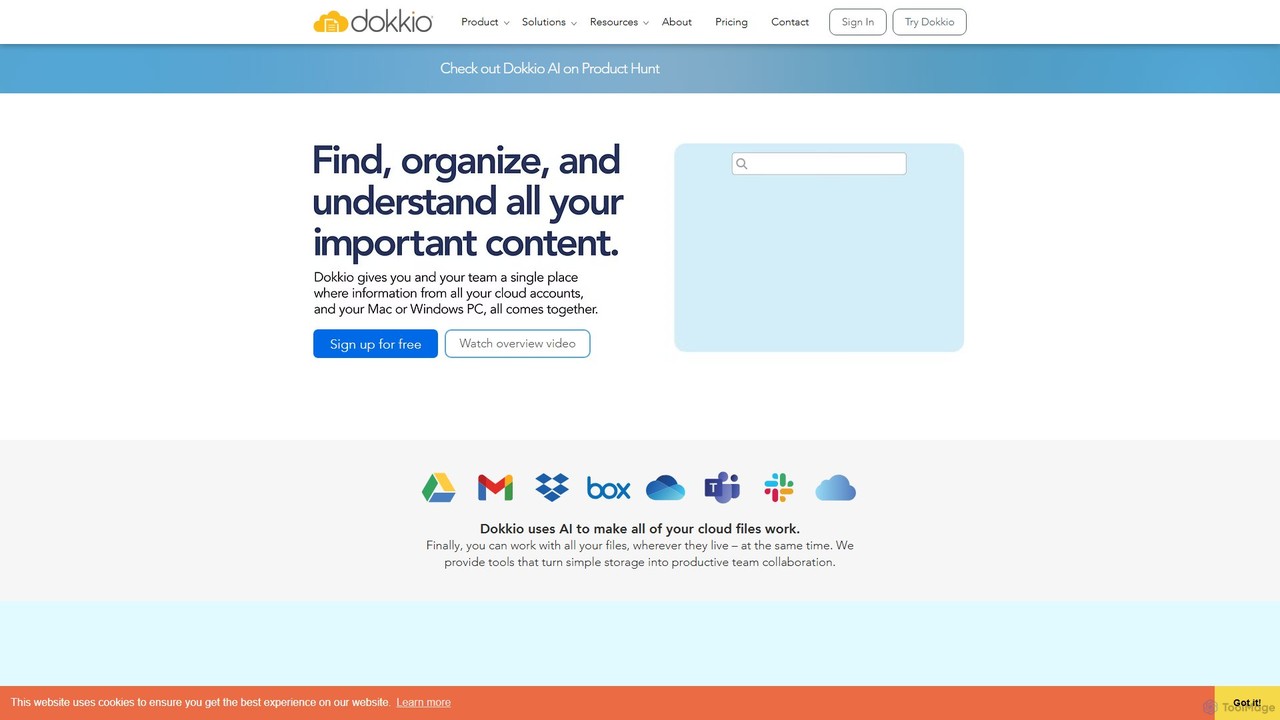
Dokkio is an AI-powered platform that unifies all your files from various cloud services like Google Drive, Dropbox, …
Dokkio is an AI-powered platform that unifies all your files from various cloud services like Google Drive, Dropbox, and Slack. It intelligently finds, organizes, and helps you understand your content, transforming scattered files into a centralized, searchable knowledge base for enhanced productivity and team collaboration.
About Search
AI Search tools are a category of advanced solutions that leverage artificial intelligence to understand user queries and retrieve highly relevant information from vast datasets. These tools go beyond keyword matching, employing natural language processing (NLP) and semantic understanding to interpret intent and context. They significantly enhance information discovery, making knowledge retrieval faster and more precise across various domains.
Core Features
- Semantic Search: Understands the meaning and context of queries, not just keywords, to deliver more accurate results.
- Natural Language Querying: Allows users to ask questions in conversational language, improving accessibility and user experience.
- Knowledge Graph Integration: Connects disparate pieces of information to provide comprehensive, interconnected answers.
- Personalized Results: Adapts search outcomes based on user history, preferences, and roles for tailored information access.
- Federated Search: Unifies search across multiple internal and external data sources, presenting a single, coherent view.
Applicable Scenarios
AI Search tools are invaluable for organizations and individuals dealing with large volumes of unstructured data. They are widely used in enterprise knowledge management for internal document discovery, in customer support for enhancing self-service portals, and in research for efficiently sifting through academic papers and reports. These tools streamline access to critical information, reducing time spent on manual searches.
How to Choose
When selecting an AI Search tool, consider its ability to integrate with your existing data sources and systems. Evaluate its natural language processing capabilities for understanding complex queries and its relevance ranking algorithms for accuracy. Assess scalability to handle growing data volumes and user bases, along with security features for sensitive information. Finally, review the user interface for ease of use and the availability of customization options.
SearchUse Cases
Enhance Enterprise Knowledge Retrieval
For large enterprises, employees often struggle to find specific documents, policies, or expert contacts across various internal systems. AI Search tools allow staff to query internal knowledge bases using natural language, instantly retrieving precise information from HR manuals, technical specifications, or project archives. This significantly reduces time spent searching, improves decision-making, and boosts overall operational efficiency.
Streamline Customer Support Self-Service
Customers often seek quick answers to common questions without needing to contact support agents. AI Search tools can power intelligent self-service portals, allowing users to type natural language questions into a chatbot or search bar. The AI then retrieves the most relevant answers from a comprehensive knowledge base, improving customer satisfaction and reducing the workload on support teams by deflecting routine inquiries.
Accelerate Academic and Scientific Research
Researchers and academics face the challenge of sifting through vast amounts of scientific literature, journals, and databases. AI Search tools enable them to perform semantic searches across these complex datasets, identifying relevant studies, methodologies, and findings much faster than traditional keyword searches. This accelerates literature reviews, helps uncover novel connections, and supports more efficient knowledge discovery in specialized fields.
Optimize Legal Document Discovery
Legal professionals often spend countless hours reviewing vast volumes of legal documents, case files, and contracts. AI Search tools can significantly reduce this burden by allowing lawyers to perform semantic searches for specific clauses, precedents, or relevant facts across massive legal corpuses. This accelerates the discovery phase, improves the accuracy of legal research, and enables more informed legal strategies.
Facilitate Market Intelligence Gathering
Market analysts and business strategists need to quickly gather insights from news articles, industry reports, social media, and competitor websites. AI Search tools enable them to perform targeted semantic searches across these diverse external data sources. This helps in identifying emerging trends, understanding competitive landscapes, and making data-driven strategic decisions more efficiently, providing a significant competitive advantage.
Personalized Content Discovery and Recommendation
For media companies, e-commerce platforms, or content creators, delivering personalized content is crucial for user engagement. AI Search tools analyze user behavior, preferences, and search history to provide highly relevant content recommendations, news articles, or product suggestions. This enhances the user experience, increases content consumption, and drives sales by connecting users with exactly what they are looking for, often before they even explicitly search.