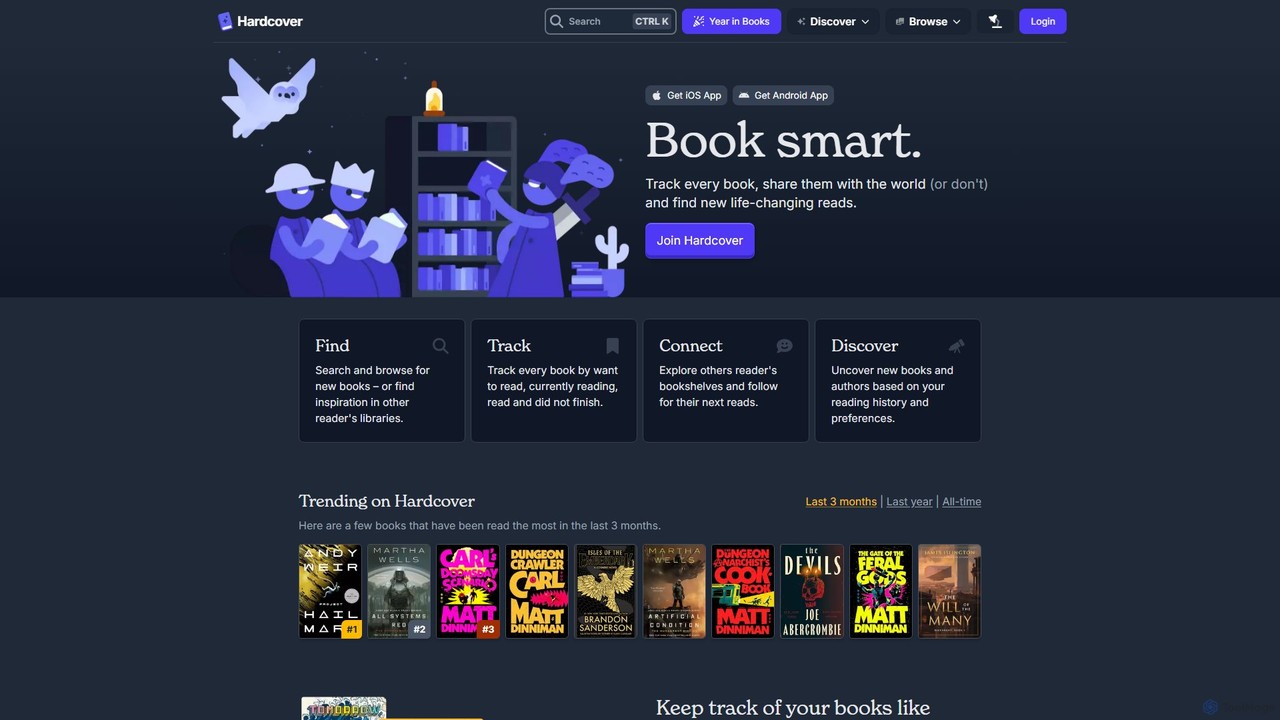
Hardcover
Hardcover is a social discovery platform for serious book lovers, designed as an independent alternative to Goodreads. It …
Hardcover is a social discovery platform for serious book lovers, designed as an independent alternative to Goodreads. It allows users to track their reading with granular detail, discover new books through personalized recommendations and community trends, and connect with a passionate community of readers. With features like library import, detailed stats, and customizable privacy, Hardcover aims to be the ultimate social network for bibliophiles.

GetBooks.ai
GetBooks.ai is an AI-powered book recommendation engine that helps you discover your next read through simple, natural language …
GetBooks.ai is an AI-powered book recommendation engine that helps you discover your next read through simple, natural language queries. Just describe the kind of book you're looking for—by mood, theme, or similarity to other works—and get instant, personalized suggestions. It's a fast, intuitive way for any reader to find new books and authors without endless browsing.
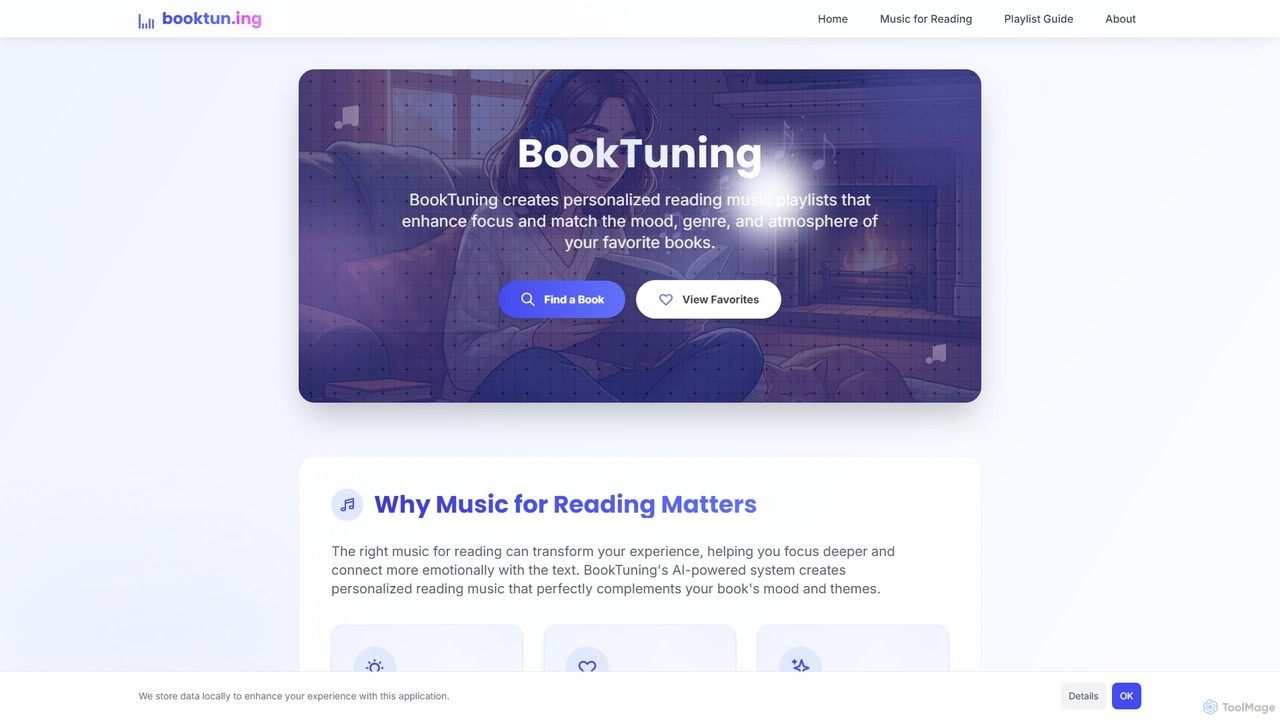
BookTuning
BookTuning is an AI-powered tool that creates personalized music playlists to enhance your reading experience. By analyzing the …
BookTuning is an AI-powered tool that creates personalized music playlists to enhance your reading experience. By analyzing the mood, genre, and themes of any book, it curates the perfect soundtrack to improve focus and deepen your emotional connection to the story. It's completely free and requires no Spotify account to use.
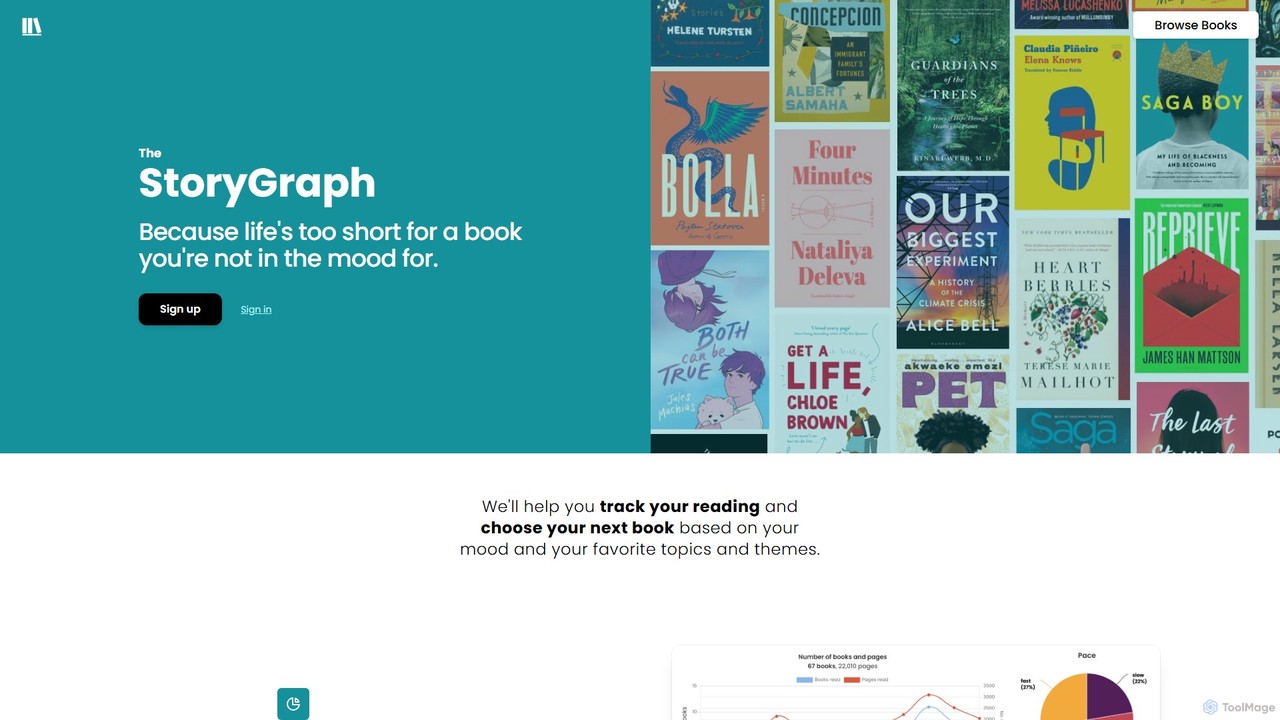
The StoryGraph
The StoryGraph is an AI-powered book tracking and recommendation platform. It helps you find your next read based …
The StoryGraph is an AI-powered book tracking and recommendation platform. It helps you find your next read based on your mood and reading preferences, provides insightful stats about your habits, and offers a unique social reading experience without spoilers.
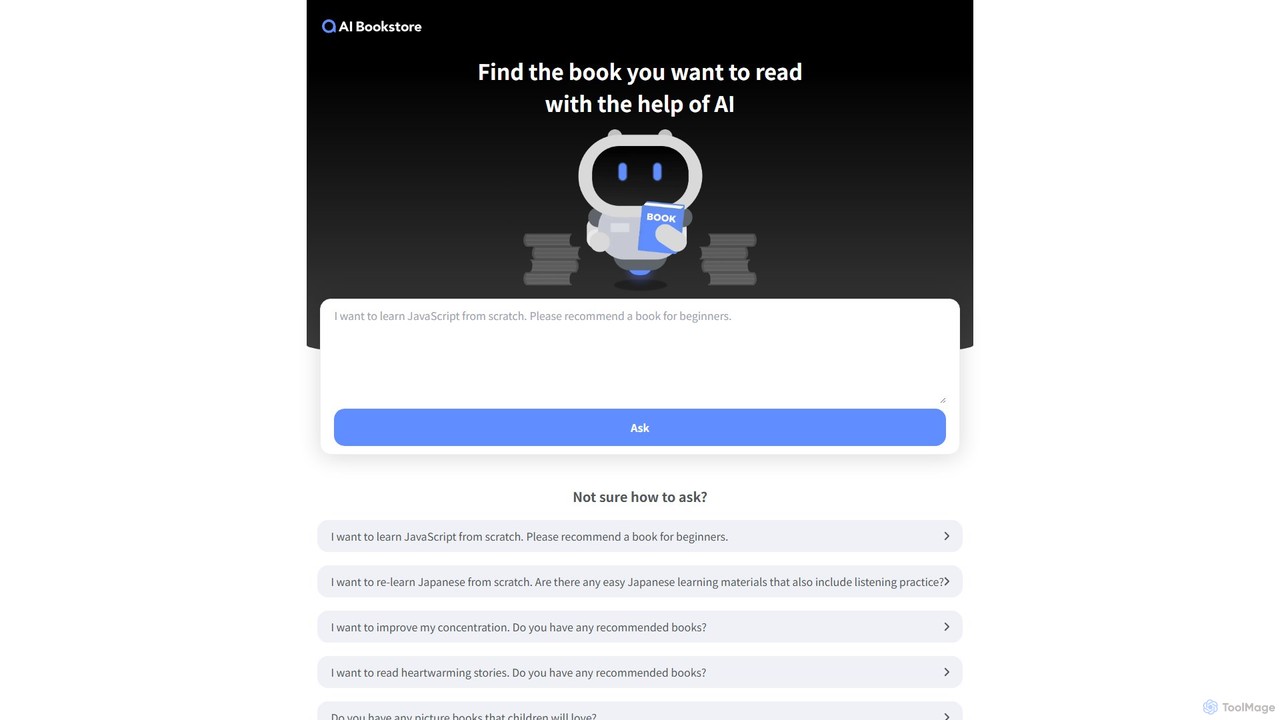
AI Bookstore
AI Bookstore is an AI-powered recommendation engine that helps you discover your next read. Simply ask for book …
AI Bookstore is an AI-powered recommendation engine that helps you discover your next read. Simply ask for book suggestions in natural language, specifying your interests, skill level, or mood. The AI provides a curated list of relevant books with descriptions and links to view on Amazon, making book discovery intuitive and personalized.
About Reading
AI Reading tools are applications that leverage artificial intelligence to transform how we process written content. They use natural language processing (NLP) to analyze, summarize, and interact with texts, going far beyond traditional digital readers. These tools help users quickly grasp key insights from dense documents, accelerate learning, and overcome information overload. By offering features like automated summarization and document Q&A, they make reading more efficient and insightful within a modern lifestyle.
Core Features
- AI Summarization: Automatically condenses long articles, reports, or PDFs into concise, digestible summaries.
- Document Q&A: Ask questions directly to your documents and receive context-aware answers instantly.
- Key Insight Extraction: Identifies and highlights crucial arguments, data points, and conclusions within the text.
- Vocabulary & Concept Explanation: Provides instant definitions for complex terms and concepts without leaving the page.
- Cross-document Analysis: Compares and synthesizes information from multiple sources to identify patterns and connections.
Use Cases
These tools are invaluable for students, researchers, analysts, and professionals who handle large volumes of text. For instance, a researcher can summarize dozens of academic papers in minutes, while a business analyst can quickly extract market trends from lengthy reports. They are also popular among lifelong learners for efficiently consuming books and online articles.
How to Choose
When selecting an AI Reading tool, consider the types of documents you work with (PDF, web pages, EPUB). Evaluate the quality and customizability of the summarization feature. Check for essential integrations like browser extensions or cloud storage sync. Finally, review the pricing model and the platform's data privacy policy to ensure it aligns with your needs.
ReadingUse Cases
Accelerate Academic Research and Literature Review
For graduate students and academic researchers, reviewing extensive literature is a time-consuming core task. An AI Reading tool streamlines this process significantly. Users can upload dozens of research papers in PDF format. The tool can then generate concise summaries for each paper, highlighting the methodology, findings, and conclusions. Instead of spending days reading, a researcher can quickly triage relevant papers, ask specific questions like "What was the sample size?" directly to the documents, and even synthesize key themes across multiple papers, dramatically speeding up the path to new insights.
Efficient Business Intelligence and Report Analysis
Business analysts and market strategists constantly need to digest dense market reports, financial statements, and competitor analyses. Using an AI Reading tool, they can upload these documents and instantly extract key performance indicators (KPIs), market trends, and strategic mentions. The Q&A feature allows them to query the reports for specific data points, such as "What was the Q3 revenue growth for competitor X?". This transforms static documents into interactive databases, enabling faster, data-driven decision-making without manually searching through hundreds of pages.
Enhance Personal Learning and Knowledge Management
Lifelong learners and avid readers often struggle to retain information from the vast number of books and articles they consume. An AI Reading tool acts as a powerful learning companion. While reading an online article or an e-book, the user can highlight sections and have the AI generate summary notes automatically. They can ask clarifying questions about complex concepts and save key insights into a personal knowledge base. This active engagement with the text improves comprehension and creates a searchable archive of learned knowledge for future reference.
Streamline Legal and Contract Document Review
Legal professionals often face the daunting task of reviewing lengthy contracts, case files, and legal precedents. An AI Reading tool can significantly reduce manual effort. By uploading a contract, a lawyer can use the tool to quickly find specific clauses, definitions, and obligations. They can ask questions like "What are the termination conditions?" and receive precise answers with source references. This not only saves hours of work but also reduces the risk of human error in overlooking critical details buried within complex legal documents.
Master New Subjects with Guided Reading
Individuals venturing into a new field, whether for work or a hobby, can feel overwhelmed by foundational texts and jargon. AI Reading tools provide scaffolding for this learning process. As they read a technical document or textbook, the tool can offer simplified explanations for complex terms and concepts in real-time. Users can ask "Explain this paragraph in simpler terms" or "What is the main argument here?". This interactive approach makes challenging material more accessible, fostering a deeper understanding and building confidence in the new subject area.
Improve Language Comprehension for Non-native Speakers
For individuals reading content in a second language, comprehension can be a major hurdle. AI Reading tools serve as an advanced language assistant. They can provide instant, in-context translations for words or entire sentences. More advanced tools can even rephrase complex sentences into simpler structures. This allows language learners to tackle authentic materials like news articles or reports that are slightly above their current proficiency level, accelerating their vocabulary acquisition and overall language skills in a practical, immersive way.