ToolMage
Sign in

Best 2 Storytelling AI tools for Lifestyle

Popular Storytelling AI tools in Lifestyle include AILifeStory and Sanota, helping you work more efficiently.

Sanota
Freemium

Sanota

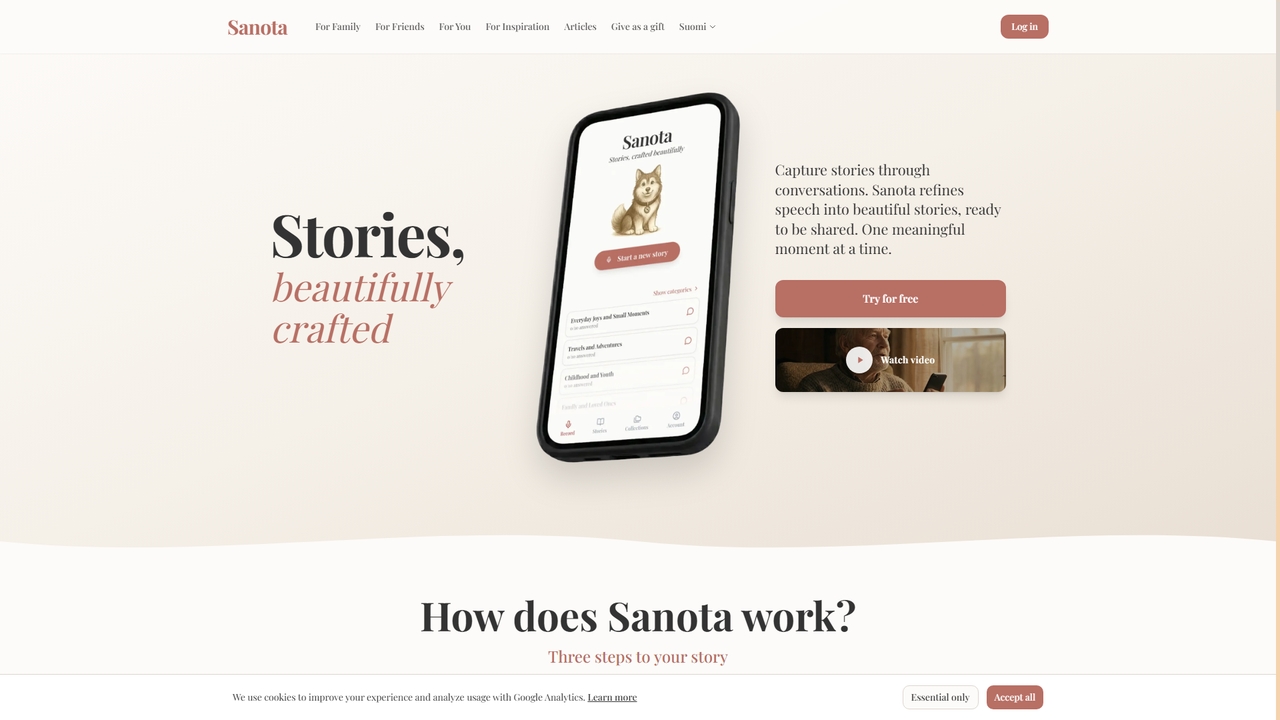
Sanota is an AI-powered tool that transforms spoken conversations into beautifully crafted, written narratives. Designed for preserving personal and family memories, it guides users through natural dialogues to capture stories effortlessly. Loved ones can contribute without downloading an app, making it ideal for genealogists, writers, and anyone wishing to document life stories.

Storytelling
Visits 6.7KFavorites 27Likes 34
AILifeStory
Freemium

AILifeStory

AILifeStory is an AI-powered platform that helps you write a captivating autobiography. Through a guided interview process with an AI ghostwriter, you can easily document your life experiences, memories, and wisdom. The tool transforms your spoken or typed answers into a professionally written, beautifully formatted digital book, creating a timeless legacy for your family and future generations.

Storytelling
Visits 8.8KFavorites 147Likes 165

About Storytelling

Storytelling AI tools are a specialized category within AI-powered creative applications that assist users in crafting compelling narratives. These tools leverage advanced natural language processing (NLP) and generation (NLG) models to facilitate various stages of story creation, from initial concept to detailed plotlines and character arcs. They empower writers, marketers, game designers, and educators to overcome creative blocks, accelerate content production, and explore new narrative possibilities, making the storytelling process more efficient and imaginative.

Core Features

  • Idea Generation: Provides prompts, themes, and initial concepts to spark creativity and overcome writer's block.
  • Plot Structuring: Helps outline narrative arcs, develop plot points, and ensure logical story progression.
  • Character Development: Assists in creating detailed character profiles, backstories, and dialogue styles.
  • Dialogue & Script Writing: Generates realistic and contextually appropriate dialogue or full script drafts.
  • World-building: Supports the creation of rich, consistent fictional universes with detailed settings and lore.

Use Cases

Content creators and marketers utilize Storytelling AI to rapidly generate engaging narratives for campaigns, social media, and brand stories. Game developers employ these tools for crafting intricate lore, dynamic character dialogues, and branching storylines. Educators can use them to create interactive learning scenarios or personalized story prompts for students, fostering creativity and critical thinking.

How to Choose

When selecting Storytelling AI tools, consider the specific stage of your creative process you need assistance with, such as idea generation, plot outlining, or full draft creation. Evaluate the AI's flexibility in adapting to your unique style and genre, its integration capabilities with existing writing software, and the level of control it offers over the generated content. Also, assess the pricing model and the quality of output for your desired narrative complexity.

Storytelling use cases

1

Developing Engaging Marketing Campaign Narratives

Marketing professionals can utilize Storytelling AI to quickly generate diverse narrative concepts for advertising campaigns, product launches, or brand storytelling. By inputting key messages and target audience demographics, the AI can produce compelling storylines that resonate emotionally, saving significant time in brainstorming and initial draft creation, leading to more impactful campaigns.

2

Overcoming Writer's Block for Novelists and Screenwriters

Authors and screenwriters often face creative hurdles. Storytelling AI tools serve as a powerful assistant, providing fresh plot twists, character motivations, or dialogue suggestions when inspiration wanes. This allows creators to maintain momentum, explore alternative narrative paths, and refine their stories without getting stuck, accelerating the writing process for books, scripts, and short stories.

3

Crafting Immersive Game Lore and Character Backstories

Game designers can leverage Storytelling AI to build rich, consistent fictional worlds and detailed character backstories for their video games. The AI can generate extensive lore, historical events, and intricate relationships between characters, ensuring depth and immersion. This streamlines the world-building process, allowing designers to focus on gameplay mechanics while maintaining narrative coherence.

4

Generating Personalized Educational Content and Prompts

Educators can use Storytelling AI to create customized learning materials, such as interactive historical narratives or science-fiction scenarios, tailored to specific curriculum needs or student interests. The AI can also generate unique story prompts for creative writing assignments, encouraging students to develop their imagination and critical thinking skills in a personalized learning environment.

5

Automating Dialogue for Virtual Assistants and Chatbots

Developers of virtual assistants and chatbots can employ Storytelling AI to generate more natural, engaging, and contextually appropriate dialogue. Instead of manually scripting every interaction, the AI can create dynamic conversational flows and responses that enhance user experience, making interactions feel more human-like and less robotic, particularly for complex customer service or interactive experiences.

6

Rapid Prototyping for Interactive Story Experiences

Interactive media creators, such as those working on choose-your-own-adventure games or immersive VR experiences, can use Storytelling AI for rapid prototyping of branching narratives. The AI can quickly generate multiple plot paths, character choices, and outcomes, allowing creators to test different story structures and user engagement models efficiently before committing to full development.

Storytelling FAQ

What are AI Storytelling tools?

AI Storytelling tools are software applications that use artificial intelligence, primarily natural language processing and generation, to assist in the creation of narratives. They help users with various aspects of storytelling, including generating ideas, outlining plots, developing characters, and writing dialogue or full story drafts. These tools aim to enhance creativity and streamline the writing process for diverse content forms.

How do AI Storytelling tools differ from traditional writing software?

Traditional writing software provides a platform for human writers to compose and edit text, offering features like spell check and formatting. AI Storytelling tools, however, actively participate in the creative process by generating content, suggesting ideas, and structuring narratives based on user input. They act as a collaborative partner, offering creative assistance beyond mere text editing, fundamentally changing how stories can be developed.

Who can benefit most from using AI Storytelling tools?

A wide range of individuals and professionals can benefit from AI Storytelling tools. This includes novelists, screenwriters, content marketers, game designers, educators, and even students. Anyone looking to overcome writer's block, accelerate their creative output, explore new narrative concepts, or enhance the depth and consistency of their stories will find these tools valuable for various creative and professional projects.

What are the key features to look for in an AI Storytelling tool?

When evaluating AI Storytelling tools, look for robust idea generation capabilities, flexible plot outlining features, and detailed character development assistance. Strong natural language generation for dialogue and narrative text is crucial. Consider tools that offer customization options for genre and style, allow for iterative refinement, and provide good integration with other creative platforms. User-friendliness and the quality of output are also important.

Can AI Storytelling tools replace human writers?

No, AI Storytelling tools are designed to be powerful assistants, not replacements, for human writers. While they can generate impressive content and provide creative prompts, the nuanced understanding of human emotion, cultural context, and unique artistic vision still primarily comes from human creators. AI tools excel at automating repetitive tasks and generating variations, allowing human writers to focus on refining the core narrative, injecting personal style, and ensuring emotional depth.