ToolMage
Sign in

Best 1 App Promotion AI tools for Marketing

Popular App Promotion AI tools in Marketing include AutoReach, helping you work more efficiently.

AutoReach
Paid

AutoReach

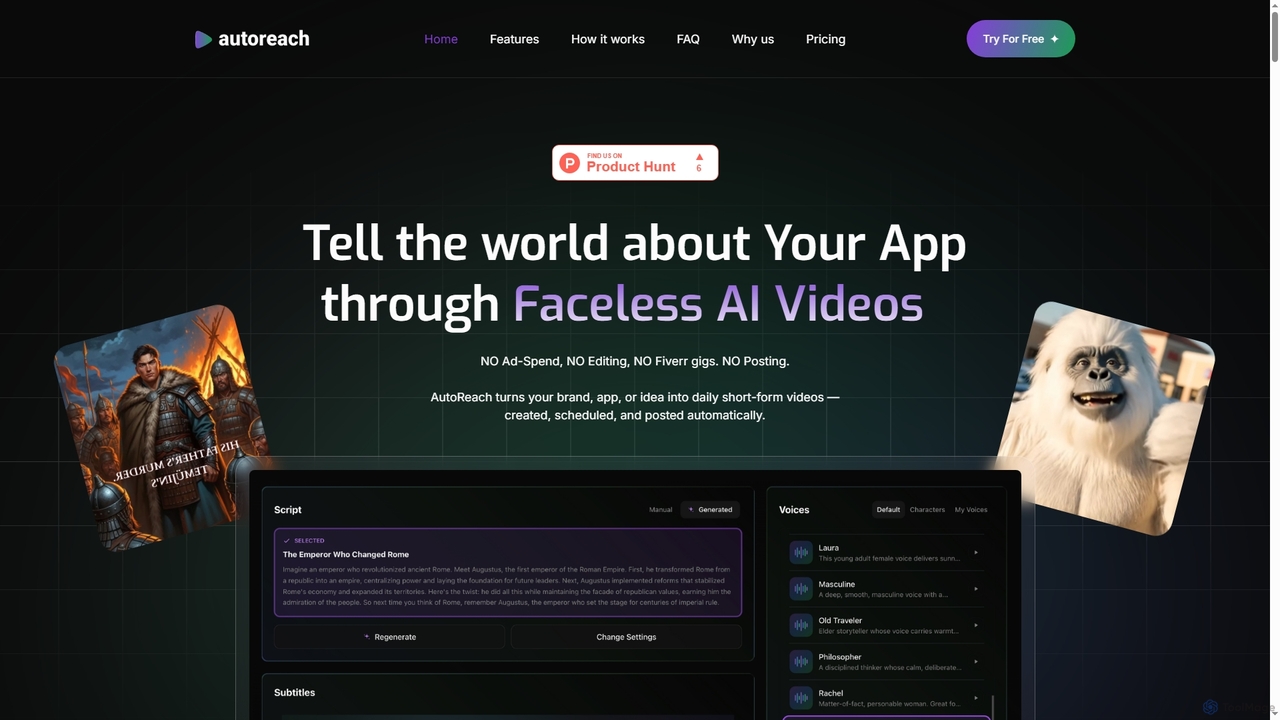
AutoReach is an AI-powered platform that automates the creation, scheduling, and posting of short-form videos to promote apps and ideas. It generates engaging, faceless content across various styles, eliminating the need for ad-spend, editing, or manual posting, helping indie developers achieve organic reach and consistent visibility.

Scriptwriting
Visits 8.4KFavorites 153Likes 170

About App Promotion

AI App Promotion tools are a specialized class of software designed to automate and optimize the process of increasing a mobile application's visibility and user base. They leverage machine learning algorithms to analyze market data, predict trends, and generate high-performing marketing assets. These tools help developers and marketers improve App Store Optimization (ASO), run more effective ad campaigns, and gain deeper insights from user feedback, ultimately driving downloads and engagement within the broader marketing landscape.

Core Features

  • AI-Powered ASO: Automatically suggests optimal keywords, titles, and descriptions to improve app store search rankings.
  • Ad Creative Generation: Creates numerous variations of ad copy, images, and videos tailored for different platforms and audiences.
  • User Review Analysis: Uses sentiment analysis to categorize user feedback, identifying bugs, feature requests, and positive trends.
  • Competitor Intelligence: Tracks competitors' rankings, keyword strategies, and advertising campaigns to inform your own strategy.
  • Performance Prediction: Forecasts the potential success of campaigns and ASO changes based on historical data and market trends.

Use Cases

These tools are essential for indie developers, marketing managers at gaming or tech companies, and dedicated ASO specialists. They are used during an app's launch to gain initial traction, for ongoing user acquisition campaigns, and to analyze user feedback for product improvement cycles. For example, a marketing team can use AI to A/B test hundreds of ad creatives simultaneously to find the most effective combination.

How to Choose

When selecting an AI App Promotion tool, consider its specific focus—whether it's ASO, creative generation, or competitive analysis. Evaluate its integration capabilities with major ad networks (like Google and Meta) and analytics platforms. Also, assess the depth of its data insights and the clarity of its recommendations. Finally, compare pricing models to ensure they align with your budget and expected scale of use.

App Promotion use cases

1

Optimize App Store Visibility with AI ASO

An indie game developer wants to launch their new puzzle game but has a limited marketing budget. They use an AI App Promotion tool to perform App Store Optimization (ASO). The tool analyzes top-ranking competitors and suggests high-traffic, low-competition keywords for the app's title, subtitle, and description. It also provides recommendations for optimizing screenshots and the app icon based on conversion data from similar apps. By implementing these AI-driven suggestions, the developer significantly improves their app's search ranking, leading to a steady stream of organic downloads without a large ad spend.

2

Automate Ad Creative for User Acquisition Campaigns

A marketing manager for a mobile commerce app needs to run user acquisition (UA) campaigns across multiple platforms like Meta, Google, and TikTok. Creating tailored ad creatives for each platform is time-consuming. They use an AI tool that generates hundreds of ad variations by combining different headlines, descriptions, images, and call-to-action buttons. The AI also predicts which combinations are most likely to resonate with specific audience segments on each platform. This allows the manager to launch highly targeted and diverse campaigns quickly, improving click-through rates and lowering the cost per install.

3

Analyze User Reviews for Product Roadmap Insights

A product manager for a popular productivity app needs to decide which features to build next. Manually sifting through thousands of user reviews on the App Store and Google Play is inefficient. They use an AI review analysis tool that automatically categorizes feedback into themes like 'bug reports,' 'feature requests,' and 'UI/UX issues.' The tool's sentiment analysis highlights the most urgent problems and most requested features. This data-driven approach helps the product manager prioritize the development roadmap based on what users actually want, leading to higher user satisfaction and better app ratings.

4

Monitor Competitor Strategies for Market Advantage

An ASO specialist at a mobile gaming company is tasked with staying ahead of the competition. They use an AI-powered competitor intelligence tool to track the ASO strategies of rival games. The tool sends alerts whenever a competitor changes their app title, icon, screenshots, or starts bidding on new keywords. It also analyzes the performance of competitors' ad campaigns, showing which creatives and messaging are performing best. This continuous monitoring provides actionable intelligence, allowing the specialist to react quickly to market shifts and adjust their own app's promotion strategy to maintain a competitive edge.

5

Localize App Listings for Global Markets

A fintech app is expanding into Japan and Brazil. The marketing team needs to adapt their App Store and Google Play listings for these new markets. Instead of direct translation, they use an AI tool that provides culturally relevant keyword suggestions and phrasing for each language. The tool analyzes local search trends and competitor listings in Japan and Brazil to recommend titles and descriptions that will resonate with local users. It also helps generate localized ad creatives, ensuring the marketing message is appropriate and effective in each new region, accelerating global growth.

6

Predict Campaign Performance to Maximize ROI

A growth marketing team is planning its quarterly budget for a lifestyle app. Before allocating significant funds, they use an AI promotion tool with predictive analytics. They input their campaign goals, target audience, and proposed ad creatives. The AI model, trained on vast amounts of historical campaign data, forecasts the likely cost per install (CPI) and return on ad spend (ROAS) for different channels like Instagram and Google App Campaigns. This allows the team to allocate their budget to the channels with the highest predicted ROI, optimizing their spending and avoiding costly, underperforming campaigns.

App Promotion FAQ

What are AI App Promotion tools?

AI App Promotion tools are specialized software that use artificial intelligence to automate and enhance mobile app marketing. They focus specifically on tasks like App Store Optimization (ASO), user acquisition ad campaigns, and analyzing user feedback. Unlike general marketing tools, they are built with a deep understanding of app store algorithms and mobile advertising ecosystems. Key functions include suggesting keywords to improve search visibility, generating ad creatives, and providing insights from user reviews to guide product development.

How do I choose the right AI tool for app promotion?

To choose the right tool, first identify your primary goal. Are you focused on improving organic discovery (ASO), running paid user acquisition campaigns, or understanding user sentiment? Consider these factors:

  • Feature Set: Does the tool specialize in one area (e.g., ASO keyword research) or offer an all-in-one suite?
  • Platform Support: Ensure it supports the platforms you target, like the iOS App Store and Google Play.
  • Integrations: Check if it connects with your existing ad networks (Google Ads, Meta) and analytics tools (Firebase, AppsFlyer).
  • Ease of Use: Evaluate the user interface and the quality of the insights and recommendations it provides. A tool should offer clear, actionable advice, not just raw data.
What's the difference between AI App Promotion tools and general marketing AI?

The key difference is specialization. General marketing AI tools are broad, covering SEO for websites, email marketing, social media management, and more. AI App Promotion tools are a highly focused subset of marketing tools. They are specifically designed for the unique challenges of the mobile app ecosystem. This includes deep integrations with app stores, understanding of ASO ranking factors which differ from web SEO, and features for managing mobile-specific ad formats and user acquisition channels like Apple Search Ads.

Can AI tools guarantee a top ranking in the app store?

No tool, AI-powered or otherwise, can guarantee a top ranking. App store rankings are influenced by many factors, including app quality, user ratings, download velocity, and competition. However, AI App Promotion tools can significantly improve your chances. They provide data-driven recommendations to optimize your app's listing (ASO), making it more discoverable. They also help you run more efficient ad campaigns to drive traffic and downloads. Think of them as powerful assistants that maximize your efforts and give you a competitive advantage, rather than a magic solution for the number one spot.

Who benefits most from using AI App Promotion tools?

A wide range of roles can benefit, but they are particularly valuable for:

  • Indie Developers & Small Teams: AI tools automate time-consuming tasks like keyword research and ad creation, allowing small teams with limited resources to compete more effectively.
  • App Marketing Managers: These tools provide the data and automation needed to manage large-scale user acquisition campaigns, optimize budgets, and track competitors at scale.
  • ASO Specialists: Dedicated ASO professionals use these tools for deep keyword analysis, competitor tracking, and testing optimization strategies to maximize organic visibility.
  • Product Managers: AI-powered review analysis helps them quickly synthesize user feedback to inform product roadmaps and prioritize feature development.