ToolMage
Sign in

Best 1 Paraphrasing AI tools for Marketing

Popular Paraphrasing AI tools in Marketing include WordAi, helping you work more efficiently.

WordAi
Paid

WordAi

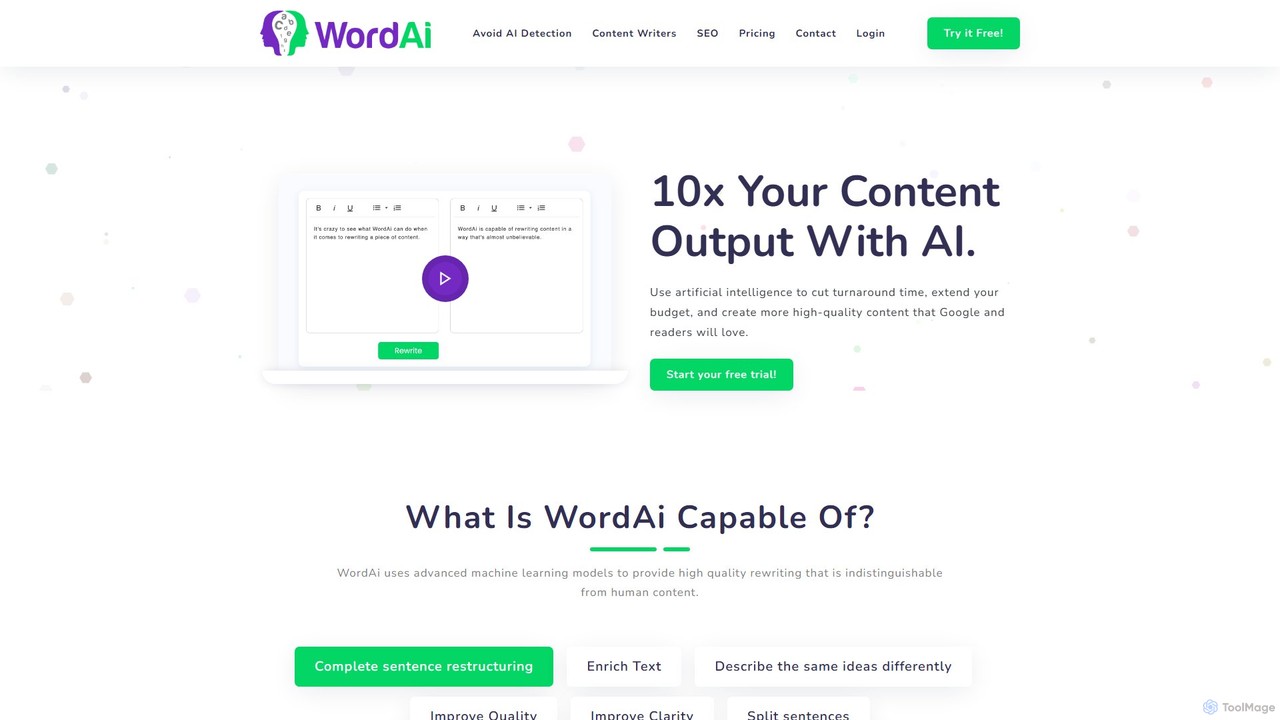
WordAi is an advanced AI text rewriter that uses machine learning to paraphrase content. It restructures sentences to create unique, human-quality text that can bypass AI detection and plagiarism checkers. It's designed to help users 10x their content output for SEO, marketing, and business efficiency.

Paraphrasing
Visits 42.8KFavorites 108Likes 123

About Paraphrasing

AI Paraphrasing tools are a class of software that uses artificial intelligence to rewrite text while preserving its original meaning. These tools leverage advanced natural language processing (NLP) models to alter sentence structure, replace words with synonyms, and adjust the tone to create unique, high-quality content. Their primary value lies in enhancing clarity, avoiding plagiarism, and efficiently generating multiple versions of content for marketing and academic purposes. This makes them highly effective for tasks ranging from content refreshment to adapting messages for different audiences.

Core Features

  • Sentence Restructuring: Intelligently reorganizes sentence components to create new phrasings without changing the core message.
  • Synonym Replacement: Contextually replaces words with appropriate synonyms to vary vocabulary and avoid repetition.
  • Tone Adjustment: Modifies the text's tone to be more formal, casual, professional, or persuasive based on user needs.
  • Clarity Enhancement: Simplifies complex sentences and jargon, making the content easier to understand for a broader audience.
  • Plagiarism Checking: Often includes a built-in feature to compare the rewritten text against existing online content to ensure originality.

Use Cases

AI Paraphrasing tools are widely used by content marketers, SEO specialists, students, and researchers. In marketing, they are used to create multiple variations of ad copy, social media posts, and email newsletters for A/B testing. Academics and students use them to rephrase research findings and avoid accidental plagiarism in papers and essays. Businesses also use these tools to repurpose blog posts into scripts for videos or summaries for presentations.

How to Choose

When selecting an AI Paraphrasing tool, consider the quality and naturalness of the output; a good tool should produce text that doesn't sound robotic. Evaluate the range of modes or tones available, such as formal, creative, or simple. Check for integration capabilities with platforms like Google Docs or WordPress, which can streamline your workflow. Finally, assess the pricing model and usage limits to ensure it aligns with your content creation volume and budget.

Paraphrasing use cases

1

Refining Ad Copy for A/B Testing

A digital marketer needs to run a campaign on multiple platforms, each requiring slightly different messaging. Instead of manually writing dozens of variations, they use an AI Paraphrasing tool. By inputting the core ad message, the tool generates ten distinct versions in seconds, varying the call-to-action, tone, and sentence structure. The marketer can then deploy these variations in an A/B test to identify which copy performs best, significantly improving conversion rates and optimizing ad spend without hours of creative work.

2

Adapting Blog Content for Social Media

A content creator has just published a comprehensive 2000-word blog post. To maximize its reach, they need to promote it on Twitter, LinkedIn, and Facebook. Using an AI Paraphrasing tool, they can quickly generate multiple summaries of the blog post. They can create a short, punchy version for Twitter, a professional summary for LinkedIn, and an engaging, question-based post for Facebook. This process allows them to repurpose one piece of long-form content into various formats tailored for different platforms, saving time and ensuring consistent messaging.

3

Ensuring Originality in Academic Writing

A university student is writing a literature review and needs to synthesize information from multiple scholarly articles. To avoid accidental plagiarism, they use an AI Paraphrasing tool. After drafting a paragraph summarizing a key concept from a source, they input their own text into the tool. The tool rephrases the sentences and suggests alternative vocabulary, helping the student express the original idea in their own unique voice while still accurately representing the source material. This ensures the final submission is original and adheres to academic integrity standards.

4

Simplifying Technical Jargon for Reports

An engineer needs to present a project update to a non-technical management team. Their initial draft is filled with complex terminology and technical details. To make the report accessible, they use an AI Paraphrasing tool with a 'simplify' or 'plain language' mode. The tool rewrites the technical sections, replacing jargon with everyday language and breaking down complex sentences into clearer, more concise ones. The result is a report that effectively communicates project progress and challenges to all stakeholders, regardless of their technical background, facilitating better decision-making.

5

Improving Email Communication Clarity

A project manager frequently communicates with international clients where English is a second language. To ensure their messages are clear and unambiguous, they use an AI Paraphrasing tool before sending important emails. They write their message and then use the tool to check for clarity and conciseness. The tool often suggests rephrasing complex sentences or replacing idiomatic expressions with more universally understood terms. This practice helps prevent misunderstandings, reduces back-and-forth clarification emails, and fosters a more professional and efficient communication channel with clients.

6

Generating SEO-Friendly Content Variations

An SEO specialist needs to create multiple unique descriptions for a product listed on various e-commerce platforms to avoid duplicate content penalties. They write a detailed master description and then use an AI Paraphrasing tool to generate several distinct versions. The tool helps them vary the sentence structure and vocabulary while keeping key product features and keywords intact. This allows the specialist to quickly populate different marketplaces with unique, SEO-friendly content, improving the product's visibility across all channels without having to write each description from scratch.

Paraphrasing FAQ

What is an AI Paraphrasing tool?

An AI Paraphrasing tool is a software application that uses artificial intelligence, specifically natural language processing (NLP), to rewrite text. Its main goal is to change the wording and structure of sentences while preserving the original meaning. Unlike simple synonym replacers, these tools understand context to produce fluent, readable, and unique content. They are commonly used to avoid plagiarism, improve writing clarity, and create multiple versions of content for marketing or SEO.

How to choose the right AI Paraphrasing tool?

To choose the right tool, consider these factors:

  • Output Quality: Test the tool to see if it produces natural, grammatically correct, and contextually accurate text.
  • Customization Options: Look for features like tone adjustment (formal, casual), different rewriting modes (fluency, creative), and the ability to protect certain keywords from being changed.
  • Integrations: Check if it integrates with your existing workflow, such as browser extensions or plugins for Google Docs and Microsoft Word.
  • Usage Limits and Pricing: Evaluate the character or word limits on free and paid plans to ensure they meet your needs without being cost-prohibitive.
What is the difference between paraphrasing and summarizing?

The key difference lies in the length and purpose. Paraphrasing involves rewriting a piece of text in your own words while maintaining a similar length and level of detail as the original. Its purpose is to rephrase for clarity or originality. Summarizing, on the other hand, involves condensing the main ideas of a longer text into a much shorter version. Its purpose is to provide a brief overview. An AI Paraphrasing tool focuses on the former, while an AI Summarizer focuses on the latter.

Can AI Paraphrasing tools be detected?

While AI-generated text is becoming more sophisticated, advanced AI detection tools can often identify patterns indicative of machine writing. However, high-quality paraphrasing tools produce text that is very close to human writing, making it harder to detect. Using the output as a first draft and then manually editing it for voice, tone, and nuance is the most effective way to ensure the final text is undetectable and truly your own. Relying solely on the tool's raw output, especially for academic or professional work, carries some risk of detection.

How do AI Paraphrasing tools help with marketing?

In marketing, these tools are valuable for content scalability and optimization. They help marketers:

  • Create Content Variations: Quickly generate multiple versions of ad copy, email subject lines, or social media posts for A/B testing to find the most effective message.
  • Avoid Duplicate Content: Rewrite product descriptions for different e-commerce sites or guest posts for various blogs, which is crucial for SEO.
  • Repurpose Content: Adapt a single piece of content, like a blog post, into different formats such as tweets, video scripts, or presentation points, maximizing its value.
  • Improve Clarity: Refine marketing messages to be clearer and more persuasive for the target audience.