Marketing Best in category 1 results Question Answering AI Tool

Popular AI tools in the Question Answering field of Marketing include aianswer, etc., helping you quickly improve efficiency.

Free
aianswer

aianswer

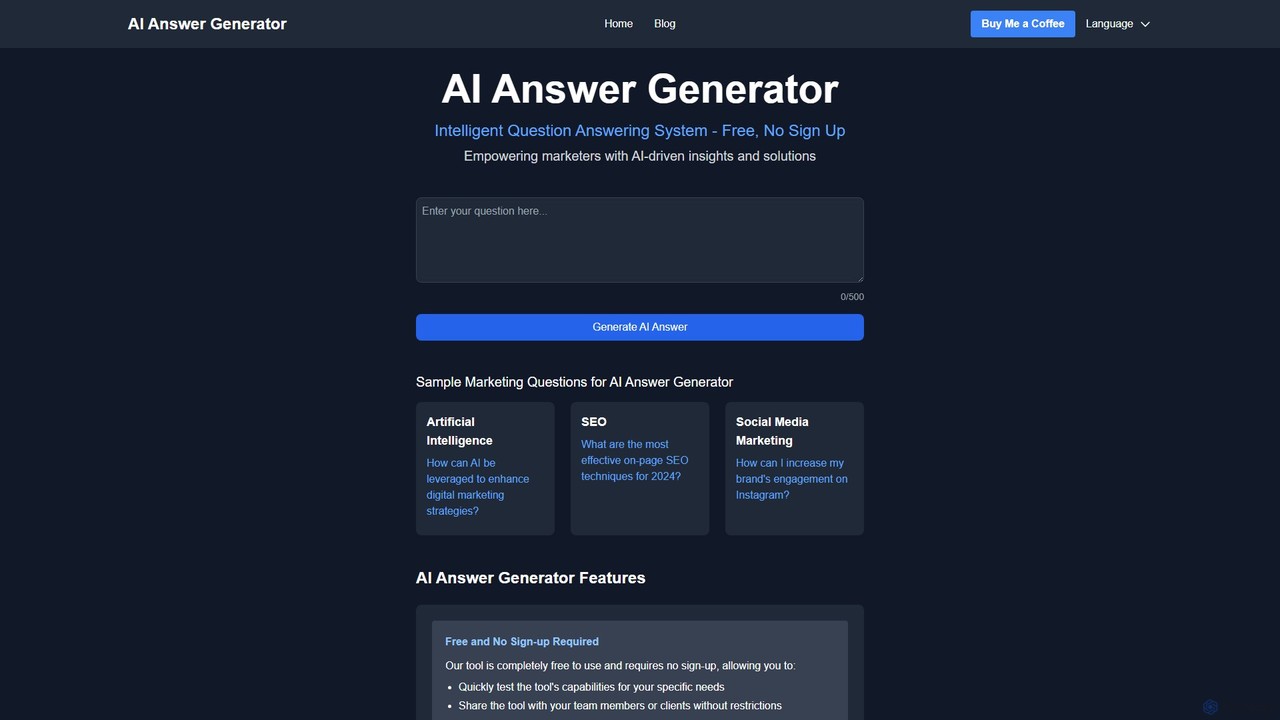
aianswer is a free, no-signup AI-powered answer generator designed for digital marketers. Instantly get accurate, creative, and up-to-date …

3.1K

About Question Answering

Question Answering tools are AI-powered solutions designed to automatically provide precise and relevant answers to user queries. Leveraging advanced Natural Language Processing (NLP) and machine learning, these tools analyze questions, retrieve information from vast knowledge bases, and formulate coherent responses. In a marketing context, they significantly enhance customer engagement, streamline information access, and improve user experience by delivering instant, accurate answers to product inquiries, service details, or common FAQs.

Core Features

  • Semantic Search: Understands the meaning and intent behind questions, not just keywords, for more accurate results.
  • Knowledge Base Integration: Connects to various data sources like websites, documents, and databases to extract information.
  • Contextual Understanding: Maintains conversational context to provide follow-up answers that are relevant to previous interactions.
  • Response Generation: Formulates human-like, concise, and informative answers based on retrieved data.
  • Multilingual Support: Offers the ability to answer questions in multiple languages, catering to a global audience.

Applicable Scenarios

These tools are invaluable for businesses aiming to improve customer service and marketing efficiency. They can power intelligent chatbots on e-commerce sites, providing instant product information and purchase guidance. Marketing teams use them to analyze customer queries for content gaps, generating ideas for blog posts or FAQ sections. Furthermore, they assist in internal knowledge management, ensuring sales and support teams have quick access to accurate information.

How to Choose

When selecting a Question Answering tool, prioritize its accuracy in understanding complex queries and its ability to integrate with your existing data sources and CRM systems. Evaluate the ease of training and customization for your specific domain knowledge. Consider the scalability to handle varying query volumes and the quality of multilingual support if targeting international markets. Finally, assess the analytics features for insights into user questions and content performance.

Question AnsweringUse Cases

1

Automating Customer Support FAQs

E-commerce businesses and service providers can deploy AI Question Answering tools on their websites or messaging platforms to instantly address common customer queries. By integrating with a comprehensive knowledge base, these tools provide immediate answers regarding shipping, returns, product specifications, or service terms, significantly reducing response times and freeing up human support agents for more complex issues. This enhances customer satisfaction and reduces operational costs.

2

Enhancing Website Content Navigation

Content managers and marketers can utilize Question Answering tools to create more intuitive website experiences. Instead of users sifting through pages, they can simply ask a question about a product feature, a company policy, or a specific article. The AI tool then directs them to the exact information or provides a concise answer, improving user engagement and helping visitors find relevant content faster, which can lead to higher conversion rates.

3

Generating Marketing Content Ideas

Marketing teams can leverage the insights from frequently asked questions to identify content gaps and popular topics. By analyzing the queries users pose to the Question Answering system, marketers can discover what information their audience is actively seeking. This data can then be used to inform the creation of new blog posts, whitepapers, video scripts, or social media content that directly addresses audience needs and interests, improving content relevance and SEO.

4

Personalizing Product Recommendations

Retailers can integrate Question Answering capabilities into their online stores to offer personalized shopping assistance. When a customer asks about product suitability (e.g., "Which laptop is best for graphic design?"), the AI tool can process the query, cross-reference product features with user needs, and recommend specific items. This personalized interaction mimics an in-store sales associate, guiding customers to the right products and potentially increasing sales.

5

Streamlining Internal Knowledge Access for Sales Teams

Sales professionals often need quick access to detailed product information, pricing, or competitor analysis during client calls. An AI Question Answering system can serve as an internal knowledge hub, allowing sales teams to instantly query company databases for accurate, up-to-date information. This ensures they can confidently answer client questions on the spot, improving sales efficiency and credibility without having to search through extensive documents manually.

6

Optimizing Lead Qualification and Nurturing

Marketing and sales departments can use Question Answering tools to engage with potential leads on landing pages or through email campaigns. When a lead asks a question about a service or product, the AI can provide immediate, tailored information. Based on the complexity and nature of the questions, the system can also help qualify leads by identifying their specific interests and pain points, enabling more targeted follow-up by human sales representatives.

Question AnsweringFrequently Asked Questions