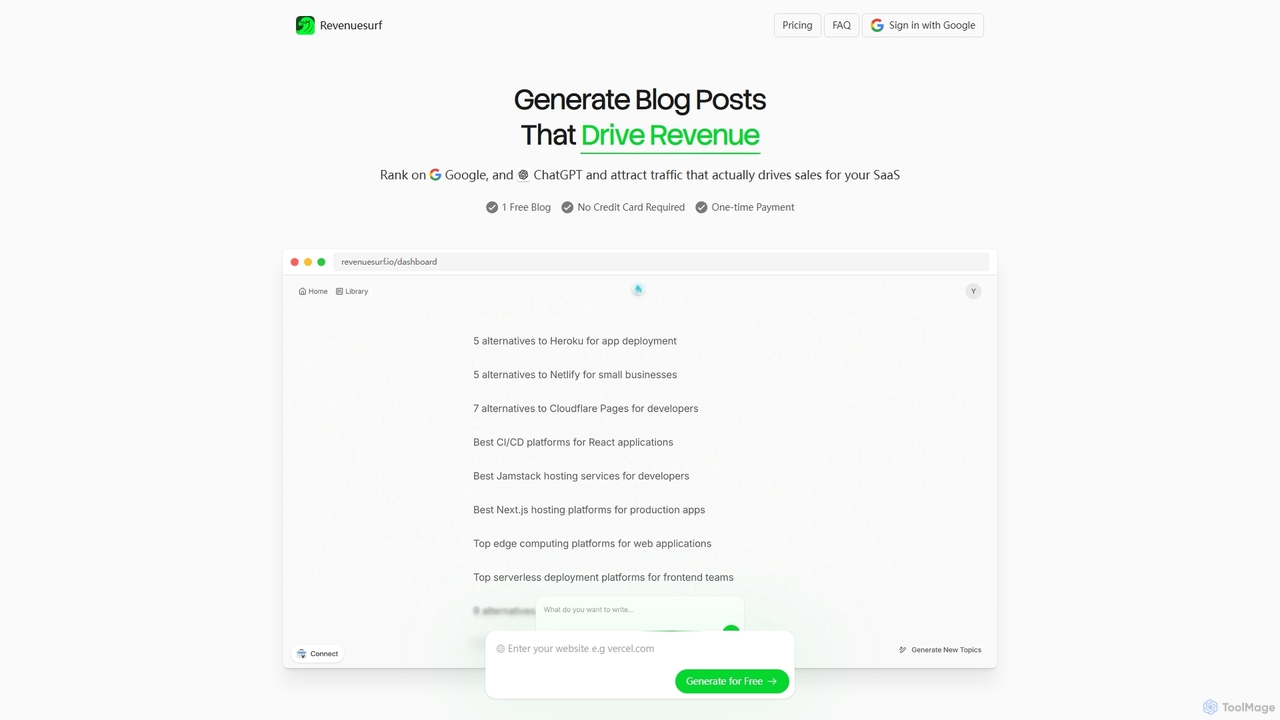
Revenuesurf
Revenuesurf is an AI blog post generator specifically designed for SaaS companies to create high-intent, solution-aware content. It …
Revenuesurf is an AI blog post generator specifically designed for SaaS companies to create high-intent, solution-aware content. It helps businesses rank on Google, attract qualified traffic, and drive actual sales by focusing on listicles and alternative articles that target users ready to make purchasing decisions.
About Saas Marketing
SaaS Marketing tools leverage artificial intelligence to optimize the entire customer lifecycle for Software as a Service businesses, from acquisition to retention. These AI-powered platforms analyze vast datasets to identify ideal customer profiles, personalize outreach, predict churn risks, and automate engagement strategies. Their primary value lies in driving sustainable growth, enhancing customer lifetime value, and improving operational efficiency for subscription-based models.
Core Features
- AI-driven Customer Segmentation: Automatically groups users based on behavior, demographics, and engagement to enable highly targeted campaigns.
- Churn Prediction & Prevention: Utilizes machine learning to identify users at risk of unsubscribing and suggests proactive retention strategies.
- Personalized Onboarding & Engagement: Delivers tailored content and support at critical touchpoints to improve user activation and satisfaction.
- Automated Lead Scoring & Nurturing: Ranks potential customers by their likelihood to convert and automates follow-up sequences.
- Subscription Analytics & Reporting: Provides deep insights into subscription metrics, revenue trends, and customer behavior patterns.
Use Cases
SaaS companies, from startups to enterprises, utilize these tools to refine their marketing efforts. Growth marketers employ them to identify high-value leads and optimize conversion funnels. Product managers leverage insights to understand user engagement and inform feature development. Customer success teams use churn predictions to intervene proactively, while sales teams benefit from intelligent lead scoring to prioritize outreach.
How to Choose
When selecting SaaS Marketing tools, consider their integration capabilities with existing CRM, billing, and product analytics platforms. Evaluate the depth and accuracy of their AI models for segmentation and prediction. Assess scalability to accommodate your user base growth and ensure compliance with data privacy regulations. Finally, compare pricing models and the level of support offered to align with your budget and team's technical expertise.
Saas MarketingUse Cases
Automating Personalized Onboarding Flows
A SaaS product manager uses AI marketing tools to design and automate personalized onboarding sequences for new users. By analyzing initial user behavior and demographic data, the AI tailors in-app tutorials, email drip campaigns, and resource recommendations, ensuring users quickly discover key features and achieve their first "aha!" moment, significantly boosting activation rates and reducing early churn.
Predicting & Preventing Customer Churn
A customer success team in a B2B SaaS company deploys AI to monitor user engagement and identify early warning signs of churn, such as decreased feature usage or support ticket frequency. The AI flags at-risk accounts, allowing the team to proactively reach out with targeted offers, personalized support, or educational content, thereby improving customer retention by up to 15-20%.
Optimizing Lead Scoring & Sales Outreach
A SaaS sales and marketing team integrates AI tools to score incoming leads based on their fit, engagement, and likelihood to convert. The AI analyzes website interactions, demo requests, and firmographic data, providing sales representatives with a prioritized list of high-potential leads. This ensures sales efforts are focused on the most promising prospects, shortening sales cycles and increasing conversion rates.
Personalizing In-App Messaging & Promotions
A SaaS growth marketer utilizes AI to deliver highly personalized in-app messages and promotions. Based on a user's subscription tier, feature usage, and past interactions, the AI presents relevant upgrade offers, new feature announcements, or helpful tips directly within the application, driving feature adoption, upsells, and overall user satisfaction without being intrusive.
Segmenting Customers for Targeted Campaigns
An email marketing specialist at a SaaS company uses AI-driven segmentation to create highly specific customer groups. Instead of broad blasts, the AI identifies segments like "power users of Feature X," "users who tried but abandoned Feature Y," or "long-term loyal customers." This enables the specialist to craft hyper-relevant email campaigns that resonate deeply with each segment, leading to higher open rates, click-throughs, and conversions.
Analyzing Subscription Metrics & Growth Opportunities
A SaaS executive employs AI marketing analytics to gain deeper insights into subscription performance. The AI processes vast amounts of data on MRR, ARR, churn rates, and customer acquisition costs, identifying trends, anomalies, and hidden growth opportunities. This data-driven approach helps in strategic decision-making, resource allocation, and forecasting future revenue with greater accuracy.