Lighthouse
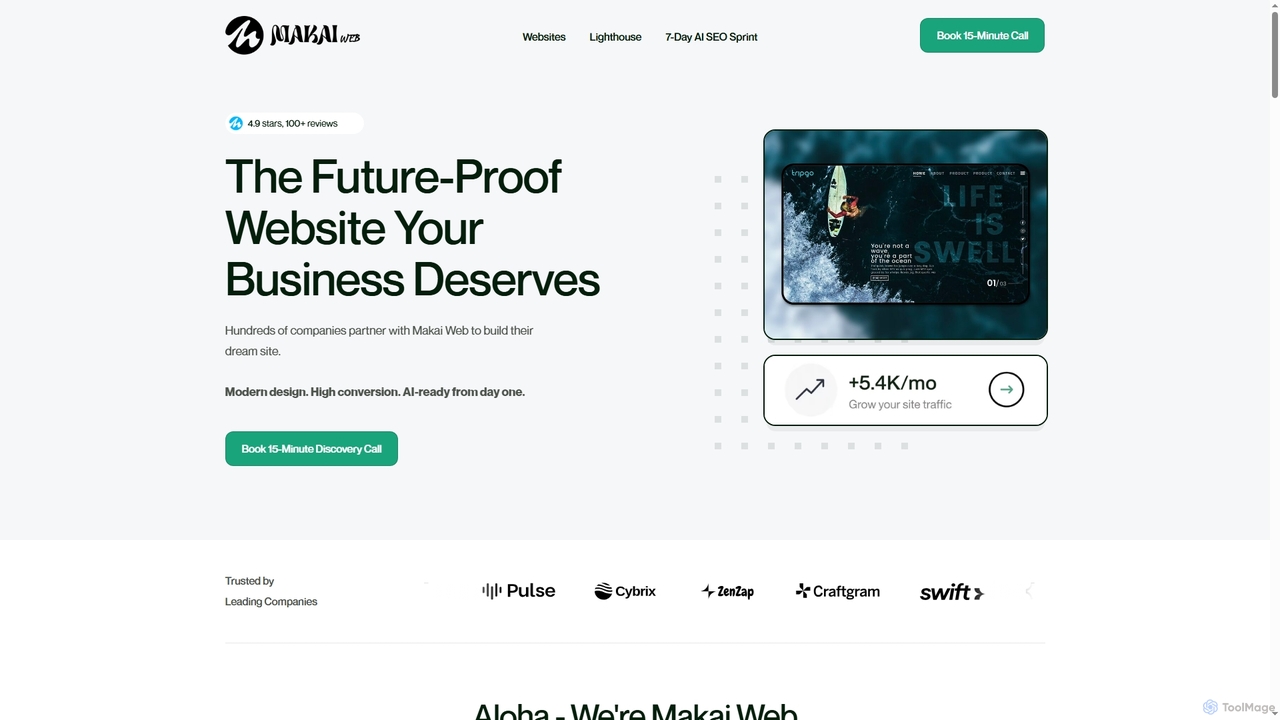
Lighthouse is Makai Web's proprietary AI SEO plugin designed to significantly enhance your website's visibility and discoverability across …
Lighthouse is Makai Web's proprietary AI SEO plugin designed to significantly enhance your website's visibility and discoverability across leading AI tools like ChatGPT, Perplexity, and Claude. It transforms your site content into AI-ready structured data, driving a substantial increase in AI-driven mentions.
itstelepathic
itstelepathic is an AI-powered infrastructure platform designed for the new era of search. It helps businesses ensure their …
itstelepathic is an AI-powered infrastructure platform designed for the new era of search. It helps businesses ensure their content is discoverable and accurately represented in AI search tools and answer engines. The platform provides the necessary tools to structure, manage, and syndicate brand information, enabling companies to get found without significantly scaling their teams.
About Search Marketing
AI Search Marketing tools are a specialized category of software designed to automate and enhance search engine optimization (SEO) and pay-per-click (PPC) campaigns. They utilize machine learning and natural language processing to analyze vast datasets, identify trends, and generate actionable insights. These tools help marketers improve search rankings, optimize ad spend, and create high-performing content to drive qualified traffic from search engines. Their core advantage lies in processing complex data at a scale and speed that is difficult for human analysts to match.
Core Features
- Keyword Research & Clustering: Automatically discovers high-potential keywords and groups them into semantically related clusters for content strategy.
- Content Optimization & Generation: Analyzes top-ranking content to provide real-time SEO suggestions or generate drafts based on target keywords.
- PPC Campaign Management: Automates bid management, generates compelling ad copy variations, and identifies negative keywords to improve ad performance.
- Technical SEO Auditing: Continuously scans websites to identify technical issues like broken links, slow page speed, or crawl errors that impact rankings.
- Competitor Analysis: Tracks competitors' keyword rankings, backlink profiles, and paid search strategies to uncover opportunities.
Use Cases
Digital marketing agencies, in-house SEO specialists, e-commerce managers, and content marketers use these tools to streamline workflows. For example, an agency can manage dozens of client SEO campaigns more efficiently, while an e-commerce store can optimize thousands of product pages at scale.
How to Choose
When selecting a tool, consider the scope of features (all-in-one suite vs. specialized tool), integration with platforms like Google Analytics and Google Ads, the accuracy of its data, the user interface's complexity, and the pricing model (per user, per project, or usage-based).
Search MarketingUse Cases
Automating SEO Keyword Research and Content Briefs
An SEO Content Strategist needs to create a comprehensive content plan for a new client's blog. Instead of spending days manually searching for keywords, they use an AI tool to input a primary topic. The tool instantly generates hundreds of long-tail keywords, user questions, and groups them into thematic clusters. It then analyzes the top-ranking pages for each cluster and automatically creates a detailed content brief, including recommended word count, headings, and key entities to include. This process reduces research time from days to hours and ensures every piece of content is strategically aligned with search intent, significantly improving its ranking potential.
Optimizing Large-Scale Google Ads PPC Campaigns
A PPC Manager for a large e-commerce brand manages thousands of ad groups. Manually adjusting bids and refreshing ad copy is inefficient. By connecting their Google Ads account to an AI platform, the tool analyzes performance data in real-time. It automates bidding strategies to maximize Return on Ad Spend (ROAS), pauses underperforming ads, and reallocates budget to high-converting campaigns. Furthermore, it generates dozens of ad copy variations (headlines and descriptions) for continuous A/B testing. This leads to a consistent improvement in ROAS and saves the manager over ten hours of manual work each week.
Scaling SEO Content Production with AI Assistance
A Content Marketing Manager at a SaaS company is tasked with doubling their blog's organic traffic within a year. This requires scaling content production without sacrificing quality. They integrate an AI writing assistant specialized in SEO into their workflow. After creating a strategic brief, writers use the tool to generate a first draft. The AI ensures the article is structured correctly for SEO, incorporates target and semantic keywords naturally, and adheres to a consistent tone. The content team then focuses their time on editing, adding unique insights, and fact-checking, allowing them to double their output of high-quality, optimized articles.
Conducting a Comprehensive Technical SEO Site Audit
A Technical SEO Specialist is onboarding a new client with a large e-commerce site containing over 50,000 pages. A manual audit would be extremely time-consuming. They use an AI-powered site crawler that scans the entire website within hours. The tool identifies and categorizes hundreds of technical issues, such as crawl errors, broken internal links, duplicate content, and Core Web Vitals performance problems. Crucially, it prioritizes these issues based on their potential impact on SEO, providing a clear, actionable roadmap for improving the site's technical health and search visibility.
Analyzing Competitor Search Strategies
A Digital Marketing Analyst for a growing startup needs to understand why a major competitor consistently outranks them for key commercial terms. They use an AI analysis tool and input the competitor's domain. The platform quickly provides a comprehensive report detailing the competitor's top organic keywords, their most successful content pieces by traffic, their complete backlink profile, and their estimated PPC budget and ad copy. This intelligence allows the analyst to identify content gaps, discover new backlink opportunities, and build a more effective counter-strategy to capture market share.
Managing Local SEO for Multi-Location Businesses
The marketing manager for a national restaurant chain needs to monitor and optimize local search performance across 100+ locations. Manually tracking rankings for terms like "pizza near me" in each city is impossible. They use an AI-powered rank tracker that monitors keywords at a granular, local level (city or zip code). The tool provides daily ranking updates, visualizes performance on a map, and offers AI-driven suggestions for optimizing the Google Business Profile for each specific location, such as responding to reviews or adding local photos. This provides a clear view of local search performance and enables targeted optimization efforts where they are needed most.