
ToolMage
Sign in

Best 1 Software Directory AI tools for Marketing

Popular Software Directory AI tools in Marketing include mavtools, helping you work more efficiently.

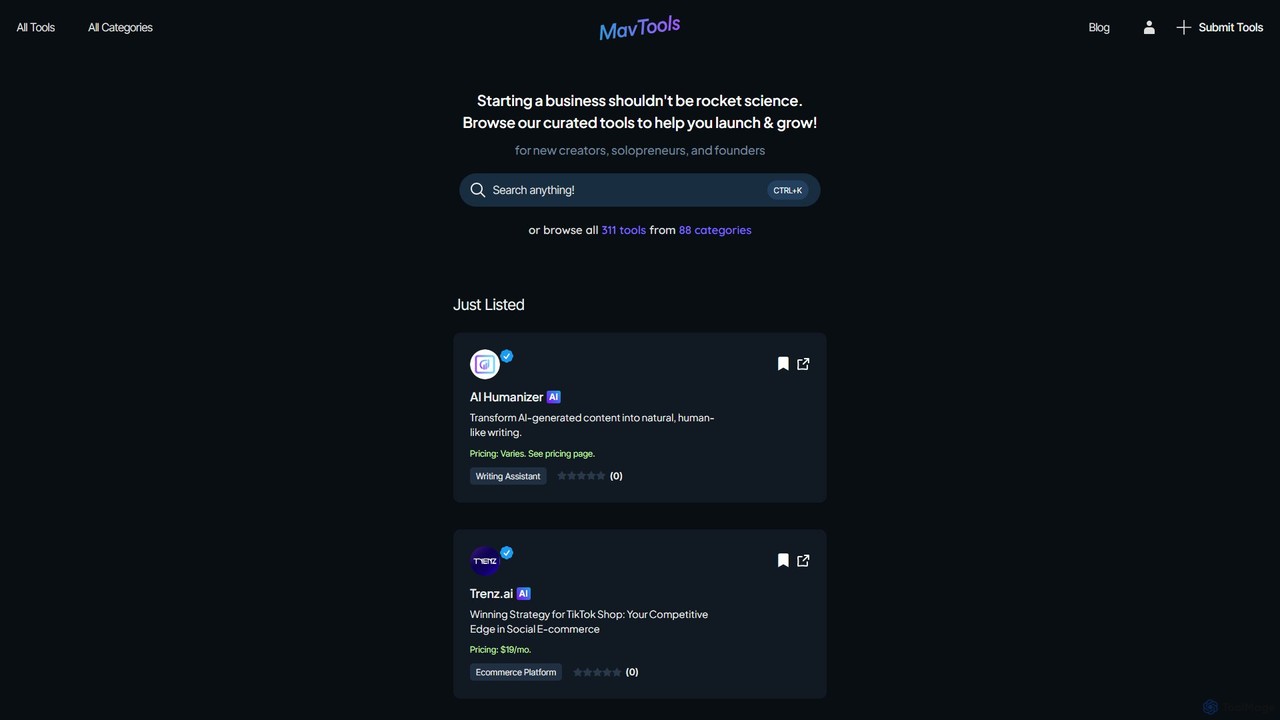
mavtools
Free

mavtools

A curated directory of battle-tested SaaS, applications, and AI tools designed for new creators, solopreneurs, and founders. It simplifies the process of discovering and selecting the right software to launch and grow a business.

Tool Discovery
Visits 29.8KFavorites 121Likes 105

About Software Directory

AI Software Directory tools are specialized platforms designed to automate and optimize a company's presence on B2B software marketplaces like G2, Capterra, and TrustRadius. These tools leverage AI to streamline directory submissions, monitor rankings, and analyze user reviews at scale. By automating these crucial marketing tasks, they help businesses increase their visibility, generate high-intent leads, and manage their online reputation efficiently. This approach turns software directories from a manual effort into a strategic channel for growth and competitive intelligence.

Core Features

  • Automated Submission: Automatically populates and submits product information across numerous software directories, saving significant manual effort.
  • Review Management: Aggregates reviews from multiple platforms and uses AI-powered sentiment analysis to identify trends and customer feedback.
  • Competitor Benchmarking: Tracks the rankings, review scores, and profile updates of competitors on key directories.
  • Listing Optimization: Provides AI-driven suggestions for keywords and descriptions to improve search visibility within directories.
  • Performance Analytics: Delivers dashboards that measure traffic, leads, and conversion rates originating from directory listings.

Use Cases

These tools are primarily used by SaaS marketing teams, product marketers, and demand generation specialists. They are essential for launching new products by ensuring broad initial visibility, managing brand reputation through systematic review monitoring, and conducting ongoing competitive analysis to stay ahead in the market. Companies use them to turn passive listings into active lead-generation engines.

How to Choose

When selecting an AI Software Directory tool, evaluate the breadth of its directory network—how many relevant platforms does it support? Assess the sophistication of its review analytics and competitor tracking features. Consider its integration capabilities with your existing CRM or marketing automation software. Finally, examine the pricing model to ensure it aligns with your expected return on investment from directory marketing.

Software Directory use cases

1

Automate Product Listings for a SaaS Launch

A product marketing manager preparing for a new software launch uses an AI directory tool to streamline their go-to-market strategy. Instead of spending days manually creating profiles and submitting product details to over 50 different software directories like Capterra, G2, and Software Advice, they input the information once. The AI tool then automatically customizes and submits the listings to each directory, ensuring compliance with each platform's specific format. This saves over 40 hours of manual work and ensures the new product achieves maximum visibility across relevant B2B marketplaces from day one.

2

Monitor and Analyze Competitor Reviews

A competitive intelligence analyst for a B2B software company uses an AI directory tool to track market sentiment. The tool aggregates all new reviews for their top five competitors from major directories into a single dashboard. Using AI-powered sentiment analysis, the analyst can quickly identify recurring complaints about a competitor's new feature, or praise for another's customer support. This provides actionable insights for their own product development roadmap and helps marketing craft messaging that highlights their competitive advantages, all without manually checking dozens of pages daily.

3

Optimize Directory Listings for Higher Rankings

A demand generation specialist aims to improve their software's ranking within a competitive category on G2. They use an AI directory tool's optimization feature, which analyzes top-ranking competitor profiles. The AI suggests adding specific, high-intent keywords to their product description, highlighting underrepresented features, and adding more screenshots for a specific use case. After implementing these changes, their profile ranking improves, leading to a 20% increase in profile views and a measurable uptick in demo requests originating from the platform.

4

Scale a Customer Review Generation Campaign

A customer marketing manager needs to increase the number of positive reviews for their product to improve social proof. Using an AI directory tool, they identify their most satisfied customers based on product usage data from their CRM integration. They then launch an automated email campaign through the tool, directing happy users to specific review sites where their presence is weakest. The tool tracks open rates and review submissions, allowing the manager to measure the campaign's success and easily follow up, resulting in a 50% increase in new reviews over one quarter.

5

Identify Product Gaps from User Feedback

A product manager uses an AI directory tool to analyze thousands of user reviews across the entire market category. The tool's AI categorizes feedback into themes like 'feature requests,' 'usability issues,' and 'integration problems.' The manager discovers a significant number of users across multiple competitor products are requesting a specific type of integration that their product lacks. This data-driven insight validates the need for this feature, helping them prioritize it on their development roadmap with high confidence, directly addressing a proven market demand.

6

Generate Performance Reports for Stakeholders

A marketing director needs to report on the ROI of their directory marketing efforts. They use an AI directory tool to generate a comprehensive monthly report. The report visualizes key metrics such as profile views, click-through rates to their website, and the number of leads generated from each directory. It also benchmarks their performance against their top three competitors. This automated report provides clear, data-backed evidence of the channel's value, enabling the director to justify budget allocation and make strategic decisions for the next quarter.

Software Directory FAQ

What are AI Software Directory tools?

AI Software Directory tools are marketing platforms that help businesses manage their presence on software review and listing sites like G2, Capterra, and Software Advice. They use AI to automate tasks such as submitting product information to multiple directories, tracking rankings, monitoring and analyzing customer reviews for sentiment, and optimizing listing content to attract more high-intent buyers. Essentially, they turn directory marketing from a manual, time-consuming process into an efficient, data-driven strategy.

How to choose the right AI Software Directory tool?

Choosing the right tool depends on your specific marketing goals. Consider these factors:

  • Directory Coverage: Does the tool support the B2B marketplaces most relevant to your industry and target audience?
  • Feature Depth: Evaluate the sophistication of its review analysis, competitor tracking, and listing optimization features. Do you need basic submission or in-depth analytics?
  • Integrations: Check if it integrates with your existing CRM (e.g., Salesforce) and marketing automation platforms to streamline workflows and data sharing.
  • Scalability and Pricing: Ensure the pricing model aligns with the number of products you need to manage and offers a clear return on investment through lead generation and time savings.
Why are software directories an important marketing channel?

Software directories are a critical marketing channel, especially for B2B and SaaS companies, for several reasons. Firstly, they attract high-intent buyers who are actively researching and comparing solutions, leading to higher quality leads. Secondly, they build social proof and trust through authentic user reviews, which heavily influence purchasing decisions. Finally, they provide a valuable platform for competitive intelligence, allowing you to monitor competitors' positioning, strengths, and weaknesses based on real customer feedback. An optimized presence on these directories can significantly impact brand visibility and lead generation.

Can these tools guarantee a 1 ranking on a directory?

No tool can guarantee a 1 ranking. Directory rankings are influenced by multiple factors, including the quantity and quality of recent user reviews, the completeness of your profile, and user engagement signals, which are outside the direct control of any tool. However, AI Software Directory tools significantly improve your chances. They help you optimize all the factors you can control, such as keyword-rich descriptions and complete feature listings. They also facilitate review generation campaigns, which directly impact one of the most important ranking factors.

What is the difference between manual directory submission and using a tool?

The primary difference is scale, efficiency, and intelligence. Manual submission involves visiting each directory site one by one, filling out forms, and periodically checking for new reviews or ranking changes. This is extremely time-consuming and difficult to track. An AI-powered tool automates this entire process. It submits your information to dozens of sites at once, aggregates all your reviews and performance data into a single dashboard, and provides AI-driven insights for optimization that are impossible to replicate manually.